
88-year-old Leeds entrepreneur reveals how he built a £12m business from a ‘shed’
Entrepreneur Paul Spencer-Schofield has written a fascinating autobiography about his inventive career - the 88-year-old speaks to Chris Burn
Paul Spencer-Schofield’s Yorkshire company has now evolved into a highly-profitable multi-million operation creating specialist factory doors for retail’s biggest names but it started from altogether more humble beginnings.
His new autobiography, entitled Mr S: The Irrepressible Optimist, charts how he and his wife Isobel began the Leeds company now known as Union Industries back in 1972 in a decrepit two-storey “shed” in Meanwood with a couple of century-old industrial sewing machines and an initial focus on manufacturing tarpaulins for businesses.
He started the business shortly after turning 34 following the unexpected collapse of the firm he had been working for and writes, “There was no business plan, only a desire to succeed, to make money and to go beyond what I had previously achieved and experienced in my years as a director of two different companies”.
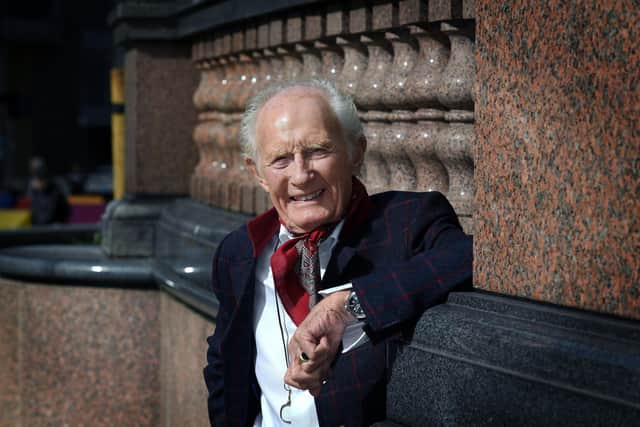

The book adds: “It was serendipity, blind faith, and certainly not just the need to work but also the need to earn good money. Cautious doom watchers would have deemed it an act of total folly, considering the economic climate prevailing in 1972/3. Strikes, power shortages, oil and petrol in short supply and a three-day working week should have put the lid on even the most ambitious aspirations.”
But they turned the difficult economic situation into a business opportunity as major companies struggled to conserve heat at their warehouses and factories during the oil crisis. Paul came up with the idea of a ‘rudimentary but heavy-duty curtain’ to separate the warm and cold areas of such sites.
Their tarpaulins were marketed as ‘heat retention curtains’ and soon became a huge hit, with their products eventually evolving into more sophisticated methods of preventing cross-contamination from toxic dust and fumes.
The business continued to evolve and Paul and Isobel, who he affectionately calls ‘Wizzer’ after their relationship began in earnest when he ‘wizzed’ her back home to Yorkshire from Birmingham after a modelling job she was working on went wrong, went onto invent and sell a vast array of products to help companies big and small.
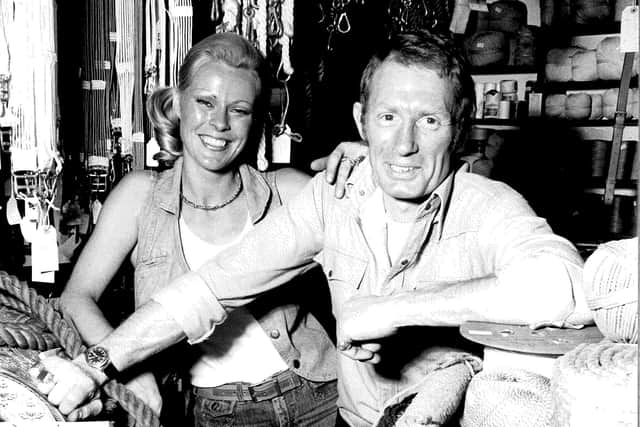
As the business grew and moved to new headquarters in Hunslet, they created everything from unique ballast bags for the building of the Humber Bridge that filled and emptied with water to maintain balance on construction of the complex project and the ‘Unicube’ containment chamber allowing workers involved in asbestos removal projects to safely enter and exit contaminated areas.
But from 1989, the firm turned its attention to high-speed roll-up doors in factories whose applications include separating hot and cold areas; products that have obvious parallels with the heat retention curtains that started the business.
As the company continued to grow, it also received plenty of attention when Paul installed two golden angels from a Glory of Venice exhibition in its atriums, gifting the building the new name ‘Angel’s Wing’ as it was reopened in its new guise by Michael Portillo.
Paul and Isobel sold the business in 2014 to the firm’s employees, with the sale structured so the workers did not have to take on any debt and could pay back the couple over a period of 14 years to make it affordable.

At 88, he remains involved with the business as chair of its trustee board which oversees the running of the company.
The firm’s move into employee ownership has clearly proved a success judging by its latest results. Its latest accounts, covering 2024/25, show revenues of almost £12m and profits of nearly £6m, with a similar result the year before.
Paul explains that after being encouraged to write a book by Union Industries’ managing director turned chairman Andrew Lane, the process of writing his self-published life story with the help of editor Josephine Galvin took him around four years to complete as he carefully wrote out his memories in longhand.
“All the things that you recall are all part of the voyage through your life,” he told The Yorkshire Post.
“The book opens with me walking up the steps to the little place on Buslingthorpe Lane, seeing that room and thinking, ‘This is mine’ and that was the start of my business life. It has just been a great experience to relive it all.”
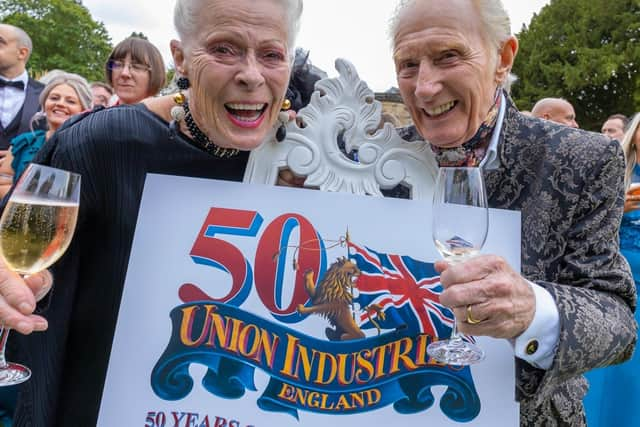
He says one of the joys of their business was inventing products which would solve problems for other companies.
“It is fair to say we’ve never turned a problem away. That’s always been our raison d’être, Isobel and I,” he says. “We used to argue the toss about how a product would be made, how it wouldn’t be made, whether we could do it, whether we couldn’t, and that was that was our life and solving other people’s problems.”
While the book is as much a love story about his relationship with his wife and their shared efforts in building their business together, it also doesn’t shy away from the fact it would not always be plain sailing.
“She’s very creative, artistic, strong-minded and strong-willed and I am also. So consequently there was always what you’d call nowadays ‘creative tension’.
“We were at a restaurant talking about a shower tray that went into an asbestos decontamination unit and there was a discussion about where it would be, how high it would be, where it would fit and I was saying ‘this’ and she was saying ‘that’. I went to the toilet and when I came back, she’d gone and taken the car. Ever since that day, we’d go to restaurants in two cars!
“There was always positive creative tension but I used to say people, ‘We’ve solved your problem but by God it was done with a lot of shouting!’”
The firm moved into high-speed door production in the late 1980s with big ambitions.
“We started off as usual at the bottom of the pile. We were pond life. There were other people making high-speed doors, but there was only one company who were the best. I said, ‘We will beat them. We will be the best, and we will make a better product than they do’.”
He says typical customers now include the distribution centres of major supermarkets and he has enjoyed coming up with product names such as the ‘Eiger Door’, a specialist freezer door named after the famously icy Swiss mountain.
“I would imagine that we deal with virtually every blue chip company in the country. We deal with people who don’t take prisoners. We deal with people who want quality, reliability and speed of service. When you work with people like that who demand the best, then it makes you be the best.”
The couple decided to sell the business to its employees despite interest from other companies – which in 2014 was a relatively unusual move but has become more common in recent years.
“We talked about it for a while because neither of us were getting any younger. It is a bit like having a child – we wanted someone to look after it because we had cherished the company and weren’t going to sell it just for money to anyone.
“We wanted continuity and for this company to still be meaningful in 50 years’ time, with a history to it.
“Employee-owned companies weren’t as well known then. You’ve got to take workers from being employees to owners. I tried to exemplify it by saying to people, ‘An owner doesn’t walk past a ringing telephone at 5.15pm because it might be business and money’. That is the hard part; getting your people to come on board. Some will, some won’t. Those that get it, get it big time and take their colleagues with them.”
He explains: “We said initially we don’t want a great pile of money. I wanted it to be something they could afford to buy. Andrew said, ‘you gave us the company in a way’. It was done in such a way they could more readily afford it.
“We said pay us back over 14 years. That was eminently doable. When they took into account our salaries they had been paying and the amount of money they’d now be paying us every month, it became a very digestible amount. That has worked well for the company.
“We also made sure the employee-owners didn’t have to go to a bank to borrow money. We left well over £1m cash in the kitty so they wouldn’t have to do that and could hit the ground running as owners.”
He says he still enjoys being part of the firm in the trustee role.
“It is still ours but it is not. I enjoy talking about the company now. Although we don’t have shares in it anymore and they have paid us off, we still talk about it, we still enthuse about it.”
While most people would be slowing down at 88, that does not apply to Mr Spencer-Schofield.
He says he has some “very futuristic” ideas connected to nanotechnology for Union Industries, while writing his life story has also inspired him to take his love of writing further.
As well as being on the hunt for a literary agent and potential publisher for his autobiography, he has also written a fictional spy thriller that is in the editing process.
“I regret not starting sooner. There is so much more I wish to do. I’m fortunate because so many people retire and get lost and don’t know what to do. I was lost at the start of my career but I’m certainly not lost now. I love creating things.”
To order a copy of the book, email editor Josephine Galvin at [email protected]