
Amazon launches its one millionth robot to ease workload on staff including many across Yorkshire
Amazon is celebrating its success in launching its one millionth robot in its operations around the world.
The company which employs 75,000 people in the UK including thousands at centres across Yorkshire, said the new devices will help make the company more efficient and ease the workload among staff.


It says technology advances support faster delivery times and lower costs for customers.
The company, which has Yorkshire bases in Wakefield, Doncaster, Hull, Leeds and Stockton-on-Tees, says it has also upskilled 700,000 staff globally through training programmes that prepare its workforce for the future.
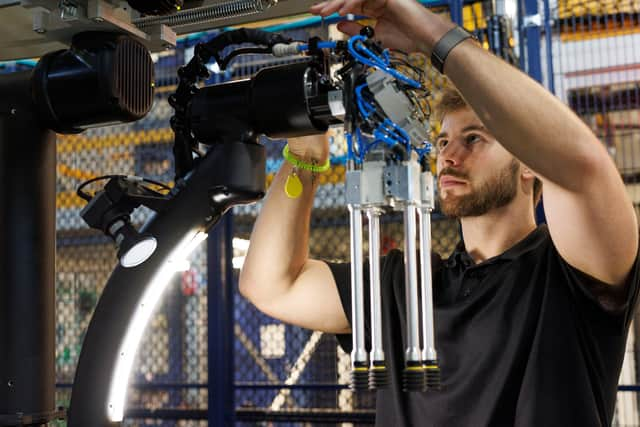
An Amazon spokesman at an international launch in San Francisco said: “We've just deployed our one millionth robot, building on our position as the world's largest manufacturer and operator of mobile robotics.
“This milestone robot was recently delivered to a fulfillment centre in Japan, joining our global network that now spans more than 300 facilities worldwide.
“But that's only part of the story. We're also introducing a new generative AI foundation model we've designed to make our entire fleet of robots smarter and more efficient. Called DeepFleet, this AI technology will coordinate the movement of robots across our fulfillment network, improving the travel time of our robotic fleet by 10 per cent and enabling us to deliver packages to customers faster and at lower costs.”
DeepFleet is said to be an intelligent traffic management system for a city filled with cars moving through congested streets.
Just as a smart traffic system could reduce wait times and create better routes for drivers, DeepFleet co-ordinates robots' movements to optimize how they navigate fulfilment centres, Amazon says. This means less congestion and faster processing of customer orders. Built using the company’s extensive data sets of inventory movement and leveraging AWS (Amazon Web Services) tools, including Amazon SageMaker, this new AI model aims to redefine fleet efficiency.
The firm says it can store more products closer to customers, leading to faster delivery and lower costs. And, because it is built on AI that learns and improves over time, it will continue to find new ways to optimize how its robots work together.
Amazon started in 2012 with a single type of robot that could move inventory shelves across warehouse floors. Today, it operates a fleet of robots designed to make employees' jobs easier and safer, and operations more efficient.
Its Hercules robots can lift and move up to 1,250 pounds of inventory. Its Pegasus robots use precision conveyor belts to handle individual packages. And Proteus, its first fully autonomous mobile robot, can safely navigate around employees in open and unrestricted areas of its sites while moving heavy carts filled with customer orders.
The spokesman said: “These robots work alongside our employees, handling heavy lifting and repetitive tasks while creating new opportunities for our front-line operators to develop technical skills.”
Aaron Parness, director of Amazon Robotics, said his team had also made a breakthrough recently with the first robot with a sense of touch. Called Vulcan, it is hailed as a big step forward.
Until now robots “see” and then “move”. Now the new system understands how it is contacting the world.
He said: “If you have spent time around industrial automotion, you know that’s a big step forward. Mosty robots see then move in a fixed sequence. It’s the old paradigm of look, think, act. Touch is different. It means the system understands how it’s contacting the world – how much force it’s applying, continuously in real time, couple with AI it knows whether it should press, glide or stop, and when to call on a human partner.”