
Apollo3D: How a Yorkshire firm is creating virtual 3D maps of the past, present and future

Over the past few years, in cavernous clothing shops across Europe, teams have been working overnight to create digital 3D maps used to plan for everything from light bulbs to new tills. Behind the project is a small, 12-person team, from Otley.
The brain-child of Mark Shepherd, Apollo3D began life around 2017, while Shepherd was working as the boss of a healthcare firm.
Shepherd took a punt on a growing trend of 3D visual mapping, which was at the time gaining traction in the US real estate market. Shepherd believed, however, that the technology had potential beyond advertising houses.
Around eight years on, the team at Apollo3D have digitally mapped roughly 350 Primark stores, as well as caves, cinemas, museums, and even a major US concert venue.
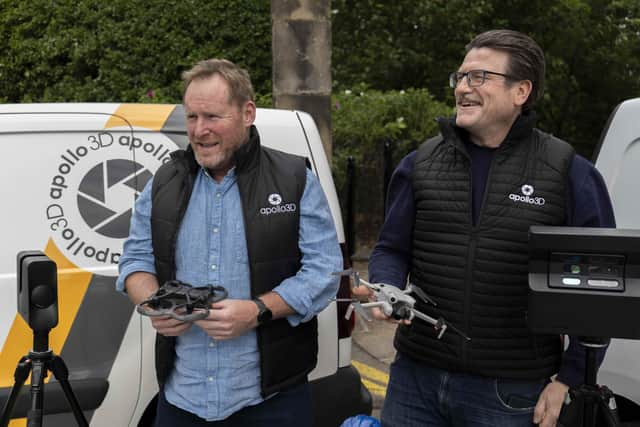

But the company now hopes to grow even further.
Last year, Apollo3D recorded revenues of £550,000, a 20 per cent jump on the year prior. Over the next 18 months, the firm has its eyes on a turnover of £1m.
“My background has always been technology,” says Shepherd.
“I've worked with IBM, then went over to the US and worked for Walmart. I had a few years of doing two weeks here and two weeks there in the US, and eventually my wife and children moved over there.
“At the time when I was there, I saw this technology called Matterport coming along, which is still the core technology for us. It was new tech at the time, and it was starting to be used in the US for selling houses.
“I remember thinking this is really good stuff, and I can see there's a market for it. Not long after, we made a family decision to move back to the UK. I had a year of running a healthcare company, but in the back of my mind, I just kept thinking about this technology, and thought there’s got to be something in it which is more than just houses.”
Shepherd went on to buy the equipment he needed to use the Matterport technology, consisting at the time of a large camera and a tablet. The technology allows for the creation of high-quality, digital twins of real-world spaces that allow people to explore venues online as if they were physically there.
The end product is a virtual 3D map of a location or venue, which companies are able to put on their website or use for planning purposes. As described by Shepherd, the resulting map resembles a “supercharged version of google street view”.
After a number of attempts to win business from estate agents, Shepherd recruited the help of sales expert, Rob Wilyman, who had been his rugby teammate of 25 years.
“Rob saw the tech, and as a typical sales guy, he told me ‘I could sell that’, so I said ‘right, come on then,’” says Shepherd.
“He took a couple of days to come and work with me, decided he loved it, and that was in effect how everything was born.
“We started knocking on a few virtual doors to say what we had, and from that point on we’ve never looked back.”
Since its launch, the company has also gone on to work on a string of well-known Yorkshire sites, including The Royal Armouries and Stump Cross Caverns.
One of the company’s biggest contracts to date was with Primark, through which it has now mapped over 350 stores, with its technology used to plan for new lighting, as well as the mapping of fire extinguishers and planning for click-and-collect tills.
While Shepherd hopes the technology can be used to give a vision into the future, with virtual models used to aid the planning system or help businesses reimagine their spaces, he also hopes the tech can be used to give a vision into the past.
The company created a virtual map of Hyde Park Picture House, in Leeds, ahead of its major refurbishment which completed in 2023. It demonstrates how the technology can be used as a tool for recording history.
“At Hyde Park Picture House, they spent a lot of money doing the place. But we had scanned it before then, so we now have a version of what it was like five years ago, which was representative of what it had been like for the last 100 years or so. For us, it's important, because otherwise all you have is a few pictures.
“With this you can put yourself in there, and really immerse yourself on what that was like. I’d like to think some of the things we're doing now are creating content for future generations to look back on and enjoy.”