
Christian ‘discriminated against’ after Leeds charity job offer withdrawn over LGBT views
A hearing at the Court of Appeal is taking place
A Christian social worker was discriminated against by being made to attend a second job interview over his religious beliefs on homosexuality, the Court of Appeal has been told.
Felix Ngole attended an initial interview with charity Touchstone Leeds in May 2022 for a hospital discharge mental health support worker role based at a hospital in Wakefield.
Touchstone offered Mr Ngole the role, subject to references, but then retracted the offer in June 2022 after learning about news articles concerning a previous court case he was involved in.

That case related to Mr Ngole’s successful legal challenge against the University of Sheffield over its decision to expel him from his MA course in social work for comments he made on social media in 2015, including stating that “homosexuality is a sin”.
Touchstone told Mr Ngole that his views on homosexuality and same-sex marriage “completely go against” its views, but offered to reconsider its position if he could give assurances that his beliefs would not compromise his role.
However Touchstone declined to offer Mr Ngole the role after a second interview, stating in a letter that it felt his views “could pose a significant risk to Touchstone’s service users”, who could find the comments “upsetting and offensive”.
In 2024, an employment tribunal (ET) ruled that Touchstone directly discriminated against Mr Ngole by rescinding the initial job offer, but rejected further claims of discrimination around the second interview and the final decision not to give him the job.
But in February, an employment appeal tribunal (EAT) judge found that the ET “erred in law in its analysis of certain complaints of direct discrimination because of religious belief”.
Mr Ngole is now appealing against the EAT’s decision to send the case back to the ET for reconsideration, with his barristers telling the Court of Appeal that “a claim of direct discrimination was made out”.
In court on Monday, Bruno Quintavalle, for Mr Ngole, said: “The requirement to have a second interview, which arose simply from the respondent discovering that Mr Ngole held a protected characteristic, in this case a belief, then meant they imposed upon him requirements that were not imposed on anyone else.
“It is a very straightforward matter of direct discrimination.”
Mr Quintavalle continued that the job description contained “simply nothing” related to LGBT issues, and that Mr Ngole had never been the subject of a complaint.
In written submissions, the barrister also said the “lengthy and invasive” second interview and the request for assurances about Mr Ngole’s beliefs amounted to stereotyping, meaning the appeal should be allowed.
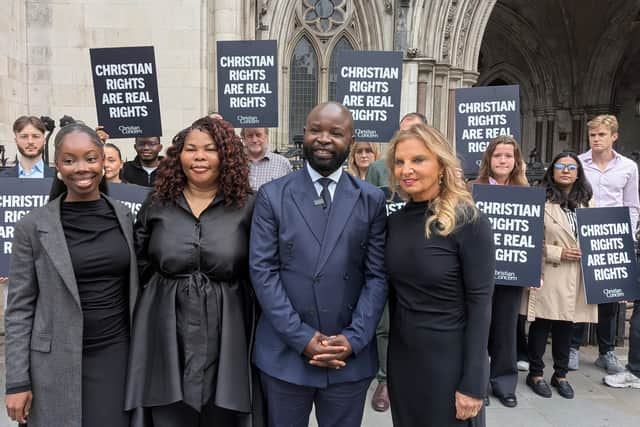
Mr Ngole, who attended the hearing in London with his wife, said: “There has never been any evidence that I have discriminated against anyone or treated anyone without dignity and respect.
“I should not have been subjected to an additional interview based on an assumption that holding orthodox Christian beliefs made me a potential danger to service users or unable to do the job.
“I had already been interviewed, assessed as the best candidate and offered the position.
“I am grateful that the Employment Appeal Tribunal recognised serious flaws in the original judgment.
“But after years of litigation, it cannot be right to send me back to the same tribunal to fight the central issues all over again.”
Touchstone is also appealing against the EAT’s decision, arguing that the initial ET ruling should be restored, or that it “should be entitled to a fair opportunity” to argue its case at a fresh ET hearing.
Katherine Apps KC, for the company, said in written submissions that it declined to offer Mr Ngole the job after the second interview because of a “lack of enthusiasm” for what the company “wished to see in the role, including actively promoting LGBTQI+ specific service and specifically tailoring services to the needs of LGBTQI+ service users”.
She also said Mr Ngole showed “resistance” to attending LGBT+ awareness training and that there was a “risk of complaints or claims” against the company by service users.
The barrister also said that the company conducted online searches about Mr Ngole over a lack of suitable references.
She said: “In this case the claimant was at least equivocal as to whether he would carry out the requirements of the role in the manner which the respondent considered most suitable to satisfy the contract with (the NHS).
“The usual evidence of suitability was lacking… and the only publicly available evidence suggested that the claimant may resist, as he then rapidly did in his emails, at interview and in litigation, key requirements of the role.”
The hearing before Lord Justice Bean, Lord Justice Miles and Lady Justice Elisabeth Laing will conclude on Tuesday, with a judgment expected in writing at a later date.