
Fuel prices UK: what Iran crisis means for oil, petrol, diesel, energy, and heating prices - will they go up?

This article contains affiliate links. We may earn a small commission on items purchased through this article, but that does not affect our editorial judgement.
Fears over a vital global shipping route have rattled markets, and could affect what households might pay in the months ahead ⛽
- Oil prices jumped after US-Israeli strikes on Iran and retaliation in the Gulf
- Fears centre on disruption to the Strait of Hormuz, a key global oil route
- Higher crude prices could push up UK petrol costs within days or weeks
- Gas and electricity bills may also rise if liquid natural gas shipments are affected
- Any impact on the energy price cap would likely come later this year
If you’re wondering whether events thousands of miles away could soon show up on your petrol receipt or energy bill, you’re not alone.
Escalating violence between the US, Israel and Iran has rattled global markets and sent oil prices sharply higher.
But will this turn into higher costs for filling up the car, heating homes and powering appliances for UK households? Here’s what we know, and what could happen next.
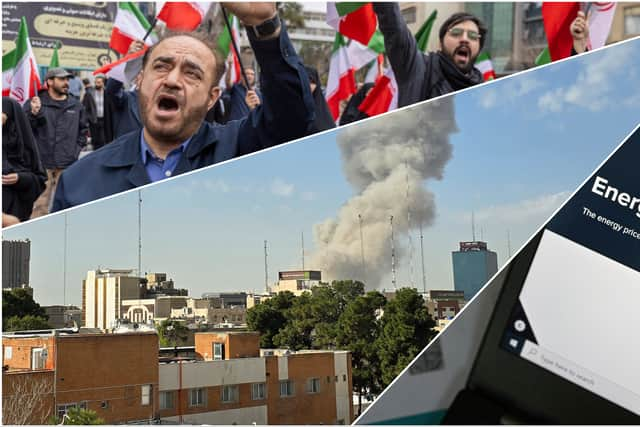

Why oil prices have jumped
Global oil markets reacted fast after this weekend’s joint US-Israeli strikes on Iran and retaliatory attacks across the region.
A key concern is the security of the Strait of Hormuz, a narrow shipping channel through which roughly a fifth of the world’s traded oil passes between the Persian Gulf and the Gulf of Oman on the south coast of Iran.
Iran has reportedly warned vessels about using the strait, and there have been confirmed strikes on ships nearby.
Though the passage remains open, the risk of disruption has been enough to send traders scrambling, and when traders fear that fewer barrels of oil will reach global markets, prices rise.
The price of Brent crude, the international benchmark used to price much of the world’s oil, surged by as much as 13% at one stage, before easing back.
But if shipping traffic through the body of water is slowed for any sustained period, analysts have warned that prices could jump by as much as 20 US dollars per barrel.
What does it mean for UK petrol prices?
For drivers, oil prices matter because crude is refined into petrol and diesel. When wholesale oil costs climb, fuel retailers eventually pay more, and that typically feeds through to pump prices.
The UK imports a significant share of its fuel, so we’re exposed to global price swings. A sustained spike in Brent crude would likely mean higher forecourt prices within days or weeks.
But it is worth remembering that oil infrastructure in the region has not yet been widely targeted, and the Strait of Hormuz remains open, even if traffic has slowed.
If disruption proves short-lived, any price rises could be modest and temporary. But if shipping were blocked entirely, we would almost certainly see sharper increases.
What about gas and electricity bills?
This is where things get more complex, and while oil prices grab headlines, UK household energy bills are more closely tied to the wholesale price of gas, which is used both for heating homes directly and for generating electricity.
The Strait of Hormuz is also a critical route for liquefied natural gas (LNG) exports, particularly from Qatar, one of the world’s largest LNG suppliers. Much like crude oil, if shipments were disrupted, global gas prices could spike.
Higher wholesale gas prices feed into electricity prices because gas-fired power stations often set the “marginal” price of electricity in the UK market.
That means potentially higher energy bills when the next price cap is set, though energy analysts stress that this would require prolonged disruption; if tensions de-escalate quickly, the impact on UK bills could be limited.
Could the energy price cap rise again?
The UK’s energy price cap set by Ofgem adjusts quarterly based largely on wholesale costs.
If gas prices rise significantly and stay high, future price cap levels could increase, but there’s usually a lag of several months between wholesale spikes and changes to regulated household bills.
In other words, it’s unlikely we’ll see an immediate jump, but sustained global turmoil could show up later in the year.
What does it mean for inflation?
Higher fuel and energy prices ripple across the economy, and can lead to knock-on cost rises to sectors like transport and manufacturing: food prices can be affected if producers face higher energy bills.
That makes inflation a secondary risk, and that’s one of the reasons the markets have been jittery; London’s FTSE 100 fell sharply in early trading following the strikes, while defence and oil stocks rose.
The pound has also weakened against the dollar, partly because investors tend to flock to the US currency during global crises. A weaker pound can make imported energy even more expensive for the UK.
Is there any good news?
There’s at least a glimmer of hope, with the Opec+ group of countries, which includes Saudi Arabia and Russia, agreeing to increase oil production before the latest escalation.
In theory, extra supply could help cushion the blow if some exports are disrupted, but of course, extra production capacity may not actually account for much if oil physically cannot leave the Gulf due to security concerns.
But shipping industry groups say trade is continuing to flow and that operators are used to adapting to geopolitical shocks. Unless there is a major change in the security situation, the impact could remain contained.
If the Strait of Hormuz stays open and tensions cool, fuel and energy prices may stabilise. But if conflict widens or shipping is blocked for weeks, the UK would likely see higher petrol prices first, followed by potential pressure on gas and electricity bills.
For now, markets are reacting to uncertainty. Whether that uncertainty turns into lasting pain for household budgets depends on what happens next in one of the world’s most critical energy corridors.

With household expenses continuing to rise and energy bills still higher than pre-crisis levels, more people are turning to Utility Warehouse (UW) to save money. UW lets you bundle services like broadband, mobile, energy and insurance into one streamlined account—reducing hassle while unlocking multi-service discounts. The more you bundle, the more you save.
Customers benefit from a single monthly bill, up to £400 towards early exit fees, and access to cashback on everyday spending. UW also offers the UK’s cheapest variable energy tariff when bundled, helping shield households from further price hikes.