
'We built this city': Inside the Irish community's history - from escaping famine to The Troubles

You don’t have to look around Leeds for long to see just how diverse and multi-layered it is.
In the last 100 years in particular, communities and cultures have travelled from all over the globe, either through force, hope or out of desperation, to settle and make West Yorkshire their new home.
Through our ‘United Leeds’ campaign we wanted to take a look at these individual communities and how they have defined the fabric of the city, as well as the challenges they’ve faced.
And where better to start than with the Irish, who have had an indelible impact on how the region has developed.
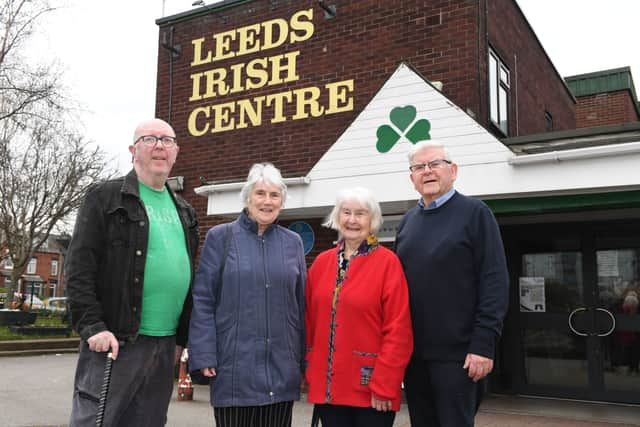
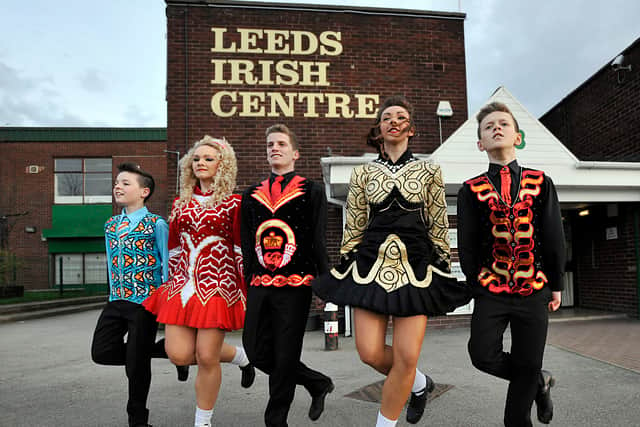
To do this, we met with some of the stalwarts of the Irish community at - where else? - the Leeds Irish Centre on York Road.

Irish emigration is central to the story of Leeds - following the influx of Roman, Norman and Viking settlers and predating the arrival of folk from the Caribbean, Middle East, Africa and China who have accrued and settled in this ever-sprawling city.
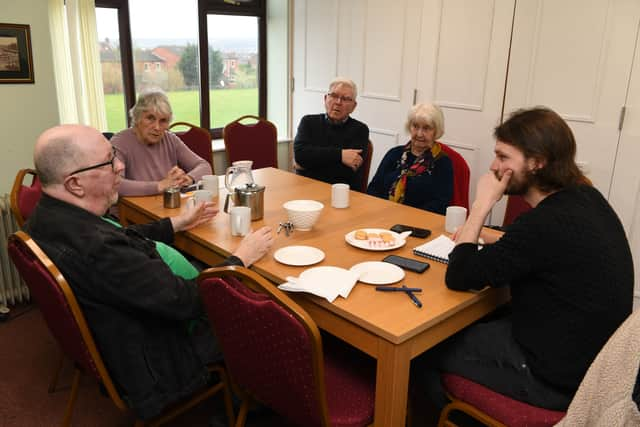
Joining us round the table for tea, biscuits and a chat about were the “father of the Irish community in Leeds” and the manager of the Leeds Irish Centre, Tom McLoughlin MBE, secretary of the Leeds Irish Centre committee Rena Cosgrove, a specialist in Irish heritage Bernard McGrath and archivist Christine Byrne.
All were either first or second generation Irish residents of Leeds and were able to give a complete and fascinating overview of how the Irish have left their mark; whether through building the roads, populating the factories or hosting the best parties.
Early days
Bernard explained that a big factor of the story of the Irish can be traced back to the 1850s, when many migrated as a result of the catastrophic famine that had spread across the island. Those who landed, many from the east coast, went to work in the mills and factories and became residents around Kirkgate in the city centre.
Bernard said: “The textile industry was big in the West Yorkshire area so it made sense.”
Many construction workers had also helped with the development of the Leeds Liverpool Canal and the railway line during the 19th century.
Bernard added that census data shows that the Irish population “vanished” from Leeds after some years which was due to a rumour about “a collapse of the textile industry”, resulting in many relocating to Halifax and Huddersfield. It also came about as tensions grew between the Irish and English over the response to the famine, with Bernard saying that many were worried of a “major kick off” at Holbeck Moor.
20th century
But there was a huge re-emergence in Leeds of the Irish during the 20th century when many came to help with the construction overhaul taking place.
Christine said: “A lot of them were manual workers who came over because they didn’t have skills, but the strength that they had from working on the land meant they were desired workers on any project that went ahead.”
Tom, who himself worked in construction for 20 years, added: “If you worked in construction then you knew who was a good worker because you had a reputation.”
Over the years the Irish contributed to development of every aspect of Leeds. In a previous conversation when organising the meeting, the Irish Centre’s head of communications Sheron Boyle said: “There’s not a building, a canal, a main road or a hospital in Leeds that Irish hands have not touched. And that’s something I’m very proud of.
“It’s shaped the city.”
The word “navvie” was coined for the abundant Irish workers from the word ‘navigation’, in response to their significant contribution.
Bernard’s father had worked in construction after moving from County Cavan with no qualifications. He said: “We never went on the M62 without him saying ‘I built this’.”
Tom added: “I do a bit of that when I’m in town! I’ll say ‘I built that!’”
The relationship between the Catholic Church and the local schools also helped nurture the community.
Bernard, a former teacher, said: “There was a degree of interlinking social cohesion between the Catholic Church and Irish identity. Whereas things have now changed because attendance has dropped off and you’re not getting the huge influx of Irish migrants into Leeds as you once did.”
‘Leeds is a Mayo city’
Among the Irish populations across the UK there is often a predominance of one county, and in Leeds it is County Mayo on the west coast.
Both Tom and Christine’s families originated from Mayo, with Tom saying that his father came from farming country in the 1920s to Bradford to work on rural land before going into construction in Leeds.
Christine said: “This is a Mayo city. There’s more Irish descendants in Leeds than there is left in Mayo I think.”
Rena’s story was unique, having moved to England from Galway to train as a teacher due to her inability to sing, which was a requirement of teachers in Ireland.
Made to feel welcome
The Irish community has always had a good relationship with the inhabitants in Leeds, those in the room said, while other communities in the likes of London and Birmingham faced a harsher response.
Particularly during The Troubles in the 1980s, signs like ‘No dogs. No Blacks. No Irish.’ and ‘No Irish need apply’ appeared. But Leeds always managed to avoid the division, Tom explained.
“I actually saw that happening down in London in the 1960s”, he said. “But I think in Leeds people integrated better.”
While Christine said that there was “no friction” and no mention of The Troubles, Tom said that there was “the odd threat” of violence. He remembered one night when he and the police sat outside after receiving a coded threat.
“But there’s only very few times”, he said. “There was the odd bomb scare and that particular night was very heightened.”
‘It was a different world’
Many of those moving to Leeds over the years were escaping the comparatively barren conditions in Ireland, with those in the room reflecting on the experiences they had when returning.
Christine said: “I remember when I told my father I wanted to go to Ireland he said ‘why do you want to go to that God forsaken place?’
“I’ll never forget it.”
Tom recounted visiting County Mayo for the first time as a child in the 1940s and seeing children “running around without shoes on”.
“When we did land I took my shoes off because I couldn’t be seen with shoes on”, he said. “Mother went to the shop and the lady said ‘I’ve seen your lad running around without a shoe to his foot’. She nearly died!”
The group loved visiting the country though and embracing its more rural aspects, where those working in agriculture could “read the sky”. Tom said: “It was a different world. That’s what made it so special.”
Bernard added: “It was freedom.”
Tom said that the centre helped raise money for those back home living in squalid conditions under the ‘Leeds Connection’.
Housing
That’s not to say that the Irish had the best of conditions in Leeds, though.
Bernard explained that up until the 1980s the census continued to show that many Irish communities had not become socially mobile and were based in the more deprived areas of the city.
He said: “What came out in the 1980s was the idea that the Irish had totally assimilated and integrated was not true.”
Christine explained that at the same time the Leeds Irish Centre helped establish a charity that helped Irish men who had been left homeless when they retired after living most of their lives in lodgings.
“The centre supported these nurses to help men who had retired to get accommodation and then from that they got housed.
“The welfare centre has been running here for many, many years. People would come here from the island and accommodation would be found immediately.”
‘They’ve worked hard’
Tom said that recent years have shown that many of the Irish have done significantly well for themselves from their time working in Leeds.
“Harehills in the 1970s, 80s was thronged with Irish people but they’re not now”, he said. “They’ve moved out to better housing and gained better education. And they’ve worked hard to get there.”
He added that many saved money or sent it home, saying: “I won’t say his name but there was a man and his family here in Leeds and he lived in a rented house. I worked with him for a short time and wondered why he didn’t buy one.
“They moved back to Ireland and I saw pictures of his funeral and he lived in a mansion. He’d saved it to go back.
“Not only that but his daughters had married and were living round him. And I thought ‘fair play to you’. That’s what he wanted to do from the day he came to Leeds. Amazing.”