
GCSE Results Day 2025: How this year's candidates did overall - and the highest achieving regions

More than a million young people can pick up their results today ✉
- Thursday is GCSE results day for pupils in England, Wales, and Northern Ireland
- Top grades are up this year, while the overall pass rate has remained stable
- However, the standard pass rate has fallen a little
- Some persistent attainment gaps have lingered on, while others have narrowed
Learners across the UK can breathe a sigh of relief. Their GCSE results are finally in, and there is plenty worth celebrating.
Thursday (August 21) is 2025’s GCSE results day, with secondary school pupils who sat their exams over the summer in England, Wales, and Northern Ireland hurrying to their school this morning to find out how they did – in what was likely their first major set of qualifications. It comes one week after A Level results day, which saw both the proportion of students getting top grades and the overall pass rate rise this year, with a record number of 18-year-old students accepted into university based on their results day outcomes.
But the picture is slightly less rosy for the candidates picking up more than 6.1 million GCSE results this week, with the proportion of those achieving at least a ‘standard pass’ experiencing a dip this year. Nevertheless, the Joint Council for Qualifications (JCQ) chair Jill Duffy says that 2025’s GCSEs cohort has shown great “resilience and determination throughout their school years”, which were marred by pandemic disruptions.
“What I find most exciting about results day is seeing the diverse range of qualifications achieved, from maths to art to hospitality – and what that means to hundreds of thousands of young people. The subjects may be very different, but every single qualification issued today is a passport to future success and opportunities,” she continued. “They now have the chance to thrive in their next endeavours”.
But how exactly did this year’s learners do, overall and across the UK? Here’s what you need to know about this year’s results:


GCSE results for 2025 at a glance
In positive news, the proportion of entries that achieved a top grade this year (a seven or above on England’s nine-point grading scale, or an A elsewhere) is up a little. It has risen 0.1 percentage points on last year, from 21.8 to 21.9%. The overall pass rate, or the amount of entries getting any passing grade from 1 or G up, has remained the same, at 97.9% of all entries total.
However, the proportion achieving at least a 4 (or a C in Northern Ireland and Wales), which is generally considered a standard pass, has fallen. This has dropped by 0.2 percentage points, from 67.6% in 2024 to 67.4% this year – representing about 32 thousand fewer entries hitting this important target. Pupils generally need to achieve at least a 4 in required subjects like maths and English, or they will have to resit them.
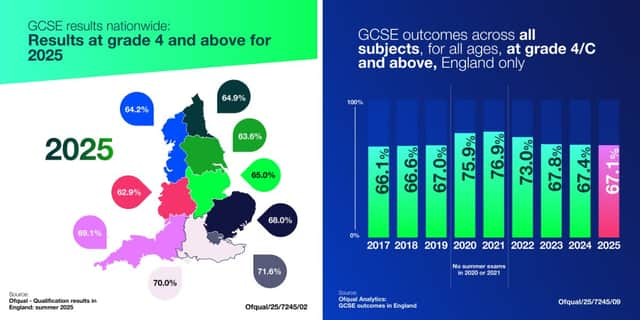
But this is not necessarily cause for alarm, with JCQ describing the figures as “stable and similar to recent years”. In England, the proportion of results achieving at least a standard pass fell 0.3 percentage points this year, from 67.4% to 67.1% But again, the country’s qualifications regulator Ofqual said that the overall outcomes showed “only minimal variation from previous years, that fall within the boundaries of natural year-on-year fluctuations”.
UK-wide, the overall number of GCSE entries fell a little this year, by about 0.4% to about 6.16 million total. But the nation’s population of 16-year-olds has also dropped this year, by about 0.3%. Interestingly, more older learners also sat the qualifications in 2025. Entries from students aged 17 and up rose 12.1% on last year, making up 7.8% of all entries (compared to just 7% in 2024).
The average number of GCSEs each candidate took has remained stable at about 7.8 – or close to eight different subjects. While the gender gap – which typically sees female pupils get higher grades than their male counterparts – has lingered on, it has narrowed this year across both passing grades and top grades alike.
How the different regions – and countries – compared
Long-standing attainment gaps between England’s different regions have stuck around this year, according to data from Ofqual. As is usually the case, London came out on top when it comes to the proportion of total results that passed with a grade of 4 or higher, at 71.6% total.
It was followed by the South East at 70%; the South West at 69.1%; the East of England at 68%; the East Midlands at 65%; the North East at 64.9%; the North West at 64.2%; Yorkshire and The Humber at 63.6%. The West Midlands had the lowest standard pass rate, at just 62.9%.
When it comes to top grades of 7 or above, London again led the pack at 28.4% – meaning nearly 3 in 10 GCSE entries achieved a top grade. It was followed by the South East at 24.6%; the East of England at 22.2%; the South West at 21.4%; the North West at 18.8%; the West Midlands at 18.5%; Yorkshire at 18.4%; the East Midlands at 18.1%; and the North East at just 17.8%.
Data from Northern Ireland’s Council for the Curriculum, Examinations & Assessment (CCEA) shows that 31.6% of students achieved a top grade of A or above this year, up from 31% in 2024. Some 83.5% of students achieved a standard pass of C or above, also an increase from 82.7% in 2024.
Most popular subjects in 2025
According to JCQ, the top ten GCSE subjects remain unchanged since last year. It is worth noting that most learners are required to take certain subjects, including mathematics and English language – as well as others like English literature, one or more science subjects, and Irish, depending on their school.
Here were the top 10 this year, as well as how many pupils sat them:
- Science Double Award (taken by 989,264 pupils)
- Mathematics (taken by 893,198 pupils)
- English language (taken by 866,023 pupils)
- English literature (taken by 649,481 pupils)
- History (taken by 306,759 pupils)
- Geography (taken by 302,706 pupils)
- Religious studies (taken by 237,515 pupils)
- Art and design (taken by 206,598 pupils)
- Biology (taken by 183,539 pupils)
- Chemistry (taken by 174,088 pupils)
Outside of the top 10, however, statistics was the subject which saw the largest increase in entries, rising 9.5% since 2024. Other subjects which have risen in popularity include Spanish, business studies, geography and physical education, JCQ says.
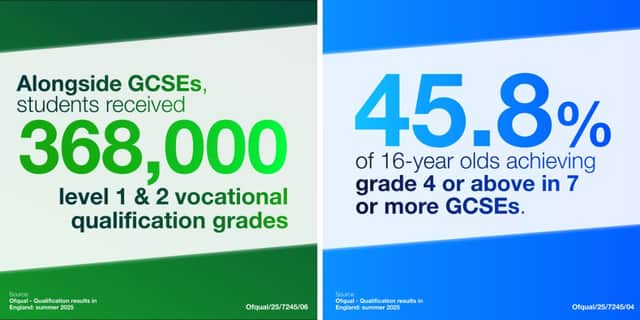
When it comes to vocational qualifications, the most popular subject area was sport, leisure and recreation, it added.
Is a young person in your life receiving their results today? Check out some of our other coverage so that you’ll be ready to help steer them through results day – and all that comes with it. Here’s where to find this year’s grade boundaries and how you can use them, and here’s our guide to appealing a grade.