
How University of Leeds students helped amputees regain independence - and a stroke survivor play guitar again

Engineering students at the University of Leeds are helping to give others a new lease of life with custom-made equipment for disabled people
From helping amputees carry shopping bags and eat independently to enabling a stroke survivor to strum his favourite song once again.


A group of enterprising University of Leeds engineering students are using innovation to restore everyday freedoms and to help people live more independent lives.
These innovative projects are part of a new collaboration between the University and REMAP, the only charity in the UK whose community of volunteers create innovative, personalised equipment for disabled people, free of charge.
Dr Anthony Herbert, undergraduate programme lead for Medical Engineering in the School of Mechanical Engineering, who leads the partnership, said: “This gives students the opportunity to use their creativity, enthusiasm and technical skills on real-world engineering challenges that genuinely matter.
“By working with REMAP, they see first-hand how their ideas can improve quality of life for individuals and communities, which is incredibly motivating: they are gaining valuable new skills and experience that goes far beyond the classroom.”
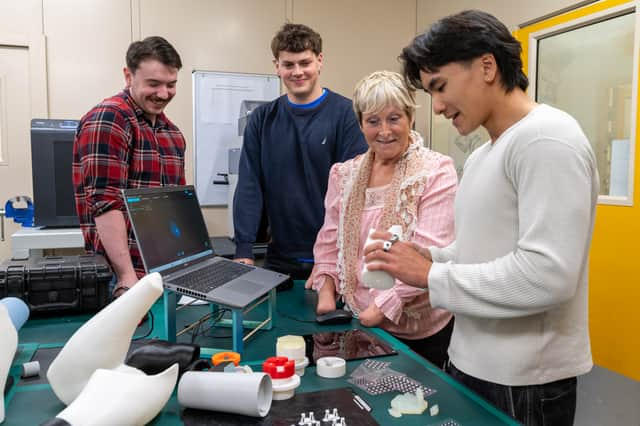
One team has developed an innovative process that uses digital tools to rapidly create bespoke temporary prostheses.
The result is a new, documented process that, with further refinement, could be followed by REMAP’s volunteer engineers to produce custom, interim prostheses in as little as a week, using a standard 3D printer.
Gerry Van Hee, chair of REMAP Leeds, said: “This will mean faster, more tailored and effective solutions, improving the benefits to our clients at a time when they are waiting for their long-term solution.”
Mandy Neal and George Glasgow, who both have upper‑limb amputations, shared their experiences with the students to aid their understanding of challenges faced by people with limb differences.
George, who is also a volunteer engineer with REMAP, said: “The method and process the students have devised can provide a vital stop gap between the healing of someone’s wound after surgery and getting their long-term prosthetic arm or hand from the NHS.
“This approach is quick, and it gives the client the ability to start getting back to normal daily activities which their amputation has left them unable to do, like using cutlery and combing their hair.
“And actually, enabling people to do these things is not just about a physical achievement, it will really help to boost their mental well-being and adjustment to a new way of doing things.”
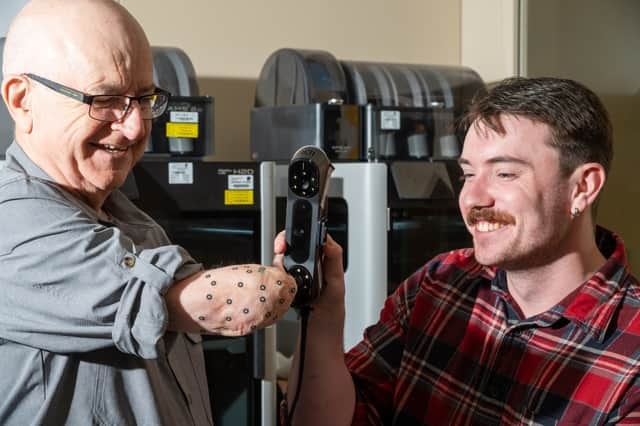
The team, who are all set to graduate this summer after completing a four-year integrated master's degree in engineering, used a digital scanner, sticking small sensors on to George’s residual limb – like systems used to capture 3D objects for computer gaming.
“This generated a 3D model, which was then 3D printed. The technology captures the limb’s exact geometry, ensuring a custom fit, which is a lot harder to achieve using traditional plaster cast moulds.
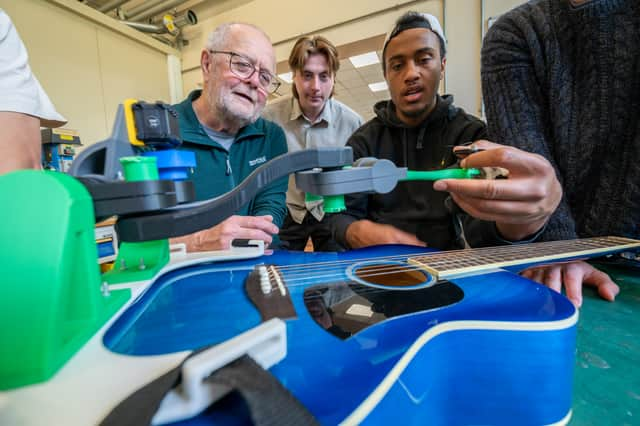
When 73-year-old John Pattison heard about the collaboration, he told REMAP he’d love to be involved as he has been unable to play his beloved guitar since having a stroke in 2017.
A group of young engineers – who all play instruments themselves – applied both creativity and empathy to the challenge of finding a way for him to recreate the arc movement needed to strum.
They created a device that works like an assisted pull up machine in the gym: it helps the user with the movement, but they must initiate it for the device to kick in and help. And just as in the gym, the end goal is to strengthen the user to a point where they no longer need the support.
To use the assistive device the client simply slides their hand into an open, fingerless glove, specially designed so that it can be put on independently by someone with reduced hand mobility.
John said: “Sadly, due to ill health, I’ve not been able to test the device yet.
“However, I’ve been so impressed by the students’ diligence and enthusiasm, and the project is very innovative in its design and capability.
“The partnership between the University and REMAP has highlighted the need for these kinds of projects, to provide a stable and effective opportunity for each other, as it is so helpful for different generations to work together in planning the future.”
REMAP makes and adapts equipment to meet the unique needs of individuals at no cost to them. Dedicated volunteer engineers create solutions when no suitable alternative exists, helping with everything from mobility and personal care, to enabling people to pursue their hobbies and ambitions.
The collaboration enables the charity to offer clients with more complex requirements a chance to benefit from new technology and cutting-edge facilities, such as industrial grade 3D printers and scanners.