
'It was such a relief to talk to other parents about their relationships'

‘I had thoughts like, am I a bad parent? Am I alone here?’
Leeds scientists are at the forefront of a creative ‘prescribed play’ programme which boosts mums’ and dads' mental health.
Mums and dads who took part in the five-week creative play programme for under-twos experienced reduction in postnatal depression symptoms, revealed the study by scientists at the Universities of Leeds and Huddersfield.
Before taking part in Let’s Play, I had thoughts like, am I a bad parent? Am I alone here?
Postnatal depression affects more than one in 10 mums, as well as new fathers and partners, in the first year after birth. It can cause a persistent feeling of sadness, difficulty looking after children, trouble sleeping, a lack of energy and frightening thoughts. Research shows it can also affect parent-child bonding.
The new programme, called Let’s Play, was developed by Darlington-based children’s arts charity Theatre Hullabaloo to boost parents’ confidence and mental health, with particular support around speech and language delays.
The free sessions are socially prescribed - which involves families being referred by GPs, health visitors, social prescribing link workers or partner organisations to take part.
Comprised of sing and play sessions in an informal, friendly setting, Let’s Play brings parents with children under two together to learn simple, fun creative activities that contribute to child development.
A key component of the programme is that the same parents and children meet every week, encouraging them to form relationships.
Mum-of-two Kellie, who took part in two segments of the five-week programme, said: “Before taking part in Let’s Play, I had thoughts like, am I a bad parent? Am I alone here? It was reassuring to hear about how other children were developing.”
She added: “In an ideal world, I think everyone should have access to this. It’s beneficial to both parents and children, rather than one or the other, and backed by real science."
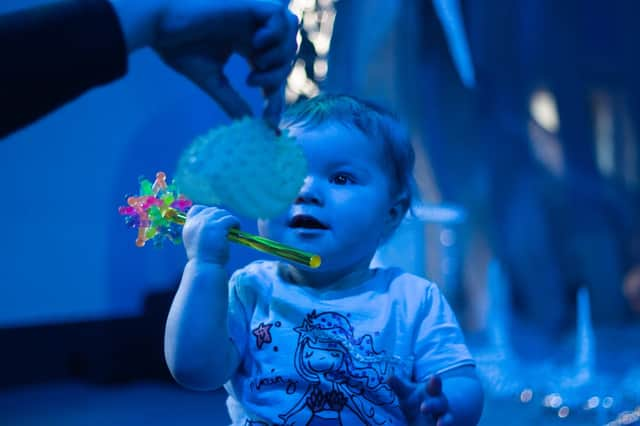

The artist-led six week programme took place at Theatre Hullabaloo’s specialist family venue in Darlington alongside its studio theatre, artist-designed creative play space, café and story corner.
Research leader Dr Paige Davis, of Leeds School of Psychology, said: “These findings show that creativity could be the key to addressing parents’ unmet needs in children’s early lives. This time is crucial for development but for parents and carers, it is often a socially isolating, tiring and challenging time – so it is encouraging to see improvements to mental health in this research. Ultimately, we hope that this trailblazing creative programme can impact communities by being taken up and rolled out by the NHS.
The next step is working on training programmes so artists can deliver Play on Prescription – helping us harness the power of creativity to help children have a healthier and fairer future.”
A total of 57 parents took part in the research. They were surveyed in the first and last sessions to track symptoms of postnatal depression.
The findings, published in the journal BMC Psychology, showed that postnatal depression symptom scores decreased throughout the five-week programme, and continued decreasing when parents attended a second round of the course.
The research also found that parents didn’t report attending for social opportunities, but at the end of the programme it was their favourite part. Parents associated social aspects with fulfilling their own needs, rather than their children’s needs.
Miranda Thain, artistic producer at Theatre Hullabaloo, said: “The value of play between parent and child, particularly in those first critical thousand and one days is so important for a child's development and also for parental confidence and wellbeing. In Let’s Play, specially designed for up to two-year-olds and their caregivers, we’ve seen first-hand how creative programmes have really made a difference to local families, giving new creative approaches to supporting vital development and helping new parents build supportive networks.
“With a growing evidence base around the impact on postnatal depression and parental well-being, we’ve now been able to roll the programme out in family hubs across the Tees Valley so even more families can benefit from our artist-led play programmes.”
Kellie was struggling with anxiety after the arrival of her first child, as he wasn’t starting to speak as quickly as his peers. She began to blame herself, questioning whether she was a good parent. Kellie went to her GP, who referred her to a socially prescribed play project as part of University of Leeds research.
Kellie said: “For the first session, I felt so anxious and tightly wound because we were running late. But when I arrived, it was very open and relaxed. It was inviting and welcoming. I genuinely felt accepted from that first session.”
She added: “It was such a relief to talk to other parents about their relationships. My husband and I had been arguing a lot more than usual, but I found it reassuring to hear this was a similar experience for other parents.”
Inspired by Let’s Play, Kellie now takes her son to music classes. She said: “We never thought much about music before because neither me nor his dad are very musical. But he absolutely thrives when music is playing. He loves jazz hands and wheels on the bus. Music really uplifts our mood too.”
Kellie and her husband, Jason, welcomed their second child in May.
Study co-author Dr Susanna Kola-Palmer, from the University of Huddersfield, said: “Community health programmes such as Let’s Play help develop and nurture social relationships, which provide a source of social connection and help parents feel more supported.
"In turn, this social support can help reduce postnatal depression, social isolation, and enhance emotional well-being in early parenthood. We’d expect to see these benefits ripple out to the children, who are more likely to feel secure and thrive when parents are emotionally balanced.”
The researchers are now calling for creative play on prescription to be rolled out across the NHS to improve support for new parents.