
Leeds Astronomical Society president reveals exact times and best viewing spots for Wednesday's solar eclipse

Steve Strickland, President of the Leeds Astronomical Society, has issued vital safety advice, exact local timings and where you can join the society to watch this week’s eclipse
The President of the Leeds Astronomical Society has issued vital guidance, exact local timings, and strict eye safety warnings ahead of what promises to be one of the most remarkable days for stargazing in decades.
Skywatchers across West Yorkshire are gearing up for Wednesday (August 12), which brings a rare cosmic double feature to the region.
During the day, Leeds will experience the UK's deepest solar eclipse in 27 years, with roughly 91% of the Sun set to be obscured.
Then, as night falls, the sky will play host to the peak of the annual Perseid meteor shower - promising up to 100 shooting stars per hour stretching into the early hours of Thursday morning.
With perfect astronomical conditions - including a New Moon providing pitch-black night skies - local experts are urging residents to plan their viewing spots carefully to make the most of both events.
What time is the solar eclipse taking place in Leeds this week?
According to the Leeds Astronomical Society, the complete window for Wednesday's partial solar eclipse in Leeds runs for just under two hours between 6:12pm and 8:03pm.
- Eclipse Begins: 6:12pm - The Moon first begins to pass across the edge of the Sun.
- Maximum Eclipse (Peak): 7:09pm - This is the peak moment when roughly 91% of the Sun's disk will be covered over Leeds.
- Eclipse Ends: 8:03pm - The Moon fully clears the Sun's disk.
What time is the Perseid meteor shower happening in Leeds this week?
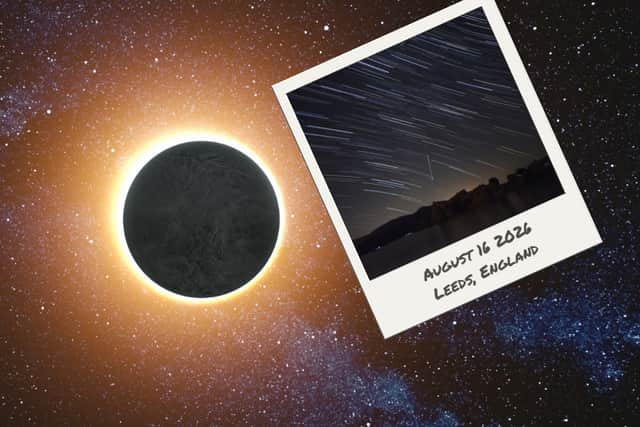

While meteors may be visible throughout the week, the shower reaches its absolute maximum peak on Wednesday night (August 12) through to the early hours of Thursday morning (August 13).
- Best Viewing Window: From 11pm on Wednesday night until around 4:30am on Thursday morning, when the sky is at its absolute darkest.
- Peak Rate: Stargazers in dark-sky areas can expect to spot between 50 and 100 meteors per hour during peak hours.
Unlike the eclipse, you do not need any telescopes or special gear to watch the meteor shower - your naked eye offers the widest view of the night sky.
What has led to both events taking place at the same time?
The double feature is a rare coincidence of solar and lunar orbital mechanics.
The Perseid meteor shower occurs at the same time every year in mid-August when Earth passes through the dense debris trail left behind by Comet Swift-Tuttle.
A solar eclipse, meanwhile, can only happen during a New Moon - when the Moon passes directly between the Earth and the Sun. By pure astronomical chance, August's New Moon phase falls precisely on August 12 this year.
This creates a perfect cosmic storm: the New Moon causes the daytime eclipse, and because a New Moon leaves the night sky completely dark without moonlight, it creates ideal, pitch-black conditions to view the Perseid meteors later that night.
What advice do astronomers give ahead of the eclipse?
Steve Strickland, President of the Leeds Astronomical Society, has issued an urgent safety warning for anyone planning to view the daytime eclipse, emphasising that standard sunglasses offer zero protection against solar eye damage.
"When observing the eclipse, it is imperative not to look directly at the Sun, even through sunglasses, as this can easily lead to eye damage," Steve warned.
"Observers can protect their eyes with eclipse glasses. These should be sourced from reputable suppliers and conform to ISO 12312-2:2015. There are also specialist filters which can be fitted to telescopes or binoculars, but again care must be taken to ensure that these are sourced from reputable dealers and that they are fitted correctly.
“Under no circumstances should the Sun be viewed through unfiltered optical equipment, as this is very dangerous and can lead to serious eye injury."
Where are the best locations in Leeds to see the eclipse?
Because Wednesday's eclipse occurs late in the afternoon, the Sun will sit low in the sky toward the evening.
Steve’s main piece of advice for choosing a viewing location is simple: you must find a spot with an unobstructed view of the western horizon.
For the best experience, members of the Leeds Astronomical Society will be hosting a public observation event at Roundhay Park on Wednesday evening. Society members will have specialised solar-filtered equipment set up and will be on hand to help the public view the eclipse safely.
Steve said: "Leeds Astronomical Society will be setting up at Roundhay Park and members of the public are welcome to join us.
Of course, the weather is also critical, but at the moment the forecast is favourable."
Other recommended Leeds viewing spots:
If you can't make it to Roundhay Park, several high-elevation spots across West Yorkshire fit Strickland's criteria for a clear western view—and double as great dark-sky spots for meteor hunting later that night:
- Otley Chevin (Surprise View): Offers sweeping, elevated panoramic views looking west across the Wharfe Valley.
- Baildon Moor / Ilkley Moor: High-altitude open moorland completely free from tall buildings and tree lines.
- Woodhouse Moor (Hyde Park): A popular central option offering wide, open grassy sightlines looking west out over the city outskirts.