
‘I taught my friend CPR - three days later she saved her baby’s life’
Here’s how a medical emergency inspired this educator to create a first aid course for parents
When Helen Underwood visited her friend’s house to give her some useful first aid tips, she had no idea just how valuable her advice would be.
No-one could have predicted that just three days later, the friend, who wishes to remain anonymous, would need to perform CPR on their own baby when they suddenly became unresponsive.
Following Helen's advice, the mother performed first aid, and within five rescue breaths her child was very luckily breathing again.
“She was fortunate that all it took was a few rescue breaths to get the child pinking up and showing signs of life again,” Helen told the Yorkshire Evening Post.
“It was so heart-breaking to hear and I just remember thinking what if I hadn’t gone?”
It was this terrifying experience which inspired Leeds-based educator Helen to create an online first-aid course specifically for parents.
Big Sick, Little Sick?! First Aid for Parents, guides parents and carers through how to provide primary care to babies and children.
From minor injuries such as cuts, stings, and splinters, to serious incidents such as burns, choking, and an unresponsive baby/child, the course aims to equip people with the skills necessary to be a confident and calm first aider in a moment of panic.
“Emergencies happen with children - they have no real sense of danger. Their immune systems are still developing and sometimes they get poorly quite quickly,” Helen told the Yorkshire Evening Post.
“Just having that first aid knowledge helps you know what to do in an emergency situation.”

When it comes to performing CPR on a baby, Helen’s offered the following advice:
- Make sure you and the child are in a safe position so you can administer first aid
- Tap the base of the baby’s feet or tickle under their armpits and look for quick reflexes as a sign of responsiveness
- If the baby is unresponsive, open their airway by gently tilting their head back and lifting the chin to pull their tongue away from the back of their throat
- If the baby is not breathing, perform rescue breaths by covering the baby’s nose and mouth with your mouth and lightly blowing just enough for the baby’s chest to rise
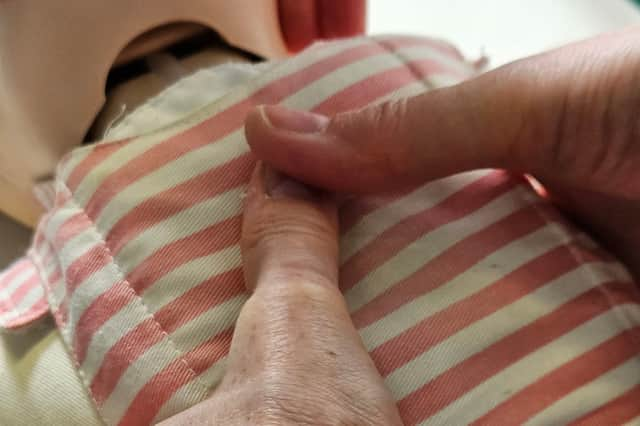
- Begin chest compressions in the centre of their chest and use just one thumb over the other due to the baby’s small size. Push down to around a third of the depth of their chest
- Alternate between 30 chest compressions and two rescue breaths until the baby is breathing again
Alongside providing first aid, calling 999 is essential in an emergency.

Since founding her first aid training company Underwood Training 20 years ago, Helen has received feedback from dozens of participants revealing they have used lessons from their course in a variety of unexpected situations.
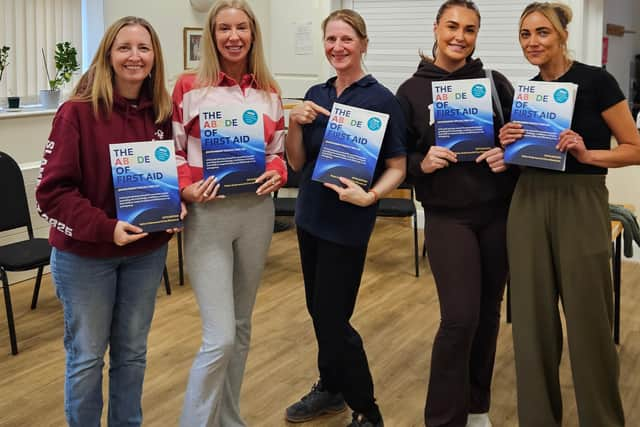
On a mission to get first aid knowledge rooted in the Leeds population, Helen co-wrote The ABCDE of First Aid alongside former NHS resuscitation lead Fran Woodcock, which teaches the simple skills that save lives.
Helen’s first aid educational tools, created from two decades of experience in the industry, have relevance to every age group.
However, aware of how accident-prone kids are and how vital primary care can be, she’s now focused on ensuring as many parents know first aid as possible.
She said: “Every child is going to learn to walk and fall over and bump their head at some point. Every child is going to wean and gag on food at some point and may possibly choke. Knowing what to do makes it so much less stressful and less scary.
“First aid is a life skill and I think everyone should learn it. When we’ve got our precious children in our life, just having the skills and knowledge of what to do gives you real peace of mind.”