
Leeds United star Gordon McQueen's inquest told heading a ball ‘contributed’ to brain disorder

An inquest into the death of former Leeds United hero Gordon McQueen heard that frequently heading a football contributed to a brain disorder.
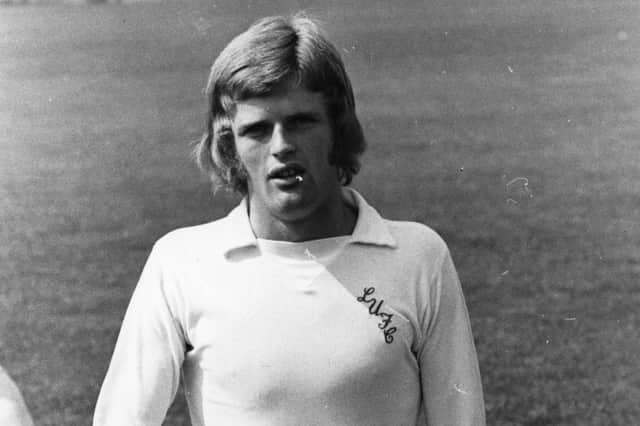
McQueen – who was capped for Scotland 30 times between 1974 and 1981, and played for both Manchester United and Leeds United during a 16-year career – died at his home in North Yorkshire in June 2023, aged 70.

The hearing in Northallerton heard McQueen’s family donated his brain, after his death, to Professor Willie Stewart – a consultant neuropathologist at Glasgow’s Queen Elizabeth University Hospital – who has conducted extensive research into brain injury in footballers and rugby players.
Prof Stewart told the inquest he found evidence of chronic traumatic encephalopathy (CTE) – a brain disorder linked to repeated head impacts – and vascular dementia.
He said there was no evidence of Alzheimer’s or Parkinson’s.
Prof Stewart did not conduct the post-mortem examination but was told McQueen’s cause of death was pneumonia, contributed to by a mixture of vascular dementia and CTE.
He said it would not be possible to say how much of McQueen’s dementia symptoms were caused by the CTE or by the vascular dementia.
The professor said studies, conducted by him and others, regarding the relationship between CTE and sports involving repeated head injuries showed a clear and strong association between repeated head injuries, usually over a number of years, and neurodegenerative changes, but the understanding of why this happens at a cellular level is still at an early stage.
Prof Stewart agreed with Mr Rawlinson, for the McQueen family, when he asked whether the CTE contributed to the death and that “heading the ball” contributed to the CTE.
The professor said the only evidence available was McQueen’s “high exposure” to heading a football.
Coroner Jon Heath read out statements from McQueen’s former colleagues Joe Jordan, Lou Macari, Bryan Robson, Eddie Gray and Gary Bailey. All described daily training sessions at Leeds or Manchester United which included repeated heading of long balls.
They all explained how McQueen was totally committed to training, often staying later for extra practice on his heading.
Bailey said McQueen “probably headed the ball more than anybody else” and Robson said McQueen probably headed the ball 10 to 15 times in matches, but this was “far exceeded in training”.
He said McQueen was “always at the forefront of heading sessions”.
Ian Maxwell, the chief executive of the Scottish FA, said McQueen scored four out of his five international goals with his head.
Earlier, the footballer’s daughter, Hayley McQueen, told the inquest he had told his family “heading a football for all those years probably hasn’t helped” after he developed dementia.
Mr Heath adjourned the inquest for legal submissions to be made in writing, and said he will give his conclusions on January 26