
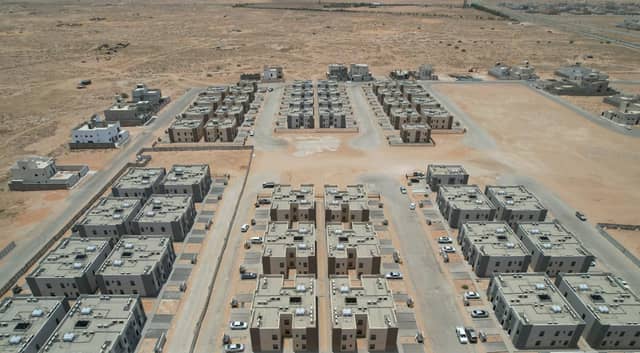
Saudi housing scheme mobilises millions in effort to tackle homes crisis


The international development community has spent years arguing that complex social challenges are best addressed through coordinated, multi-stakeholder systems.
Governments, charities, volunteers, donors and digital platforms are all meant to play distinct roles within a shared framework of accountability. It is a persuasive idea, but far less common to see it operating at genuine national scale.
Saudi Arabia’s Jood Eskan programme offers one such example, and one that was previously highlighted in The Herald.
Run by the Housing Developmental Foundation, known as SAKAN, the programme has developed a housing support model that brings together 313 nonprofit organisations and 1.4 million volunteers, while processing contributions from more than 4.5 million donors through a unified platform.
It also manages a digital assessment process that handles more than 400,000 beneficiary applications each year.
For a development sector that often speaks in the language of collaboration, accountability and scale, that is not a minor example. It is a working model of the sort many institutions have spent years trying to define in theory.
What makes the programme notable is not only its size, but the way responsibilities are distributed. The nonprofit partners are not simply delivery arms.
They are the organisations closest to families on the ground, helping identify needs, understand local housing conditions and provide the human support that no digital system can fully replace. The platform, meanwhile, performs a different role: coordinating processes, verifying cases and managing the movement of funds.
That distinction matters. One of the recurring weaknesses in large social programmes is the tendency to centralise control while weakening local relationships.
Jood Eskan appears to be attempting something more balanced: preserving the relevance of local partners while applying a shared governance framework across a broad network. Doing that across hundreds of organisations with different capacities and operating environments is no small task.
Its volunteer base adds another dimension. A network of 1.4 million volunteers is not merely a sign of public goodwill. At that scale, volunteer participation becomes an institutional capability in its own right. Recruitment, coordination, quality assurance and sustained engagement all become part of the programme’s operating model.
This is especially significant during Ramadan, when charitable activity intensifies and pressure on the system increases. A seasonal surge in giving, volunteer mobilisation and beneficiary demand can test governance standards as much as logistics. Any platform able to maintain operational discipline during that period is demonstrating more than campaign momentum. It is showing resilience under concentrated demand.
There are also features of the programme’s governance structure that deserve closer attention.
One is cost control. The platform states that deductions from non-zakat contributions for platform and partner costs are capped at up to seven per cent, and only applied when needed and approved by designated committees. In development terms, that is not vague language about efficiency. It is a rule that can be examined and assessed.
Another is data governance. A programme processing hundreds of thousands of applications inevitably handles a substantial volume of beneficiary information. Managing that data within a
defined privacy framework and under national jurisdiction reflects an understanding that digital scale creates real ethical and administrative obligations.
A third is the role of digital infrastructure itself. The reduction in case resolution time from roughly one month to 19 days is important, but speed is not the only point. The more meaningful question is whether digital systems produce decisions that are more consistent, traceable and reviewable. In high-volume social programmes, auditability matters as much as efficiency.
None of this means the model should be treated uncritically.
Important questions remain. Processing applications is not the same as proving long-term housing stability. The gap between administrative throughput and verified long-term outcomes is still one that any serious observer would want to examine closely. Likewise, a partner network of this size inevitably raises questions about consistency, oversight and quality assurance. Volunteer participation at scale may be impressive, but it also merits proper evaluation rather than automatic praise.
That is precisely why Jood Eskan should not be seen merely as a communications success story, nor dismissed for political reasons. It should be examined for what it is: an ambitious, imperfect and potentially relevant governance model.
Too often, the development world either celebrates such programmes too easily or overlooks them entirely. Neither response is especially useful. The more valuable approach is serious scrutiny: what has been built, what appears to be working, where the limitations lie and what other housing or development systems might learn from it.
For a sector that has spent years discussing how multi-stakeholder governance ought to work, Saudi Arabia has produced a large-scale example that appears to be testing that idea in practice. That alone makes it worthy of closer attention.