
Chinese-language novel 'A Tibetan Girl Called Ata' released in English



This article contains affiliate links. We may earn a small commission on items purchased through this article, but that does not affect our editorial judgement.
Author Zhang Pu has released his first translated novel ‘A Tibetan Girl Called Ata’ in English.
Zhang, whose older sister Jung Chang, rose to fame with her book ‘Wild Swans’, has had the first of his three Chinese-language novels translated into English. ‘A Tibetan Girl Called Ata’ has been released across the UK.
The author and his sister say they find it hard to imagine ever returning to China, fearing that they would simply ‘disappear’ as soon as they touched down.
The siblings incurred the wrath of the country’s communist regime with the works they published while abroad, and they now reside in London.
Today, both are well into their seventies. Living five thousand miles from their homeland, they lead fulfilling lives and remain tirelessly dedicated to their writing.
Zhang, whose novel A Tibetan Girl Called Ata went on sale in the UK earlier this year, said: “We know it is not safe for us to return. It is a decision we had to make, but in a way, it was made for us.
“Without a doubt, we are blacklisted and are essentially enemies of the state. It is now 12 years since I went back and Jung Chang hasn't been back since 2018.”
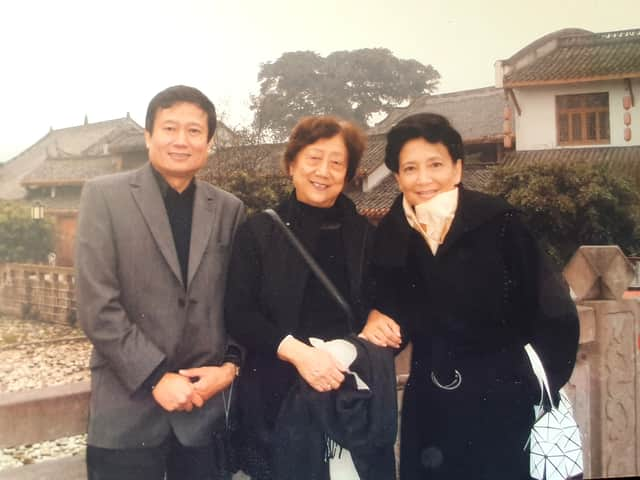
Zhang and his sister were happy children in Chengdu, close to the Tibetan border where they both grew up. But when the Cultural Revolution began in 1966, their childhood changed dramatically and was never the same again.
The sibling’s lives changed when their parents, who were government officials, became targets of struggle sessions during the Cultural Revolution and were detained by the faction then in power.
Zhang Pu spent his days roaming the streets, eventually joining one of Chengdu’s many gangs and repeatedly becoming caught up in street brawls between rival factions. It was during this time that his rebellious nature took shape.
Towards the end of the Cultural Revolution and in its aftermath, both Jung Chang and Zhang Pu went on to attend university. Jung Chang moved to the UK in 1978 for further studies and earned a doctorate, while Zhang Pu arrived in the early 1990s and obtained a master’s degree.
Shortly after Zhang Pu arrived in the UK, his sister’s novel ‘Wild Swans’ was published. It was during the process of translating the book into Chinese that he was suddenly struck by the urge to write.
Zhang Pu poured his pent-up rage into his writing, producing articles critical of the government. He was well aware that these pieces were highly controversial and bound to provoke a backlash. The success brought by his writing was a double-edged sword, making Zhang Pu a prime target of scrutiny by the authorities.

Jung Chang utilised the horror of their childhood years in a more subtle way, making it the subject of her global bestseller, Wild Swans. Works by both authors are banned in China. The waves of controversy stirred by their writing have also rippled far beyond Zhang Pu’s homeland.
Having already penned two tragic love stories, both of which were published in Taiwan, meeting a Tibetan woman in Chengdu who was engaged to a Han Chinese man, proved to be the inspiration Zhang was seeking for book number three.
While there is nothing particularly new or unusual about telling love stories between people of different ethnic backgrounds - a contemporary love story between a Han Chinese and a Tibetan — one that fully captures the joys and sorrows, the obstacles and triumphs — remains vanishingly rare.
Zhang explains: “I had grown up absorbing certain assumptions about Tibetan society. But once I began travelling, researching and looking beyond those assumptions, I saw something very different.
“There is a spiritual depth to Tibetan life that fascinates me. Their civilisation stretches back more than a thousand years, and despite numbering only a few million people, they have preserved an extraordinary cultural heritage.

“I knew, of course, that writing about these things would cause problems. Friends warned me not to write the novel. They told me the Chinese authorities would hate it. They were probably right - but I wrote it anyway.”
On his self-imposed exile, Zhang explains: “There are, of course, many things I miss about China, and there is sadness in knowing that returning home is not really an option.
“Perhaps I should take it as a compliment. But being in exile has also given me something unexpected. It has given me London. I love living here. And perhaps one of the greatest pleasures of all is that my sister and I are able to spend so much time together. We see each other most weeks.
“When I think back to those two children in Chengdu — one permanently carrying books, the other permanently getting into trouble — it seems remarkable that so many decades later we should both find ourselves living in London, still talking about books, still arguing about ideas and still looking out for one another.”