
Dramatic pictures as former military bunker on Yorkshire coast 'days away' from falling into sea

A nuclear bunker which is teetering on the edge of a cliff on the Yorkshire coast is said to be "days away" from falling into the sea.
The brick building, found above Tunstall beach between Withernsea and Hornsea, on the East Yorkshire coast, was said to be around 100 yards from the cliff edge when it was first built.
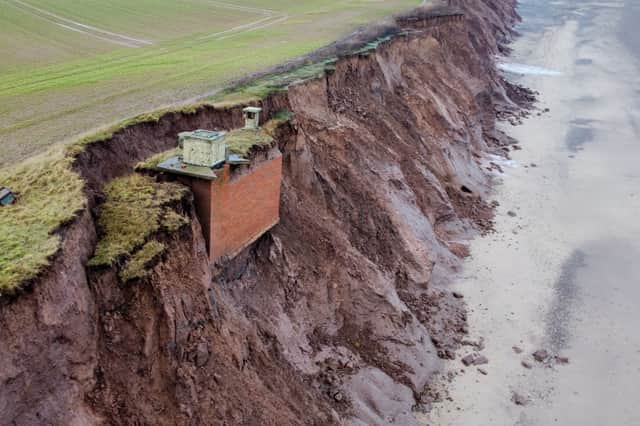

The once hidden structure was constructed in 1959 as Cold War-era lookout station in case of a nuclear war.
It was commissioned and operated by the Royal Observer Corps (ROC) and formed part of the UK’s Cold War civil defence network, used for nuclear blast detection and radiation monitoring.
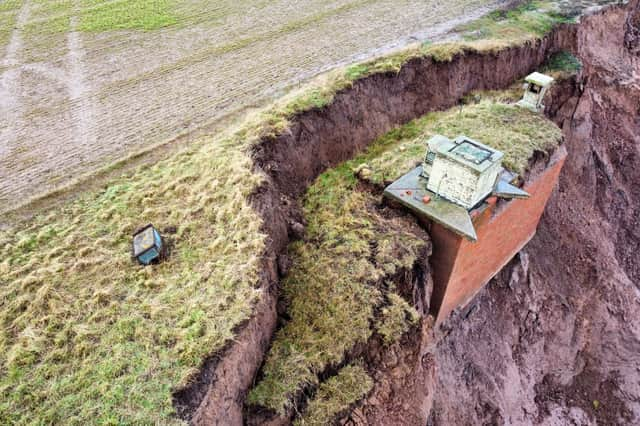
Two small chambers were built underground which were intended for short-term occupancy, usually by volunteers. It was later decommissioned in the early 1990s.
Now 70 years on, the coastline has slowly been eaten away by crashing waves and it sits precariously 25 feet above the sand and sea below.
According to amateur historian Davey Robinson - who has been filming the bunkers final days and posting them on his YouTube channel Timothy's Travels - its collapse is "a few days away".
East Yorkshire has one of the fastest eroding coastline in the UK, according to the Environment Agency.
It is also said around 3 miles of land is thought to have been lost since Roman times due to erosion along the coastline.
East Riding Council have since warned people not to visit the area due to the risk of its collapse.
A spokesperson for East Riding Council said: “Recognising the risk posed by the structure, the council would ask that people avoid the area, both at the cliff top and at the beach as it descends the cliff.
“The council would also remind visitors and residents to always maintain a safe distance to the base of eroding cliffs, due to the risks associated. East Riding Council does not have any statutory responsibilities connected to the structure.
"The structure sits on an area of privately owned land. This location lies within Policy Unit E (Rolston to Waxholme) of the Shoreline Management Plan.
"The approach for this location remains at ‘no active intervention’. Therefore, the coast is undefended in this area, which allows coastal processes to continue. The Ministry of Defence originally requisitioned the land to build the structure. But following its closure, the land was returned to the landowner. which included any military infrastructure upon it.
“The responsibility for this infrastructure therefore belongs to the landowner, and the management responsibility for the rural beach in this area sits with the Crown Estate.”