
'Hormonal changes felt demonic': meet the Adel performer heading to Edinburgh Fringe with horror-comedy debut

Adel writer and award-winning burlesque performer Georgina Collins speaks to the YEP about her playwriting debut, reclaiming autonomy from a severe hormonal disorder, and taking her blood-soaked solo horror-comedy to Edinburgh Fringe
Behind the glitter, gore, and theatrical irreverence of the North’s cabaret scene lies a quiet, systemic crisis that thousands of women face daily in consulting rooms across the UK: the exhausting battle to have severe hormonal health struggles taken seriously.
For Adel-based writer and performer Georgina Collins, that battle became an entirely disruptive reality in her mid-20s when she was hit by Premenstrual Dysphoric Disorder (PMDD) - a severe, often misunderstood hormonal condition that she describes as feeling like a "second puberty."
Unlike standard premenstrual symptoms, PMDD is a deeply debilitating disorder characterised by severe emotional and physical distress.


Yet, like so many women navigating the healthcare system, Collins found herself met with the all-too-familiar wall of medical negligence, routinely told by professionals that her extreme symptoms were "just hormones."
"It’s an often overlooked and misunderstood hormonal disorder, and it’s not something I fully understand myself," Georgina candidly admits.
The reality of managing the condition is a gruelling, cyclical process, as she continues to explain: "I have to take medication daily to prevent myself from going to dark and scary places during my luteal phase - this cycle is extremely frustrating."
It was out of this fog of medical ‘gaslighting’ and vulnerability that the seeds for her creative breakthrough were planted, as when faced with a system that offered little solace and even less understanding, Collins chose to fight back using the sharpest tool in her arsenal: dark comedy.
By taking the very real, terrifying moments of her health struggles and blowing them up into a literal, monstrous caricature, she found a way to strip the condition of its power.
"I’ve regained autonomy by turning my darkest moments into something so ridiculous and light-hearted," Georgina reflects.
"The play isn’t going to change or even challenge the system, but it is an outlet. I want women to feel a little less alone in their struggles, to find some solace and, hopefully, a few laughs along the way."
Rhinestones, gore, and flipping the script
This reclamation of control didn’t happen in a vacuum; as an award-winning fixture of the North’s cabaret circuit under her stage persona, Strawberry Duvall, Collins was already thoroughly versed in using bodily autonomy, sharp satire, and a commanding stage presence to connect with an audience.
Her burlesque acts have never shied away from the visceral, frequently incorporating body horror and practical effects - including everything from rhinestone-dipped tampons to mock-scalping herself live on stage.
When it came to processing her PMDD diagnosis, the cabaret stage was naturally the first place she looked - however, translating the fleeting, high-impact language of burlesque into a sustained, full-length theatrical production required a completely different creative blueprint.
"Burlesque was my first thought when I took pen to paper," Georgina explains. "I thought, 'Hey, I know how to tell a story in a five-minute act; I just need to build a show from 10 of those.'
“So that was the writing process, and what began as individual sketches soon formed a cohesive narrative."
Yet, as those distinct comedic vignettes began to stitch together into a singular, hour-length story, Georgina faced the complex task of separating her own lived trauma from the demonic entity manifesting on the page.
While the raw emotional fuel was entirely real, the character taking shape had to become her own beast.
"The story was born out of personal experiences," Georgina reflects. "While I have no experience turning into a succubus, I have had hormonal changes which felt pretty demonic.
“The protagonist and myself might share the same frustrations and sense of humour, but she isn’t me. She has her own worldview and relationships, her own stories."
From an Adel bedroom to the Underbelly stage
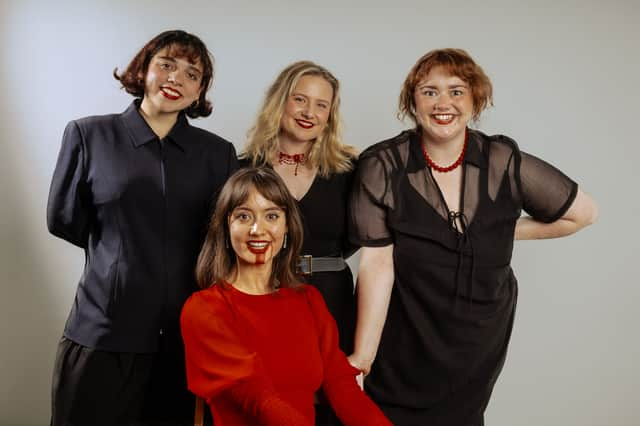
Securing a debut solo show with a venue giant like Underbelly is a massive milestone for any artist, but bringing ‘SUCCUBUS ‘to Edinburgh’s 'Dexter' space—a name that serves as a perfect visual homage to the production's dark influences—comes with intense Fringe logistics.
Working alongside director Grainne Robson, Collins has designed a minimalist, high-impact show built to survive tight 15-minute venue turnarounds. Instead of heavy staging, the world-building relies entirely on atmosphere, sound design, and a generous helping of practical effects.
"Our set is small—we’re working with blocks, plastic tarp, and a custom floor splash-deck for easy clean-up," Georgina reveals, promising a production that aims to be wonderfully "gnarly" without making audiences look through slotted fingers.
For the first-time Fringe performer, it represents a surreal full-circle moment from her creative roots in West Yorkshire.
"I used to spend nights in my bedroom in Leeds building a Devil’s Kettle town replica from ‘Jennifer’s Body’ on ‘The Sims,’" Georgina admits.
"And now I’m taking my love letter to horror straight to the Underbelly stage."
SUCCUBUS will play at Underbelly, Bristo Square from August 5–16, and tickets can be booked directly via the Underbelly Edinburgh Box Office.