
'I'm not a pipe and slippers man - instead I drove a field ambulance to frontline medics in Ukraine'

Karl Lavery spent several years with the army but only experienced the true nature of a conflict zone whilst on an aid mission to war-torn Ukraine. He speaks to Laura Reid.
This year, however, as a 64-year-old civilian, he found himself caught up among drone warfare and missile fire, travelling solo through Ukraine on a mission to deliver aid. “It wasn’t scary,” he says, “but I was very alert and aware.”
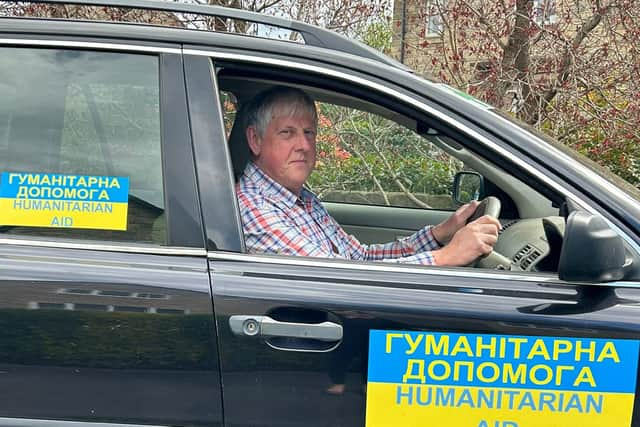
Karl embarked on his humanitarian trip to to give much-needed support to frontline medics in the country amidst ongoing conflict stemming from Russia’s invasion of Ukraine more than four years ago. His final destination was a base close to Kharkiv, one of the most heavily targeted and destructive battlefields of the war, with the delivery of supplies and an old 4x4 SUV to be used as a field ambulance for the recovery and treatment of wounded soldiers.
He also stopped en-route to take medical equipment to a hospital at Kryvyi Rih, a city in central Ukraine. “Kryvyi Rhi is really rundown, looks like it hasn’t been touched since its soviet days,” he says. “Nice people but a very poor place and the hospital, which we would call a cottage hospital, was the main city hospital and was doubling up because a hospital in a neighbouring area got blown up so not only did they lose a lot of medical staff and patients, they lost a lot of equipment…

“The hospital administrator came out crying because donations of equipment were so important to them. Compared to their needs, it’s a drop in the ocean but it’s helpful. And the fact that people are prepared to go out of their way and do this for them is huge for their morale four years into this war.”
As for the ambulance, “vehicles are getting hammered all the time (through wear and tear and through ground fire and drone attacks),” he explains. “Vehicles with good off road tyres can work in the field and so having a steady supply of them is important.”
The 2,850 mile road trip to deliver the 20-year-old SUV was bound to bring challenges, though not necessarily the obvious. Romania, for example (Karl took a route across Germany, the Czech Republic Slovakia, Hungary and Romania before crossing the Danube at Isaccea and entering Ukraine), brought torrential downpours, heavy snow and hairpin hills, whilst some of the roads he encountered in Ukraine were badly broken.
“On the road to Kharkiv, due to the closer proximity of the frontline and the number of Russian drones in sky, the satellite navigation systems had been turned off too,” Karl recalls. “So I had to do the last 160 miles with no navigation and no road signs, so as not to aid the enemy.”
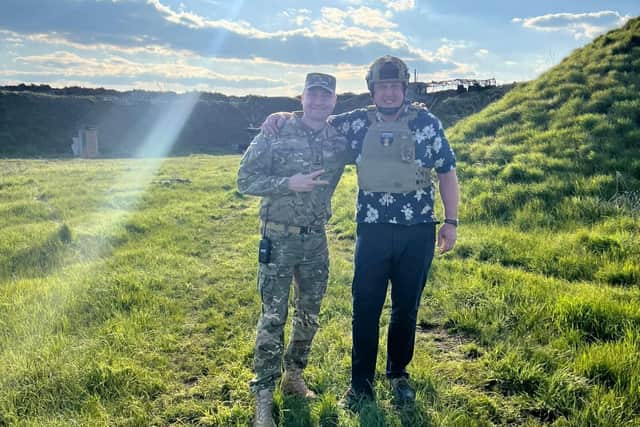
Thankfully, Karl is no stranger to a challenge. In his army days, it was free-running that took his fancy, and after that, whilst working for West Yorkshire Police in Leeds, he took part in a two-week multi-marathon which saw him climb three mountains, as well as cycle and swim huge distances, to raise money for charity. The rest of his career was in financial services, including co-owning and running a financial planning business, before Karl ‘retired’ two years ago, and has since focused on writing, with the publication of a self-help guide and a children’s book.
“Although it’s nice having more free time, I’m not a pipe and slippers man. I have a very active life, always have,” he says, from his home in Burley-in-Wharfedale, West Yorkshire. His more recent adventures have included tuk tuk racing around India and Sri Lanka and this year, self-professed “adrenaline junkie” Karl had intended to embark on a mammoth road trip across the Balkans.
He turned to an ex-army social media group in search of a companion to join him – and it was there the idea for the aid trip to Ukraine was posed to him instead. It appealed to Karl to try to help. “If I had been younger and fitter (when the war started), I’d have volunteered to go over and help,” he says. “I wanted to do something and I knew there was lots of people understandably fleeing the country so I took in two refugees instead.”
The chance to source, prepare and deliver a vehicle to be used as an ambulance was another way Karl could help, guided by a man from Wiltshire who’d already done more than 20 similar missions.
In Ukraine, especially close to Kharkiv, Karl had to be alert to the presence of Russian drones and warfare. “When I got across the border over the Danube from Romania, the first thing that struck me was how normal they tried to keep life,” he says. “That evening I got my head down early but there were sirens going off in the middle of the night and the second time I heard the buzz. I looked out of the window and three drones came across and I could hear gunfire and explosions. People are constantly alert and under attack even that far west in the country. I didn’t expect it to be that active that far west but they’re aiming at things like fuel depots and strategic points.”
In Kryvyi Rih, Karl was again woken by the sound of air raid sirens and gunfire and heard a missile hit what transpired to be a railway engineering workshop close by. Then, as he journeyed by overnight train from Kharkiv to Lviv after dropping off the ambulance, Karl was made aware of the risk of an attack and soon found himself evacuated with other passengers at a station platform “in the middle of nowhere” as drones passed nearby for over two hours.
The people he met were resilient, he says, Ukrainians attempting to go about their daily lives or medics helping those injured or unwell. Many were weary – four years in, they desperately want the war to be over. “But they’re not giving in,” he says. “They’re determined, it’s their country.”