
'I'm climbing to inspire': Researcher's mission to be first woman with incurable cancer to climb Mount Everest
Leeds researcher aims to become the first woman with incurable cancer to climb Mount Everest.
A Leeds researcher has raised over £25,000 for charity as she aims to become the first woman with incurable cancer to climb Mount Everest.
Dr Shaunna Burke, an exercise psychologist at the University of Leeds, has begun her Everest expedition today (April 16) as she endeavours to climb the highest mountain in the world.
After dedicating her career to researching how exercise can be used in cancer treatment, Dr Burke was diagnosed with incurable, stage four breast cancer in 2024.


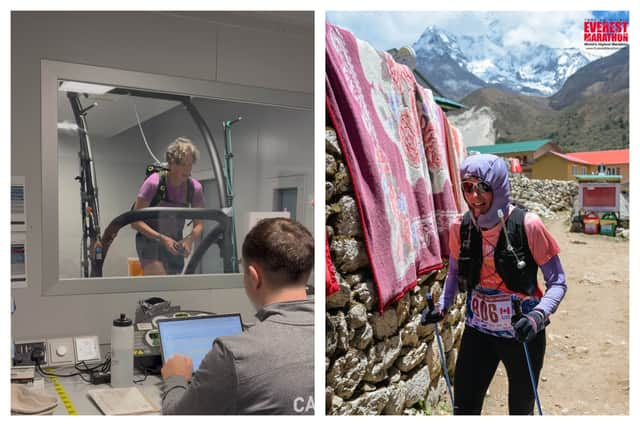
This will be the researcher’s third visit to the Himalayan mountain after reaching the summit in 2005 and completing the Everest Marathon last year.
Everest’s peak stands at 8,849m above sea level, making it the highest point on earth.
Through the mountainous challenge, Dr Burke has already raised £25,254 for Macmillan Cancer Support, one of the UK’s leading charities providing specialist health care, information, and financial support to people affected by cancer.
Dr Burke said: “I’m not just climbing a mountain — I’m climbing to inspire, to support research, and to raise funds that can change lives.
“Mountaineering taught me life is fragile; cancer taught me to keep climbing — back into life, fully and with possibility.”
Alongside a personal challenge for a good cause, the forthcoming expedition is also a research project and the subject of upcoming documentary Dying to Climb.
In preparation for Everest, Dr Burke will be accompanied by Dr Barney Wainwright, an Applied Sports Scientist at Leeds Beckett University.
The experienced mountaineer and expert in high altitude training will be monitoring the impact of the challenge on Dr Burke’s body, including her immune function and cancer markers.
To prepare for the mountainous challenge, Dr Burke has been training in the altitude chamber at Leeds Beckett’s Carnegie School of Sport, walking on a treadmill with a weighted rucksack to simulate the demands of climbing above 4,000 metres.
Also joining the team is anaesthetist and high-altitude expert Dr Patrycja Jonetzko, who has provided medical support for several mountain expeditions, as well as camera operator and director of Dying to Climb, Ben Ayers.
The expedition begins with the team’s ascent of Mera Peak, a 6,400-metre mountain where the research testing will be conducted and Dr Burke will be closely monitored as she acclimatises to high altitude.
In two weeks time, Dr Burke will say goodbye to her team and progress to Everest Base Camp at 5,364 metres with her team of Sherpas on April 30.
After she is joined by friends for a traditional Hindu Puja ceremony, Dr Burke will then progress to climbing up Camp 2 and 3.
For Dr Burke, the mountainous challenge is both exciting and nerve-wracking.
“Standing on the summit of Everest is awe-inspiring — you can see the curvature of the Earth,” Dr Burke said.
“But it’s also terrifying, because the climb isn’t over. Most accidents happen on the way down, where you’re exposed to extreme weather and even hallucinations at altitude.”
To support Dr Burke’s Everest challenge, donate to her givestar fundraising page.