
Leeds doorbell blunder: Hilarious moment woman mistakenly says “love you” to takeaway delivery driver
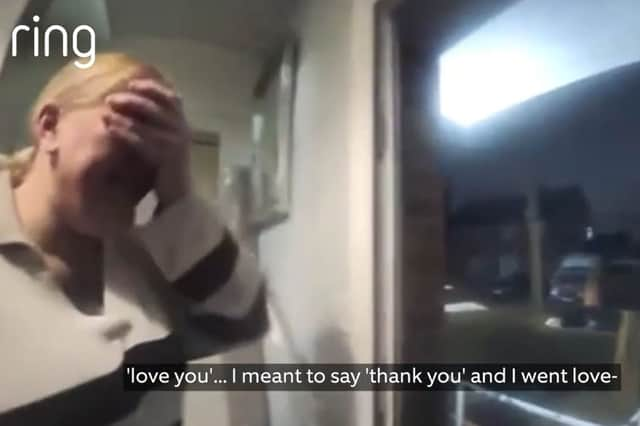
Watch as 45-year-old Lyndsey Pinkney from Leeds covers her face with her hand and awkwardly laughs at her comical doorbell blunder.
Doorbell footage shows the hilarious moment a Leeds woman says “love you” to a takeaway delivery driver instead of “thank you”.
Lyndsey Pinkney quickly realised and acknowledged her blunder, which was captured on her Ring doorbell.
Lyndsey said: “I have never said love you to someone by accident before, but when my family found out they said it wasn’t a shock as I am quite clumsy…I have made verbal slip ups before numerous times but none were caught on camera or this awkward!”

Dr Lalitaa Sunglani, world leading psychologist and author of the book ‘High Functioning Anxiety’ said: “Psychologists call these ‘schema slips’ or ‘script errors’. Our brains rely on well-worn mental patterns, or schemas, to help us operate efficiently in daily life. These language mix-ups are part of the brain's habit loop system: a blend of memory, familiarity, and emotional context.
“Saying ”I love you’“ is often a habitual phrase we associate with comfort, safety, or parting, so it's no surprise that it can pop out unexpectedly in a social situation that mimics those emotional cues.”
76% of Brits have admitted to fumbling their words
A new Ring survey of 2,000 UK adults found 76% of Brits have admitted to fumbling their words, in similarly awkward ways. Over a quarter (26%) have shared that they previously made this declaration of love instead of ‘thanks’, with millennials (25-34 year olds) most likely to make the error.
A further 29% of baby boomers admit to the classic mix-up of calling their kids by the wrong sibling’s name, while 44% of Gen Z (13-28 year olds) are more likely to cringe after saying “you too” to well-wishes like “enjoy your meal” or “get well soon.” Perhaps as no surprise, a huge two-fifths (40%) of students, aged 16-24, admitted to calling a teacher "Mum" or "Dad".
Top ten most common verbal slip-ups Brits just can’t stop making
- Saying "you too" when someone said "enjoy your meal", "have a safe flight" or "get well soon" (33%)
- Calling your child by their sibling's name (24%)
- Mixing up the order of your words in a sentence: saying "I wait can't to go" instead of "I can't wait to go" (23%)
- Saying "good night" instead of "good morning" (22%)
- Transposing the initial sounds of words, such as saying "blushing crow" instead of "crushing blow" (19%)
- Accidentally said "bye, love you" at the end of a work call or to someone that’s not your partner (17%)
- Calling a teacher "Mum" or "Dad" (16%)
- Calling your partner/ child/ loved one by your pet's name (13%)
- Saying "I love you" instead of "thank you" (13%)
- Calling your current partner by your ex-partner's name (11%)