
I visited the Guide Dog training centre in Leeds - and met the pups who will make a life-changing difference
Here is what it was like when I visited the Guide Dog training centre in Thorner 🐕
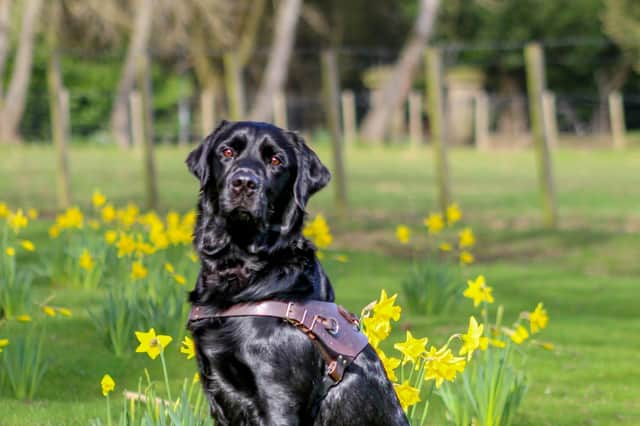
Ellis the Labrador is playful, cuddly, and loves a treat. In many ways, he is just like any other two-year-old dog.
However, Ellis has a very important future ahead of him: he is training to become a guide dog.
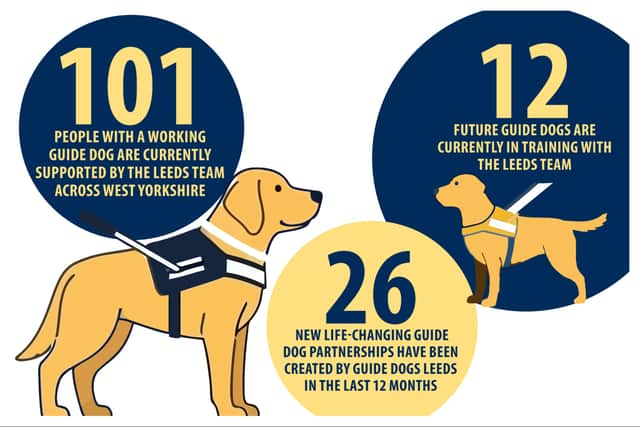
At the Guide Dogs training centre in Thorner, Ellis is one of 12 dogs learning the vital skills needed to support someone with a visual impairment. His role will be to help provide safety, mobility, and independence to his owner.
But when it comes to training a guide dog, where do you begin? I spoke to two guide dog trainers to find out.

Meet the trainers who are preparing guide dogs in Leeds for their future
Elysha McBride, a guide dog trainer, has been working at Guide Dogs for the past four years and her role is to look after dogs in their early stages of training. For Elysha, it’s the perfect job to combine her interest in animal training and passion for guide dogs.
“I’ve always been involved with guide dogs from a very young age. I had a Saturday job in Specsavers and I used to see Guide Dog owners and puppies so I’ve always admired what guide dogs do,” Elysha said.
“When I went to university for animal behaviour, training was something I always loved and it kind of combined two things that I really enjoyed.”
Hannah Watts, meanwhile, has been working at Guide Dogs for the past 18 years. In her role as a guide dog mobility specialist, she supports dogs during the later parts of their training, alongside co-ordinating matches between dogs and owners.
Like Elysha, it was a childhood interest which led her to this career.
Hannah said: “I grew up working and training with dogs. (I) used to compete with dogs, so I knew I wanted a job that would involve dog training and I also love working with people so I just wanted to combine those two things.
“I knew at school this was the job I wanted so I just set my sights on it and went for it.”
What happens when a guide dog first arrives at the Guide Dog training centre
Elysha and Hannah affectionately refer to the Guide Dog training centre as “school” for trainee guide dogs as they arrive for short bursts of focused training sessions.
Interestingly, the centre is not a guide dog's first training destination. Instead, from eight weeks, trainee guide dogs are initially raised by volunteer puppy raisers. These volunteers give puppies the foundation for their future working life as they introduce them to different experiences and environments and begin training.

When the trainee guide dog is around 14 months old, they arrive at their local guide dog training centre for specialised training, which typically lasts six to nine months.
Having seen numerous first steps into the centre, Elysha says young guide dogs tend to be excitable, like any other young dog.
Elysha said: “They’re usually very giddy, very silly young puppies and they are still very much puppies when they first come.
“They’re often very overexcited - everything's brand new, it's a lot of playfulness. We then try and mould and filter that energy and happiness into the work.”
How training a guide dog really works
When training guide dogs, Elysha and Hannah use a positive-reinforcement system focused on repetition and rewards. In some ways, this can look similar to how you’d train any other dog. However, instead of learning cute tricks, guide dogs are learning behaviours that will prepare them for their working life.
For example, Ellis has been trained to settle calmly under a table, so when his future owner takes him to a busy environment like a coffee shop in the future, they can know exactly where he is.
Ellis has also learned how to undergo gentle co-operative health checks so his owner can regularly examine them to check they are healthy.
Common misconceptions surrounding guide dogs
For most of us, the most common place we will see a guide dog working is in an outdoor space with their owner. Here, guide dogs play a vital role in helping a visually impaired person travel safely.
However, Hannah highlighted that many people misunderstand the capabilities of guide dogs as they assume they are trained to independently cross roads, memorise routes, and understand traffic lights.
Hannah said: “We get people who think they can read bus numbers, can find milk in a supermarket, but they’re not robots.”
To learn how a guide dog’s job works in practice, we headed out on a walk alongside Erik, another trainee guide dog at the centre, who is a two-year-old golden retriever.
We began by putting on Erik’s harness to signal that he is in working mode. Then, we started a three-step sequence to prepare to move.
Red - The guide dog owner stands with their feet together
Amber - As the guide dog owner prepares to walk, they move their right foot one step backwards
Green - The guide dog owner lifts their right arm and announces ‘forward’ when it is safe to start moving
As Hannah and Erik started to walk, I saw how he helped her stay safe by walking alongside her in a straight line. If Hannah came close to a road, Erik would divert her to the lowest part of the kerb to prevent her from tripping, and he would also divert her away from obstacles if they came in her path.
On the walk, I realised I had my own misconceptions about what guide dogs do. I thought guide dogs effectively lead their owners on outdoor walks, however, it turns out it is the opposite.
While guide dogs like Erik are trained to help their owner navigate their environment safely, the guide dog owner needs to know their route so they know when it is safe to cross the road, and the guide dog owner needs to know their route so they can direct their guide dog along the correct course.
A walk relies on a partnership between the guide dog and their owner, who both have important roles to ensure their journey is safe.
Because both parties need to intensely focus on their surroundings, Elysha warned that distractions can cause danger. Petting a guide dog while they are working can break their concentration, while grabbing a visually impaired person to direct them, while well-intentioned, can create confusion.
Elysha said an offer for help can be well appreciated; however, the approach you take is crucial.
“You need to ask for permission and respect the answer,” Elysha added.
“Acknowledge the guide dog owner too as so many people just talk to the dog.”
What is it like to walk with a guide dog?
After I watched Hannah walk Erik, I was offered a turn. I put on a blindfold to gain a sense of what it is really like to rely on a guide dog in a public setting.
The moment I put the blindfold on, I instantly became slightly disoriented. It made me realise just how much I rely on my vision to walk and how nervous I felt without it.
I took hold of Erik’s harness in my left hand and after following the three-step sequence, we started walking along the pavement. Erik helped me easily move past obstacles in the pavement and fellow pedestrians too, and crucially gave me the confidence that I was safe.
With a blindfold on, I felt more aware of my other senses. Particularly, I’ve never been so conscious of the feeling of the ground beneath my feet as we moved from the smooth road to the tactile bumps of a crossing. I was also listening out more but it took intense focus to figure out where exactly the sound of car engines, and bike bells, were coming from.
Having Erik next to me made me feel far more confident as I walked to the Crossgates shopping centre in Thorner. However, I also felt a sense of responsibility that I needed to keep Erik safe too. My trust laid in Erik, but Erik’s trust also laid in me.
What happens after a guide dog completes their training
In 2024-2025, Guide Dogs Leeds supported 26 different partnerships between guide dogs and owners.
For Elysha it is always an emotional moment when a guide dog leaves the centre to start their new life, because you build an attachment with each dog.
Elysha said: “Obviously I’m thrilled they’ve made it and they’re going off doing what they’re doing but it's always this kind of lump in the throat day when they go because you do spend everyday with them.
“You get to know them so well - you know them inside out.”
Hannah agreed but she also said that a dog’s departure is positive too because it means they will soon change someone’s life for the better.
Hannah said: “For me that's the best part of the job, not that the dog’s leaving me but the fact that the dog has fulfilled what we hoped it would and it has actually partnered with somebody.
“You get a really close working relationship with your guide dog owners. For me the best part is seeing that because we’ve achieved what we set out to do”
Elysha and Hannah play an essential role in training guide dogs, however, they emphasise that it is support from volunteers which makes their job possible.
Hannah said: “All of our training dogs live with volunteers outside of working hours. They have them at evenings and weekends and help out massively.
“Without those volunteers we wouldn’t be able to have the dogs and do what we do.”

Elysha also highlighted that funding from donations means “everything” to the charity and helps it keep running day to day.
Elysha said: “We couldn’t do what we do without donations from people.
“We are almost fully funded on donations - everything from dog food to the equipment that we use, we couldn’t do any of it without donations from members of the public.”
Guide Dogs has had a presence in Leeds for the past 30 years, first in Headingley before moving to the Thorner training centre three years ago. Tucked in the small village, it’s a building which is easy to miss.
However, as 101 people with a working guide dog are currently supported by our Leeds team across West Yorkshire, the charity is making a monumental impact across our region.
Ellis and Erik are both almost ready to leave the Guide Dog training centre as they are set to help a person with a visual impairment gain more independence and confidence.
The difference they make will be life-changing, but none of it would be possible without the work of Guide Dogs UK.
To find out more about Guide Dogs and how to volunteer or donate, visit the charity’s website to learn more.