
'We forgot our humanity’: Leeds director explains why movie fights back against digital noise

Ahead of his Victorian feature film, ‘The Leaving of Lower Headrow,’ independent director Sam Judd opens up about filming at City Varieties, breaking down barriers for neurodivergent crew, and why we need a new wave of human storytelling
There is a certain aesthetic in Leeds which draws film producers to our neck of the woods - from the lush green spaces on the city's edges through to the gothic, Victorian architecture tucked between modern business blocks in the city centre.
For independent director Sam Judd, that rich historical backdrop isn't just set dressing; it is the living, breathing heart of his latest project.
“The City Varieties is filled with history - from Charlie Chaplin performing there to tales of Edward VII hiding in the balcony to court one of the music hall stars,” Sam explains to the Yorkshire Evening Post.
“It is so rich with the past, you can practically feel it. That is what I want my film to be: a time capsule. I want the audience to feel the history, to sense it in the air.”
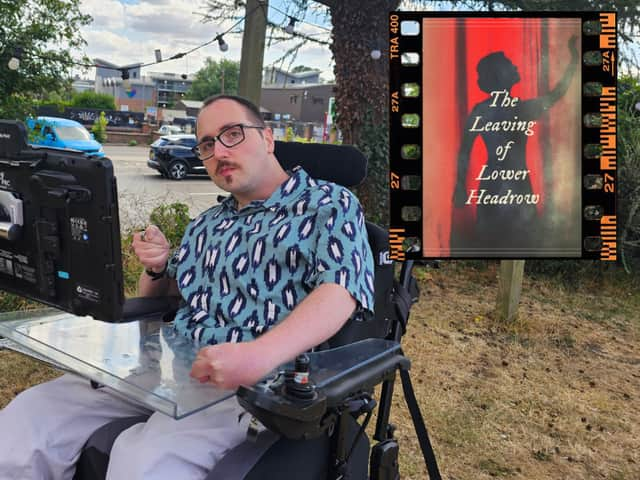

Set in 1907, Judd’s upcoming feature ‘The Leaving of Lower Headrow’ takes place inside that very music hall culture, celebrating dance as one of humanity's oldest forms of creative expression.
The story follows Eliza, a young woman hungry for a better life as she recounts her fight to slay her tormentor, the menacing Bertram Frankley, before fleeing for the wonders of America.
“I want you to feel the history seeping out of the screen,” Sam details. “I want you to feel the grime. I want you to feel the dimly lit streets.”
He points to 19th-century Leeds artist John Atkinson Grimshaw as a key visual touchstone for the film's mood. “I find Grimshaw deeply influential,” Judd says. “I can see Bertram and Eliza roaming the streets and alleys in his paintings.”
For Sam, choosing this era and focusing on dance was a deliberate step away from the non-stop stream of digital content and AI in modern life.
“Dance will bring rhythm and emotion to the piece, adding depth and bringing a whole new level of meaning to the words,” Sam reveals, explaining that the new film is about emotion: grief, fear, anger, the need for more.
“We need to be reminded of our emotions again - the emotions which we all experience.”
Marrying digital and analogue in a digitally noisy world
Having suffered a brain stem stroke at just four years old, Sam is disabled and relies on speech interpretation software to communicate.
Giving him a unique, deeply personal perspective on modern technology: while digital tools are essential to his daily life, he believes society as a whole has become dangerously disconnected.
“Technology has its place, and the internet is one of mankind’s greatest inventions - I wouldn't be able to live my life today the way I do if it wasn't for it,” Sam wryly acknowledges. “It has admittedly done a lot of good. However, somewhere along the way we forgot our humanity and what makes us human.
“We don't know how to interact with strangers anymore.”
“If someone you don't know engages you in conversation, they are 'weird' or they have a hidden agenda - why is that automatically the case? We need to take it back. We need to reconnect our disconnected world, marry the digital and the analogue together, taking the strengths of both and discarding the rest.”
For Sam, meeting in person for an interview rather than exchanging emails was a deliberate choice.
“Meeting in person gives you the extra spice, the extra grain of truth for your writing to stand apart,” he explains. “Connect to the human and the emotion, not a screen.”
It is a poignant comment from someone who relies on technology to speak, rather than someone who has become a slave to algorithmic ‘suggestions’.
‘We need to be a bit more New Wave’
That philosophy of human connection extends directly behind the camera.
Over half of the junior crew roles on ‘The Leaving of Lower Headrow’ are going to Northern film students, alongside a deliberate commitment to championing disabled and neurodivergent talent across the production.
“I do think it creates a calmer, more relaxed environment, which I find more congenial; a healthier workplace for everyone,” Sam says. “Having that level of acceptance and understanding gets everyone on the same wavelength, fighting for your film.
The best films come out of collaboration, and in order for collaboration to happen, you need your team behind you.”
For Sam, representation is not a superficial industry exercise, but an authentic extension of his identity.
“As an artist, your past feeds your creative process,” he explains. “I am disabled. I am from the disabled community. Helping disabled and neurodiverse talent is my way of reminding myself about my community and how we got here.”
He points to cinema history’s original game-changers as proof that fresh perspectives drive industry revivals.
“The American New Wave - which produced filmmakers like Steven Spielberg, Martin Scorsese, and Francis Ford Coppola - came out of a cultural shift and the need for new voices,” Sam notes. “We need to get previously unheard voices and perspectives into the industry to keep things fresh, instead of the same people telling the same stories over and over again.
“We all need to be a bit more New Wave in our approach.”
As pre-production moves into its final stretch, Sam admits to feeling the heavy weight of responsibility — balanced by the thrill of what lies ahead.
“It is resting on my shoulders, and if it fails, I will feel so much responsibility,” he admits. “However, if it succeeds, it will be such a sense of achievement for everyone involved.
“That feeling is electric, and it keeps me going.”
Film lovers can follow the progress of ‘The Leaving of Lower Headrow’ by visiting the film’s official Instagram page, or to support the production, you can also donate to the dedicated Crowdfunder campaign.