
VE Day 80th anniversary: Heroic Leeds war veterans mark milestone sharing powerful memories from conflict

Heroic war veterans from Leeds have shared powerful memories as commemorations mark the 80th anniversary of VE Day.
The city will today (May 8) honour the sacrifices made by those who served during the Second World War, as civic leaders gather to observe the milestone and pay tribute to the enduring legacy of the wartime generation.
There will be a short service at the War Memorial in Victoria Gardens led by the Lord Mayor Coun Abigail Marshall Katung and the Lord Lieutenant of West Yorkshire at 11am, where wreaths will be laid.
Then, on Saturday evening (May 10), Coun Katung will host a civic event at Leeds Minster. It will feature orchestral, choir, and bagpipe performances, contemporary songs of the war era, and personal stories of Leeds people who contributed to the victory.
Focusing on a timeline running through the nearly six years of war, the testimonies will not just examine the stories of those who fought, but contributions from the Women’s Land Army, firefighters, the home front in Leeds, and the contribution of the royal family.
As the country celebrates reflects on the end of the war, 101-year-old Jack Mortimer, from Seacroft, will be remembering the moment he landed on the beaches of Normandy - and the countless comrades who never made it home.


Mr Mortimer, from Seacroft, was 19-years-old when he was given a train ticket to start his army training for the outbreak of war. He said it is impossible to forget the sheer numbers of lives lost - and he cannot count the thousands who didn't come back.
“Those are the ones we should remember,” he said. His training in Portsmouth was for the Ordnance Corps. They were taking care of stores, so there was practice driving under fire. The, suddenly, it was time to move.
Mr Mortimer continued: “We were going for the invasion, but we didn't know. That was the beginning.”
He was put in charge of a Jeep, with a trailer for ammunition and petrol. On the morning of D-Day, June 6, 1944, he woke up halfway to France. His ship landed near Sword Beach.
“I won't say it was frightening, not frightening,” he said. “It was apprehensive certainly. But when the French coast came into view, well, I knew that was it then. There was a great big cordite smell because all the guns were going off. And the great big ships in the channel were firing over our heads. It was really noisy and smelly.”
He continued: “It's difficult to imagine that you look left and right and see hundreds of ships all along the coast, almost every hundred yards, a landing craft, discharging vehicles and men. It was noisy, very noisy, shells screaming over the top of us, gunfire going off, and the beach master shouting, 'Get off the bloody beach!’”
In all the chaos, he said that there was a military precision. In the days that followed, teams worked to clear the roads of debris. Moving towards Antwerp, they became a target for bombers, searching the rubble for any survivors. It was there that he was stationed when the end of the war came.
“We had a gigantic party,” he said, remembering VE Day. “Everybody was happy and it was a great relief really that there was no danger now again. A feeling of great relief.”
But even amid the celebrations, there is a sense of sadness to his memories. Every time he returns to Normandy, he visits the Commonwealth War Graves Cemetery in Bayeux and another at Ranville. He said: “If cemeteries could be called beautiful, then they are beautiful. All the gravestones are immaculately in line, not a blade of grass out of place.
“It's very emotional, as being an ex-soldier to walk down those lines of gravestones. And sometimes, I think, sometimes they speak to you in silence.”
Another veteran who will be recalling his experiences this week will be Alf Herring, 101, from Pudsey. He was shot down over occupied France 80 years ago and was taken prisoner almost immediately.
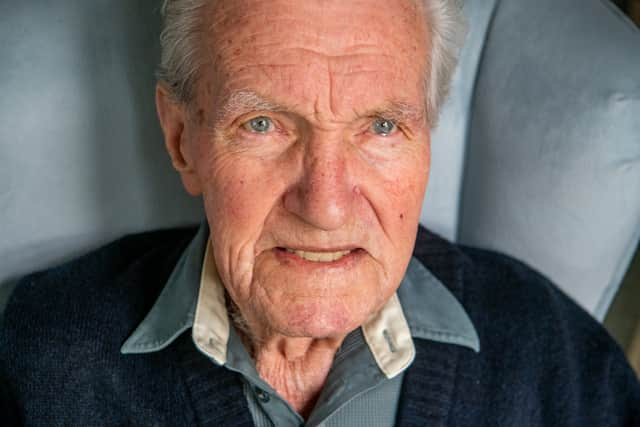
Having never spoken of his memories of war before, he said: “Here we are at the 80th anniversary of VE Day. I was still in a PoW camp when the war ended.
“It’s such a special moment for the country and should remind us all of what we owe those who fought and those who lost their lives.”
Mr Herring, an RAF veteran, was a leading aircraftman on the Halifax heavy bombers. He would take control when it was on a bombing run.
Lying flat in the nose of the plane, his job was to direct the pilot before releasing the bombs. But then he was shot down, at just 19, and taken captive for the final 14 months of war.
“I’ve never really spoken about it before, just with close family,” he said. “But it’s a part of my life that comes to the forefront of my mind every now and then. At the time it was something we felt we had to do.”
Mr Herring signed up in 1942. His parents were fearful, but he felt the RAF trained them well. He became a bomb-aimer on a seven-man team, serving with 158 Squadron at Lissett.
He can recall around seven missions. But he said that he was never scared. Although the journeys were in fact quite long and boring, they always felt safe in the Halifax.
“It was a well-armed bomber so we had quite a lot of teeth and we defended ourselves well, thanks to the gunners,” he said.
“We always had the same team, and we became good friends. Sometimes you could be airborne for several hours and we would travel in complete silence.”

But on 30 March 1944, the crew was shot down returning from a bombing raid on Nuremberg.
“We all survived, but we had to bail out,” said Mr Herring. “I landed on my own in the Belgian countryside, and had to ditch my parachute and find cover.”
Soon, the teenage airman was picked up by the Belgian police, who handed him over to the local German garrison. Some five of the crew were captured but two - the navigator and the rear gunner - were able to meet up and escape with the French resistance.
Herring was taken to a police station for interrogation before being held at PoW camps in Lithuania, Poland and Germany. He was held captive with Flight Engineer Leonard Robinson.
Eventually, Herring was released and flew home just after VE Day, at the end of May 1945. He spent his working life as an engineer, starting at crane makers Joseph Booth & Bros.
Today, to mark the 80th anniversary, he has been invited to join the RBL's anniversary tea party and service of remembrance.
It will bring together the largest gathering of Second World War veterans. Mr Herring said: “I hope everyone joins in the spirit of the celebrations.”
Les Sunter, 99, from Rothwell, is also recalling his experiences. He is starring in the campaign from Blind Veterans UK, the national charity for vision-impaired ex-service men and women.
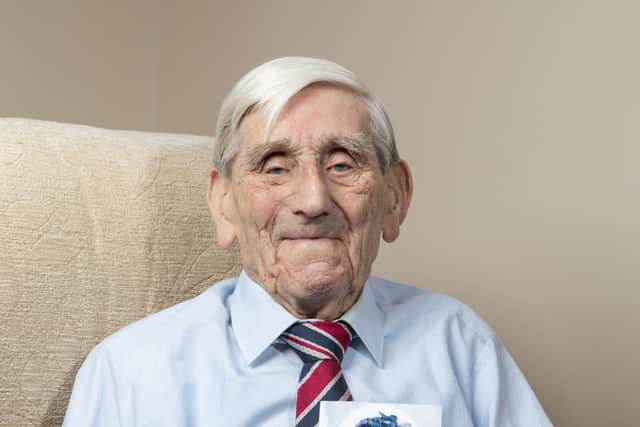
The charity’s campaign, ‘After the Darkness’ features a striking image of Mr Sunter coming out of the darkness and into the light, a powerful metaphor to represent the end of nearly six years of warfare in Europe. It prompts people to experience VE Day through Les’ eyes by visiting blindveterans.org.uk and reading his story.
The two digital screens in Leeds will display Les’ advert in the build up to VE Day between 6 and 8 May. Both screens are on York Road on the way into Leeds City Centre from the east.
Royal Navy veteran Mr Sunter remembers the drunken revelry on VE Day, and the trepidation about Japan. He said: “We were in harbour in Gibraltar when we found out about the announcement, so we went out and had a few drinks. Everybody was shouting and carrying on.
“And then we come back and a stoker off the next ship to us got up on a big crane. He climbed up to the top and just stripped off! All the ships had their headlights on him.
“So, we went out on the upper deck and looked up. We couldn't see very much, but he continued getting undressed. He wasn't supposed to be up there, and there was a punishment waiting for him when he come down, but he’d had too much to drink, probably. So that's what I remember about VE Day!”

As the news sunk in, the feeling from Mr Sunter and his crew was huge relief. He said: “Everybody was saying the same words: ‘We've got away with it.’ In convoys, the U-boats were chasing us all the time, sinking our ships, though it had eased up a bit.
“If you get torpedoed in the mid-Atlantic, there's not much chance for you, really. It was just a relief. When you’re out there doing it, you don't think of it. But the fact that the war was over. We were lucky.”
After VE Day, Mr Sunter and the crew continued escorting merchant ships, but within a couple of weeks they were on their way to the Japanese War.
He said: “We were supposed to go through the Panama Canal and down to the Pacific. But halfway across the Atlantic, the war with Japan was over so we got away with that as well! I remember our Captain announcing it over the Tannoy: 'We've been given new instructions. We're not going to the Pacific… because the war with Japan is over!'
“Relief is a small word, but it was a hell of a size. It was a big word because it was the word everybody seemed to express. Relieved they got away with it. When you think about the people got killed… And it could have happened to us at any time. So, huge relief.”
When asked about being one of the stars of Blind Veterans UK’s campaign, Mr Sunter said: “It’s been an exciting time and kept me very busy. I’m even in a magazine and I take it with me when I go out to show people.”