
How did your MP in Leeds vote on the assisted dying bill? Full list
See how your MP voted on the assisted dying bill today
An attempt to legalise assisted dying has been rejected by MPs.
The Terminally Ill Adults (End of Life) Bill sparked passionate speeches both in favour and against it in a four-hour debate in the House of Commons on Friday (September 11).
The Bill was voted down by a majority of 16, after 286 voted against while 270 voted in favour.
The draft legislation had proposed allowing adults in England and Wales, with fewer than six months to live, to apply for an assisted death subject to the approval of two doctors and an expert panel.

Prime Minister Andy Burnham had already confirmed his intention not to vote on the Bill so as not to “unduly influence the debate”.
The Government was neutral on the Bill and MPs voted according to their consciences rather than along party lines.
But how did your MP in Leeds vote? See the full list below:
- Hilary Benn- Leeds South - Aye
- Fabian Hamilton - Leeds North East - Aye
- Mark Sewards - Leeds South West and Morley - Aye
- Katie White - Leeds North West - Aye
- Richard Burgon - Leeds East - No
- Rachel Reeves - Leeds West and Pudsey - Aye
- Alex Sobel - Leeds Central and Headingley - No vote recorded
- Sir Alec Shelbrooke - Wetherby and Easingwold - No
- Keir Mather - Selby - Aye
- Simon Lightwood - Wakefield and Rothwell - Aye
Before the vote this afternoon, the Yorkshire Evening Post turned to Facebook to get readers thoughts on whether assisted dying should be legalised. It proved to be a very heated debate.
Stewart Daniels wrote: “Yes especially for those who wish it & also those have long term illnesses such as dementia & Alzheimer’s. We put a dog down if it has a long term illness so why can’t it be for humans under the correct control of a doctor.”
Karren Gaughan echoed: “Yes! We should be able to choose the way we end our lives, I understand both sides and I believe we should have dignity in death. It is our life and it is only our responsibility to end it, no one else.”
On the other side of the debate, Aileen Barrass said: “Not before we put in place good care for people who need it. It should be of a quality that each person gets help to enjoy what time they have left.
“I understand when people are suffering they must feel there's nothing left to live for - but why are they being left in pain - no need.”
Paul Gibbon added: “Only if there's no possible cure and the person's circumstances, like pain, have no chance of ever getting any better.
“The reason I say this is because I've met people who wanted to die, and years later when their circumstances have changed, they thank God they didn't go through with it.”
Taking the middle ground, reader Andy Hepworth said: “Under the right circumstances yes, terminal or debilitating conditions for example.”
Campaigners against it argued it contained inadequate safeguards and that it could result in some of society’s most vulnerable being at risk of coercion and choosing an assisted death because they feel like a burden.
Opposition to the Bill had been voiced by the leader of Catholics in England and Wales, Archbishop Richard Moth, who called it “wrong in principle” and “deeply flawed” as well as the Church of England’s Archbishop of Canterbury, Dame Sarah Mullally.
Medical colleges, including the Royal College of Psychiatrists (RCPsych), had also raised “serious concerns” about the Bill, saying there were “too many unanswered questions about the safeguarding of people with mental illness”.
Mr Burnham previously said he believes the funding of palliative care needs to be fixed before consideration can be given to legalising assisted dying but Bill sponsor Lauren Edwards had insisted both were possible alongside each other.
Marie Curie, Hospice UK and St Christopher’s Hospice charity are all neutral on the principle of assisted dying but have repeatedly warned access to and quality of end-of-life care is too patchy across the country and that the sector is severely lacking in funding and said “the need for more urgent and ambitious action to fix end-of-life care could not be clearer”.
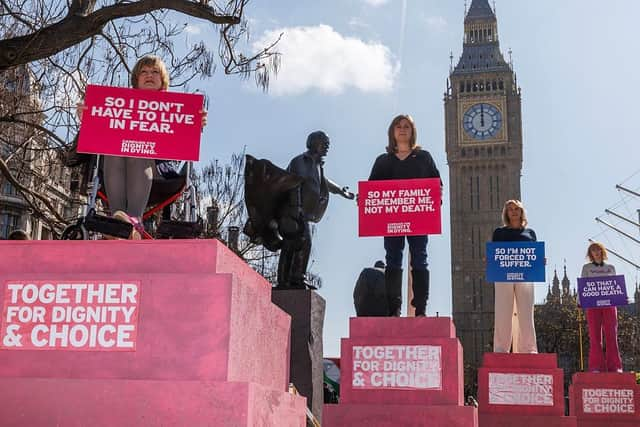
Demonstrators in opposition and in favour gathered outside Parliament on Friday to make their voices heard on the debate.