
‘Where is this magic tree?’: Leeds locals tell us what they think of Andy Burnham's social care plans

When Andy Burnham called for an NHS-style National Care Service, the response in YEP readers was swift, emotional, and deeply divided
It takes a lot to get a comment section moving on a Monday morning, but put social care at the top of Downing Street's priorities and the floodgates open immediately.
When Prime Minister Andy Burnham laid out his flagship vision for an "NHS-style" National Care Service, arguing that social care should be publicly funded, free at the point of use, and stripped of the brutal means-testing that forces families to sell off their homes.
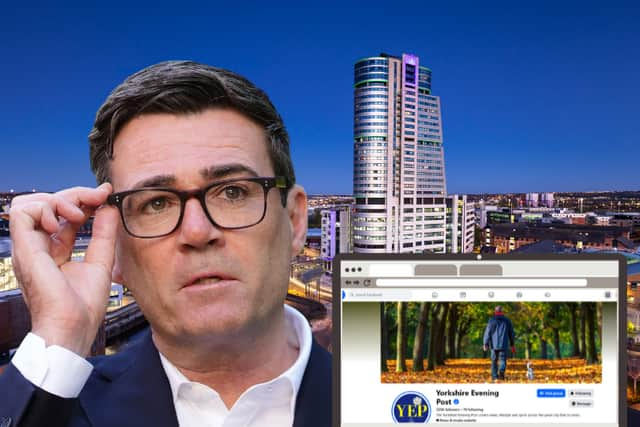
We put a simple question to our readers on the Yorkshire Evening Post Facebook page: Does Andy Burnham's plan for an NHS-style care service make you more likely to vote for Labour?
The deluge of responses didn't just highlight political divides; it exposed raw, personal anxieties about growing old in Britain today.
The Human Cost of Doing Nothing

Behind the headline politics, the strongest support for the Prime Minister's proposal came from readers who have seen the current system's cruelty first-hand.
Take reader Julia Manning, whose comment cut straight to the emotional heart of the crisis.
Describing how her family is currently spending £10,000 a month on live-in home care using equity release on her mother’s home, she laid bare the looming cliff-edge facing thousands of families: "Once they run out... I have no idea what to do to keep them where they want to be. We can’t afford to pay, and social care won’t pay. This is all of us unless we die before we need care.
“So when your time comes, what would you prefer? Paying more tax or an early death because you can’t afford to look after yourself?”
For reader Paul Weston, Burnham’s plan isn't a radical gamble but instead basic arithmetic. Pointing out that families already pay a hidden "dementia tax" through wiped-out life savings and house sales, spreading the cost across general taxation simply makes economic sense.
Others, like Les Brady and Sonya Paine, focused on the immediate benefit to local hospitals: if No. 10 fixes social care, it stops "bed-blocking" and frees up much-needed space in A&E corridors.
Intriguingly, reader Lynn Johnson offered a piece of local history, recalling her start in Leeds City Council's Welfare Department back in 1968: "At that time the council owned and ran several old people's homes and a home help service to clean and shop for old and disabled people at home. All worked perfectly well.
“Then in 1971... all those services for old people were privatised. And here we are now."
The Trust Deficit and the 'Magic Tree'
Yet for every reader hailing a public care service as a long-overdue lifeline, another expressed deep cynicism - not necessarily toward the idea, but toward central government's ability to actually deliver it.
"It’s great having a plan," wrote Stephen Markham. "It’s following it up where it usually comes unstuck."
The most prevalent objection came down to cold, hard cash.
With households across Leeds already feeling squeezed by council tax precepts and broader economic pressures, readers like Jackie Whalley asked where the funding would come from, asking wryly: "Please can I have a cutting of this magic tree?"
Others questioned whether adopting an "NHS-style" model was even a compliment anymore.
As Catherine Sammons put it, if the NHS is already struggling with waiting lists and corridor care, building a parallel bureaucracy won't magically solve the social care deficit without fixing broader public services first.
The Forgotten Elephant in the Room
Perhaps the most poignant point raised in the entire debate came from reader Liz Evans, who highlighted the demographic entirely missing from big speech rollouts: Britain's unpaid family carers.
"The plan ignores one critical solution: unpaid carers. If they were fully supported, it would be a much cheaper option to either stop taking Carer's Allowance off Universal Credit or pay it at minimum wage. It would allow people to stay in their homes much longer."
It was a sharp reminder that behind every debate over tax brackets and Whitehall announcements, millions of people in West Yorkshire are quietly propping up the social care system in their own living rooms for pennies a day.
The Verdict

If our comment section proved one thing, it's that people in Leeds are tired of promises. Whether voters back Burnham’s vision or remain deeply sceptical of how it will be funded, no one believes the status quo is working.
Social care isn't a niche policy debate anymore - it is an impending crisis sitting on every kitchen table in the city. No. 10 can keep making announcements, but as our readers made abundantly clear: the time for action is now.