
Climate campaigners react to 'mixed' CLUED outcome as Leeds Bradford Airport night flights debate rumbles on

Leeds City Council are being urged to reconsider part of the ruling
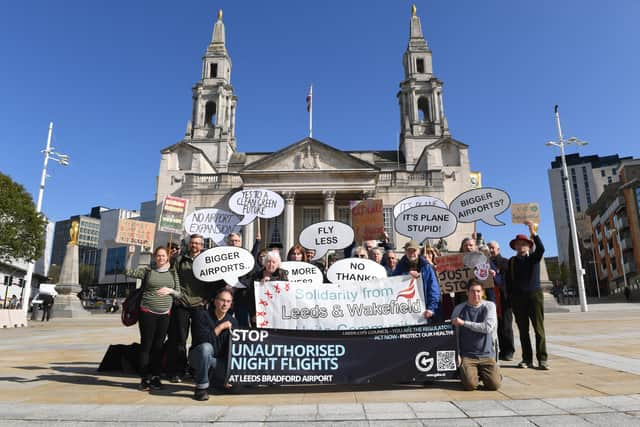
Climate campaigners have reacted to a “mixed decision” on the future of Leeds Bradford Airport’s night flights restrictions.
The Group for Action on Leeds Bradford Airport (GALBA) say they are pleased that Leeds City Council has ruled that Leeds Bradford Airport cannot fly an unlimited number of planes at night. This is the result of the council’s decision to award a Certificate of Lawful Existing Use or Development (CLEUD) to the airport.
However, the climate campaigners say they strongly disagree with the City Council's view that LBA is allowed to fly an additional 941 planes per year at night.
Urging them to reconsider that part of the ruling, GALBA has sent a legal letter to the council and is exploring options to potentially challenge the ruling.

“Obviously, it’s disappointing that the council has allowed the CLEUD but it’s a mixed decision,” said Nick Hodgkinson, Chair of GALBA. “The good news is that they did not allow unlimited night time flying at LBA. That’s what the airport wanted and they failed.
“However, the council has allowed the airport to fly an additional 941 planes at night every year. We believe that part of the decision is legally incorrect and our lawyers have written to the council today, asking them to put it right.
“In practice, LBA will try to fly all of those additional planes during the summer months, causing a big increase in noise and pollution. That would be bad news for local people, the air we breathe and the climate we all depend on.”
GALBA has called into question Leeds City Council’s interpretation of the way that planning conditions 6 and 7 work after receiving updated legal advice.
Condition 6 lists all the types of aircraft that are lawfully allowed to fly at night. The council’s decision has ruled that the aircraft covered by the CLEUD are now lawfully allowed to fly at night, and therefore they are part of Condition 6.
Meanwhile, Condition 7 places limits on the total number of night flights that can be made by all the types of aircraft listed in Condition 6. The limits are 2,800 in summer and 1,200 in winter. These limits apply to all the aircraft covered by Condition 6, including those now approved by the CLEUD.
Leeds City Council approved and confirmed as lawful up to 941 additional night‑time aircraft movements per year by quieter aircraft, a figure which is in line with movement numbers previously operated by the airport.
A spokesperson for the local authority explained: “The council, acting as the local planning authority for Leeds, has determined a CLEUD application submitted by Leeds Bradford Airport. This provides increased clarity on the airport’s operation regarding night-time flight numbers, which we are aware is a matter of local interest.
“Leeds Bradford Airport had asked the council to confirm that unlimited flights by these quieter aircraft during the night‑time were lawful. The council did not agree to this.
“The 941 newly confirmed movements are in addition to the existing limits on night‑time flights at the airport, which were established in a 2007 planning permission and are capped at 2,800 movements during British Summer Time and 1,200 during the winter season. Any additional night-time movements above the 941 figure will count towards these caps.”
The CLEUD application, which seeked to establish the lawfulness of take-offs and landings at the airport at night by certain types of aircraft, was determined following a formal call for evidence by Leeds City Council.
All flight data submitted by third parties was independently verified by the council and external sources. It is based on UK planning law and an assessment of the airport’s flight records over a 10-year period.
Under a condition of Leeds Bradford Airport’s planning permission in 2007, the night-time period is defined as running between 11pm and 7am each night. Any aircraft movements above the total capped movements would constitute a breach of planning permission and could be subject to enforcement action.
As part of the CLUED outcome, it was confirmed that the Yeadon-based airport did not breach the movement limits governing night flights during the 2023, 2024, and 2025 periods.
A spokesperson for Leeds Bradford Airport said: “We are pleased with the decision by Leeds City Council, which confirms our long-held position that LBA has operated responsibly and in full compliance with night flight regulations over the last three years. This decision provides much-needed certainty for our partners, our passengers, and the local community.
“LBA remains committed to being a responsible neighbour while continuing to serve as a vital economic gateway for the region.
“We look forward to continuing our constructive work with Leeds City Council to develop a sustainable long-term framework for flights that balances the region’s connectivity needs with our environmental and local commitments.”
It comes as LBA has embarked on LBA:REGEN, its most transformative period in decades including a fundamental transformation and extension of the terminal building and the launch of its new Together for Tomorrow sustainability strategy.
As part of its Together for Tomorrow strategy, LBA continues to work with airlines to deploy the latest generation of quieter, more fuel-efficient aircraft as part of its ongoing effort to modernise operations and reduce the noise footprint of its flight schedule.
City Council previously issued the airport with an enforcement notice in September 2024 after they were found to have breached noise rules. Two of three subsequent appeals were dismissed.