
'We want our pavements back': How introduction of floating bus stops has impacted blind people in Leeds

‘It’s introduced another layer of risk’
The visually-impaired community in Leeds are campaigning to get their pavements back after the introduction of floating bus stops.
Unlike at traditional stops, a floating bus stop requires passengers to cross a live bike lane either to get to the stop itself or board the bus.
While designed to protect cyclists from general traffic, critics argue that the layout creates a daily hazard for vulnerable pedestrians attempting to board or leave the city’s buses.
Speaking to the Yorkshire Evening Post, Iain Mitchell, who runs sight loss councils across Yorkshire for the Thomas Pocklington Trust, said the introduction has created an added risk for already vulnerable pedestrians.
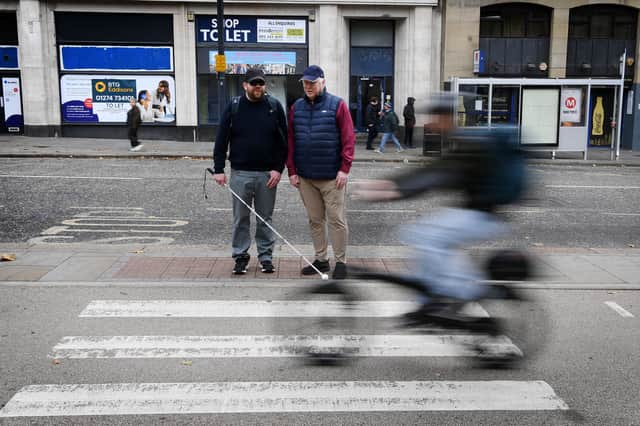

“It erodes peoples confidence in their ability to get around,” he said. “It will make some people think twice about going out and it’s just introduced another layer of risk that people have to plan to get around when they go out.
“It isolates people from sometimes even wanting to go out and stops them navigating their streets, their roads and their cities the way that they used to be able to.”
The Thomas Pocklington Trust is a national charity which supports blind and partially-sighted people and has long stood opposed to the new infrastructure.
Research carried out by the Trust has found that most cyclists do not stop, even if a zebra crossing is included in the design.
For Calum McCready, who walks with the use of a white cane, these types of stops have added “another obstacle” for the visually-impaired to navigate.
“It brings stress and anxiety, or it might make you not go and isolation is a big issue for people with disabilities,” Calum explained.
“It’s hard enough to get out and about when you are visually-impaired so adding another obstacle into the mix just makes it harder. We just want our pavements back.”
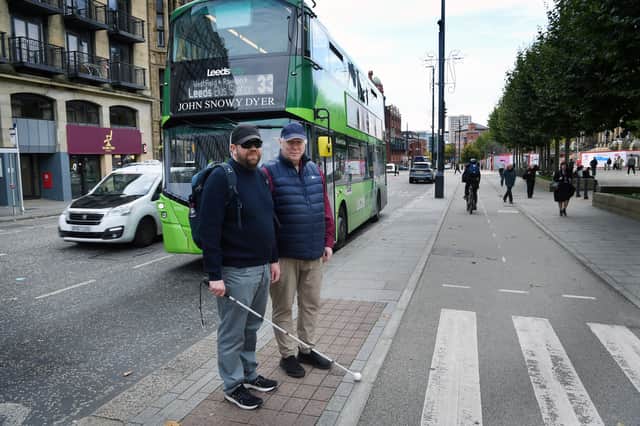
According to Leeds City Council, there are around 131 floating bus stops across the council area, including outside the Leeds Art Gallery on the Headrow.
The local authority has been working with the Thomas Pocklington Trust and is currently making alterations to three of the recently installed stops on the A660 in Headingley, after getting feedback from road users.
Changes include narrowing the cycle path through to the bus stop, and giving pedestrians priority to cross the path.
A spokesperson said: “Leeds City Council commissioned Wheels for Wellbeing and the Sight Loss Council (Pocklington Trust) to independently review how cycling infrastructure around bus stops affects disabled people and consider whether alternative or improved designs could address these concerns.
“The work has strengthened understanding of the different needs of disabled people, particularly the challenges faced by blind and partially sighted bus passengers and the importance of safe, accessible cycling infrastructure for people using adapted cycles and mobility equipment.
“The findings will build on existing knowledge and help shape the council’s approach to future schemes together with the latest national guidance as well as emerging technologies.”
For people who are blind or partially-sighted, the new infrastructure has presented particular problems because they are unable to see whether cyclists are approaching. Traffic and other street noise means also means that it is difficult or impossible to hear cyclists.
In November 2025, then minister for roads and buses, Wakefield and Rothwell MP Simon Lightwood, wrote to all local authorities in England asking them to pause the installation of floating bus stop designs which require passengers to board directly from or into a cycle track.
This pause is still in place and the Department for Transport said where these designs are already installed, new guidance should be used to make adjustments to them.
“There will be people that plan their trips in order to avoid stops like this because they don’t feel confident in the environment and what’s around them,” Iain added.
“Cyclists have as much right to be safe as everyone else, we just want the pavements to maintain their status of being dedicated to pedestrians.”