
'He’ll be a life-changer': Behind the scenes with the puppy fosterers raising Guide Dogs to transform lives
Michael the golden retriever is easy-going, sociable, and very adorable. At first glance, the five-month-old pup looks just like any other young dog. But Michael is slightly different. Why? Well he’s training to become a guide dog.
Judith and Andrew Pike, a retired couple from Apperley Bridge, first took in Michael at just over seven weeks old as they became ‘puppy raisers’ with the Guide Dogs charity. In this role, they’ll help Michael gain the foundational training to one day become an assistance dog for someone with a vision impairment.
Since 1931, there have been more than 31,000 guide dog partnerships in the UK. A guide dog, who is often a golden retriever or a labrador, can help someone with a vision impairment gain more independence by acting as a mobility aid and helping them navigate the world around them.
Judith and Andrew were inspired to become puppy raisers after seeing how a guide dog transformed the life of a close relative.
Judith said: “We have a relative who is fully blind. She’s 20 and she got a guide dog when she was 15 and he has transformed her life.
“She’s now at university living her best life and what he’s done for her is fantastic.”
To train Michael, Judith and Andrew take him to monthly group classes, and follow guidance from a training manual. Their goal isn’t to teach Michael classic dog tricks such as how to high five or roll over, but rather to teach him practical skills and behaviours that will help work as a guide dog including walking to the side of the owner, keeping focused in busy environments, and toileting on command.
Andrew said: “You start with the guide dog puppy raising manual from the minute the puppy arrives.
“You have to set very clear rules and boundaries which you might obviously choose to do some of those things with a pet dog but with a guide dog they’re compulsory.”
Like Judith and Andrew, Rosemary and Geoff Heslop from Shadwell also are puppy raisers They are currently looking after fellow golden retriever and future guide dog Waldo who at nine-months-old, is in his “teenage years” and very cheeky and excitable. It’s a stage familiar to Rosemary and Geoff as Waldo isn’t their first guide dog, he’s their tenth.
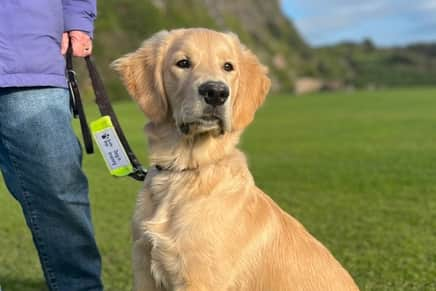

Geoff said: “Waldo is our tenth puppy and we’ve been doing this for about 13 or 14 years.”
Rosemary added: “My mum went blind later on in life, so when we retired we wanted to do a little bit more than just giving money.
“We decided we’d do one puppy and see if we like it but it’s very addictive.”
When you become a puppy raiser, Guide Dogs are on hand to provide support and advice. One way they do this is by connecting each puppy raising household to a Puppy Development Advisor (PDA), to support them through the training process.
Judith said: “We have a PDA and she visits regularly and makes sure that we’re on track.
“She’s always got the time for you and you never feel that she’s rushing off to her next appointment.”

Andrew added: “Having a guide dog puppy to raise is both harder and easier than having a pet puppy. It’s harder in the sense that you’ve got more rules and a manual to follow but it’s easier in the sense that you get a huge amount of support.”
Judith, Andrew, Rosemary and Geoff, are part of a network of local puppy raisers and both feel they have made friends for life through this.

When a Guide Dog puppy is aged between 12 and 16 months, they will move on to their next stage of training and leave their original puppy raising family. Both couples said that though this is the toughest part of the puppy raising process, they are happy that it means their dog will one day become a guide dog.
Judith said: “Obviously we will be sad to see him go as we’ve got a strong bond with him already, but knowing he’s moving on to something better is something we’ll cope with.”
Andrew added: “We’ll be very happy to see him go on to the next stage and hopefully become a life-changer for someone.”
Meanwhile Geoff said: “The day the puppy leaves is the worst day of the 12 months or so you have the dog but that’s what you're signing up for.”
When a guide dog puppy is aged between 12-16 months, they’ll move to a specialised training centre to further build their skills before they are matched with a vision impaired owner.
After six months of bonding time, the new owner can choose to make contact with their guide dog’s puppy raisers. This has led Rosemary and Geoff to meeting up with some of the puppies they raised in later life. A particularly fond memory is when they reunited with Crumble a few years after she’d become a buddy dog to support a child with a visual impairment and their family.
Rosemary said: “We were fortunate enough to meet the lovely buddy family who were amazing but (Crumble) has not seen us for five years.
“She was sniffing around and then she suddenly recognised who we were. The family said she acted like a puppy again because that’s her memories of us.”
Puppy raising has also led to a permanent edition in Rosemary and Geoff’s home, nine-year-old Magic. Magic was initially trained to become a guide dog but was unable to fulfil the role due to his sensitive nature. Now, he acts as a positive role model to the puppies Rosemary and Geoff take in.
Becoming puppy raisers has brought companionship, community, and lots of cuddles to Rosemary, Geoff, Judith, and Andrew’s lives. Though puppy raising can be difficult at times, knowing the difference a guide dog will make to someone’s life motivates both couples to keep puppy raising.
Andrew said: “You get all the tremendous benefits that you get from having a pet dog but with him as a guide dog I get a huge amount of satisfaction from seeing him make progress and seeing him be so confident, calm, and happy.”
Rosemary said: “You need time, you need patience and you need to be realistic because you’re getting a puppy.
“It has the label ‘guide dog’ but you’re getting a puppy and it is going to be a puppy.
“You need to be realistic but it is a really enjoyable role and you get loads out of it: your interactions with the dogs, your interactions with the rest of the organisation, your interactions with the general public, and a really good feeling about giving someone their independence.”