
Why it took me so long to buy an oscillating multitool – now I use it for almost every DIY job


This article contains affiliate links. We may earn a small commission on items purchased through this article, but that does not affect our editorial judgement.
I’d ignored oscillating multitools for years, assuming they were a specialist trade tool. After finally buying one, it’s become the most useful piece of DIY kit I own
Why did it take me so long to buy a multitool?
That was the question I kept asking myself after spending a few hours with the WORKPRO 300W Oscillating Multi-Tool. It has already ticked off jobs that had been sitting on my household to-do list for months, and I genuinely wish I’d bought one years ago.
One of the interesting things about oscillating multitools is that they’re actually a relatively recent addition to most DIY toolkits. Although the concept dates back to the 1960s, the original design was patented by German company Fein, which first developed the technology as a medical saw capable of cutting through plaster casts without harming patients. It wasn’t until that patent expired around 20 years ago that other manufacturers could enter the market, transforming what had once been a specialist tool into something found in almost every professional tradesperson’s van.
I’d noticed exactly that while watching our kitchen fitter work. Time after time he reached for his multitool instead of a jigsaw, hacksaw or sander. Need to trim a bit of skirting? Multitool. Cut a pipe flush to the wall? Multitool. Remove old adhesive? Multitool. It seemed to solve dozens of awkward little jobs with one machine.
Watching him convinced me to look on Amazon, where I eventually settled on the WORKPRO 300W Oscillating Multi-Tool. I deliberately chose the corded version because I didn’t want to buy into yet another battery ecosystem. Most of my DIY happens within a few metres of a plug socket anyway, so paying extra for cordless convenience simply didn’t seem worthwhile.
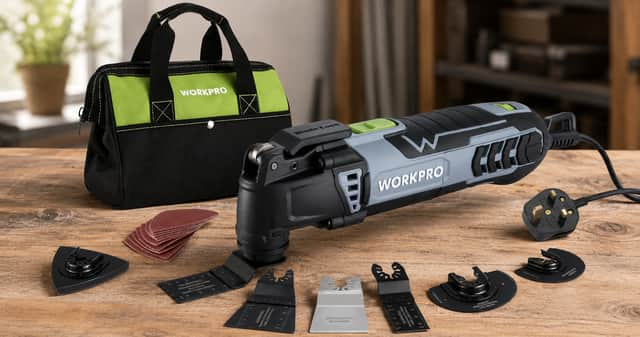
The first job appeared almost immediately after it arrived.
I’ve been meaning to repaint the timber surround around the letterbox at the top of our garden for ages. Using the sanding attachment supplied with the WORKPRO multitool, the old paint disappeared far quicker than I expected and the timber was ready for primer in no time. For somebody whose DIY projects usually take much longer than planned, it felt almost suspiciously easy.
The machine itself took a little getting used to. There’s much more power than you’d expect from something so compact, but it also has a reassuring weight and balance. Once I’d become familiar with the variable speed control, it felt comfortable and easy to guide, particularly for sanding jobs.
Next came a project I’d been avoiding for months.
Several miniature pallets had been sitting behind my shed because I wanted to salvage the timber rather than throw them away. The problem was the dozens of nails buried inside the joints. Rather than splitting the wood trying to prise them apart, I fitted the supplied bi-metal blade to the WORKPRO multitool and simply cut through the fixings. I genuinely wasn’t expecting it to work quite so well. Within minutes I had stacks of reusable battens and plywood instead of a pile of scrap.
I’ve not yet used it for detailed plunge cuts or intricate woodworking, so I can’t honestly compare it with a dedicated jigsaw for precision work. But for the sort of repairs most homeowners actually tackle, from trimming skirting boards to cutting plastic pipework, removing grout or scraping away old sealant, I can already see why so many tradespeople wouldn’t be without one.
There are a couple of things worth mentioning.
The tool isn’t especially light, although that extra weight actually helps keep it stable during use. Because I chose the corded version, you also need to stay aware of where the cable is at all times. The blade oscillates incredibly quickly and it’s obviously important to keep the lead well clear.
If you’re buying your first multitool, I’d also recommend budgeting for a decent pair of safety goggles and some cut-resistant work gloves. Flying splinters, dust and the occasional metal fragment are simply part of the job, and proper protection makes a lot of sense. You may also find yourself picking up a few additional blades to complement the excellent starter kit included with the WORKPRO multitool, depending on the sort of DIY projects you tackle most often.
For me, though, the biggest surprise wasn’t any individual feature. It was just how often I immediately started finding uses for it.
Instead of needing separate tools for sanding, scraping, cutting wood, trimming metal and removing stubborn old adhesive, I now have one machine capable of tackling almost every small snagging job around the house.
I honestly can’t believe I waited this long to buy one.