
'I spend my days holding 100,000-year-old artefacts - and Leeds still finds ways to surprise me'
As part of our Heritage Heroes series we meet the woman tasked with preserving Leeds’ ancient past
Most people can only imagine what it would be like to spend their working days handling objects that are thousands of years old.
For Kat Baxter, it’s all part of the job.
From prehistoric hand axes and Roman jewellery to Anglo-Saxon treasures uncovered in Yorkshire fields, Kat is responsible for preserving and sharing the archaeology of Leeds, helping bring the city’s ancient past to life for modern audiences.
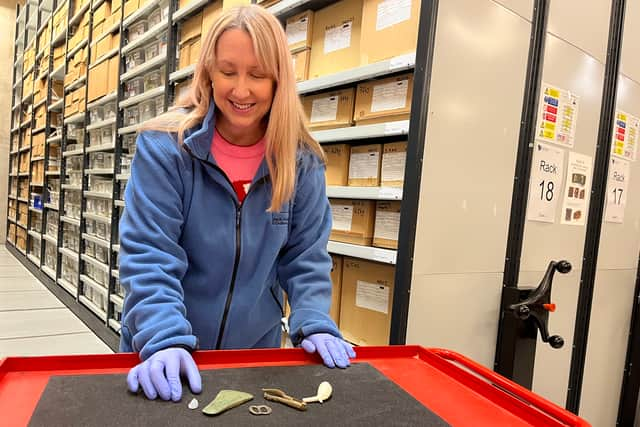
As Leeds Museums and Galleries’ Curator of Archaeology and Numismatics, she cares for around 60,000 artefacts owned by the city, with collections spanning thousands of years of Leeds history.
“I look after basically the archaeology collection belonging to Leeds City Council,” she said.

“The vast majority of the collection I look after is from Leeds, representing the archaeology of Leeds from the earliest people here right up until the 16th century.”
Her role stretches far beyond museum displays, involving everything from cataloguing finds and preserving delicate artefacts to giving talks, curating exhibitions and working with researchers and local communities.
“My job is to physically take care of these artefacts to make sure they’re preserved for the future, but also to share the joy and the interest of these amazing collections,” she said.
“We’ve been collecting for over 200 years as an institution, so you can imagine the backlog is quite large.”
Despite the scale of the work, Kat says it is the constant sense of discovery that keeps the job exciting.
“There’s not a day goes by that I don’t learn something new, which is why I absolutely love this job,” she said.
Her fascination with history began when she was just nine years old during a school trip to Newcastle’s Hancock Museum.
“I remember being nine and just completely in awe of everything that I saw there,” she said.
“I thought the place was completely magical.”
After studying archaeology at Manchester University, Kat initially found herself working in museums almost by accident after taking a temporary position at Manchester Museum.
“It was only when I was actually working there that I realised the variety of work you could do in a museum and I realised I really wanted to be part of it,” she said.
Among the oldest objects in Leeds’ collection are prehistoric hand axes from the Palaeolithic period.
“We’re talking about early humans. They’re at least 100,000 years old, if not older,” said Kat.
But while some artefacts are remarkable because of their age, Kat says she is often most fascinated by ordinary objects connected to everyday people.
“One I was looking at yesterday, which I love, is a little silver ring from the Roman period found in the Leeds area,” she said.
“It has a little carving of what I think is the goddess Fortuna, so it’s all about good luck and good fortune.
“Sometimes when you look at something like that and realise somebody wore that on their finger nearly 2,000 years ago, it gives you that connection to the past.”

She added: “I like objects that connect you to more ordinary people. When you get a glimpse of ordinary lives, I love that.”
Archaeology, Kat says, still has the power to surprise her, even after years in the industry.
“One of the most surprising days of my career was opening an email from our local Finds Liaison Officer,” she said.
“He’d sent me a picture of something found by a metal detectorist and I nearly fell off my chair.”
The discovery turned out to be part of the West Yorkshire Hoard, a collection of high-status Anglo-Saxon objects now displayed at Leeds City Museum.
“That’s the brilliant thing about archaeology,” she said.
“You have no idea what’s going to be found next.”
Recent excavations linked to the East Leeds Orbital Route have also produced finds spanning thousands of years of local history.
“There were objects representing different periods of time all along the same stretch of land,” Kat said.
“The oldest was a Neolithic arrowhead from around 6,000 years ago, but there were also things like a pair of nutcrackers from the 1700s and a clay pipe bowl from the late 1800s.
“It’s this amazing snapshot of life through time.”
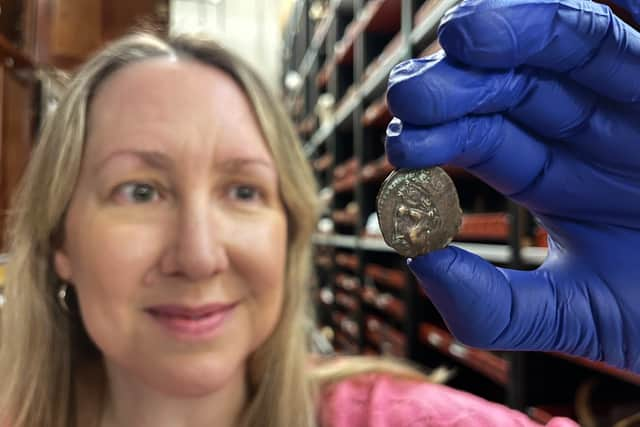
One particularly unusual object even made national headlines - a 2,000-year-old Punic coin minted in Cadiz, Spain, which somehow ended up being used as bus fare on a Leeds bus during the 1960s.
“How did that coin end up being spent as somebody’s bus fare in Leeds after 2,000 years?” Kat said. “It’s amazing.”
While nearby York is often viewed as Yorkshire’s archaeological capital, Kat believes Leeds has an extraordinary history of its own.
“I think people are surprised at how much archaeology there is right here in Leeds,” she said.
“We’re lucky to have places like Kirkstall Abbey and fantastic archaeology collections in our museums.
“Even though we’re sometimes overshadowed by places like York, there’s so much heritage here.”
For Kat, preserving archaeology is ultimately about preserving human stories.
“These objects are a tangible connection to the people who’ve gone before us,” she said.
“Whether it’s 200 years ago or 4,000 years ago, there’s nothing quite like that connection to the past.”