
Reflections of Leeds on market day in 1872

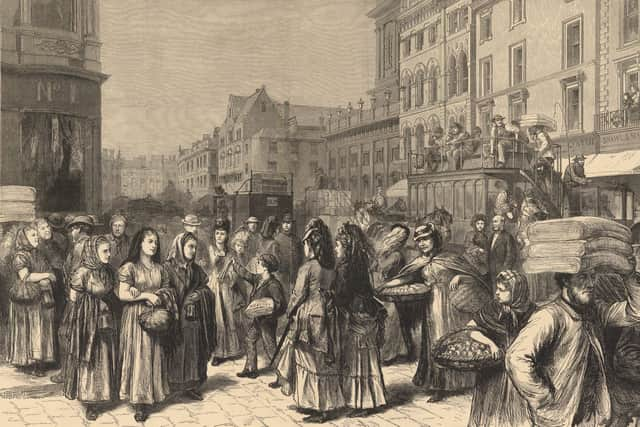
This intriguing artist's impression shows Leeds on a market day in 1872.
It brings into focus the hustle and bustle shoppers of Boar Lane, centre, at the junction with Briggate.
It is taken from a supplement to The Graphic and is dated September 21, 1872.
Prior to 1867, Boar Lane was a narrow street, measuring only 21 ft (approx. 6.5 metres) but between that date and 1869 it underwent a major improvement scheme including the widening of the road to 66 feet (just over 20 metres), involving the demolition of buildings on the south side.

New buildings were designed by Thomas Ambler and the scheme cost £60,000.
The area at this time was frequented by the middle classes who preferred to shop here rather than the other Leeds markets - note the well-dressed ladies in the foreground.
Boar Lane had a choice of fashionable shops as well as provisions and grocery stores. In 1872, numbers 8 and 9, located opposite Holy Trinity Church, were occupied by George Newby, Fishmonger and Gamedealer & Co.
Eventually, these premises were taken over by Richard Boston's Great Fruit, Game and Fish Market.
The Waddington's Guide to Leeds' of 1894 wrote: "The sight of Mr. Boston's stock is enough to shorten an epicure's breath and give an appetite to the most dyspeptic. Everyday needs and Sybaritic taste are alike provided for. Does the reader seek fish? Here he finds 50 varieties.
”Does he want birds? There is scarcely a wing that flutters in life that may not be found drooping here in it's season. Does he need poultry? Let him ask and he can have. Thirty-six varieties of vegetables, one hundred sorts of fruit, a selection of luxuries too numerous to name and a business-like briskness in attention to the smallest order are within the customer's reach."
Trinity Church is visible in the background, right of centre - where a row of ornamental urns can be seen. The working class women to the left of the picture wear shawls tied around their heads. They are carrying tin cans and two of them hold baskets.
The three women in the foreground each appear to have a length of cloth draped over one arm, and may possibly have been Irish plaid weavers selling their cloth, but this is only conjecture.
The building on the left-hand side is number 1 Boar Lane, John Barran, tailor and outfitter, as listed in the Porter's Directory for 1872, but, next door, at number 2, was the Irish Needlework Society managed by Thomas MacFarlane.
A young boy is selling copies of the Leeds Mercury in the street.
The Leeds Mercury was a newspaper founded in 1718. At the right edge is Charles Pullan's Shawl & Mantle Warehouse at number 73 Boar Lane, situated at the corner with Briggate.