
9 of the best toys you remember playing with, from the 60s to the 90s, including 'rage-inducing' game

Do you remember playing with any of these as a child?
- We asked you to name your favourite childhood toys, and the response was amazing
- It got you reminiscing about much-loved toys from the 60s to the 90s
- Below are some of the best suggestions, from the classics to more obscure items
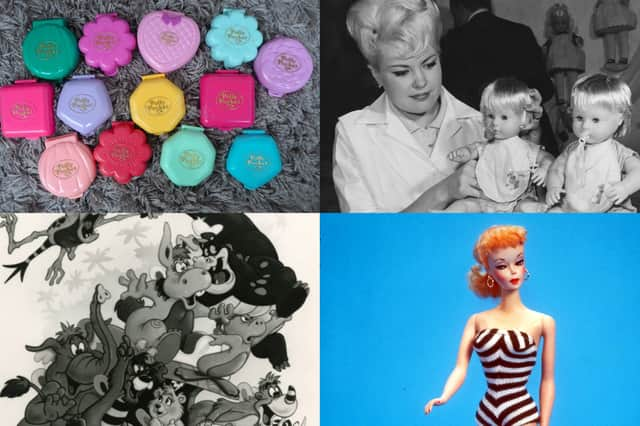

Everyone had a favourite toy growing up, whether that was a doll that never left your side or an action figure you put through the wars.
For many of us, the mere mention of that toy can take us right back to those treasured childhood memories.
Some people have kept those cherished toys and today enjoy watching how much joy they bring their children or grandchildren.
Others would give anything to hold that beloved cuddly toy once more.
We asked you to share your memories of your favourite childhood toys, and the response was great.
Some people named classic toys that remain popular today, while others recalled more obscure ones that were loved in their day but have not stood the test of time.
Below are some of the best suggestions of popular toys from the 60s to the 90s. How many do you remember, and is your favourite among them?
Eleroo from The Wuzzles
The Wuzzles was a short-lived 80s animated children’s TV show about a group of animal hybrid characters, each made up of two different species.
The programme only ran for one series of 13 episodes in 1985, but it retains a place in the hearts of those youngsters who grew up watching it.
The characters, including Bumblelion (half bumblebee, half lion), Butterbear (half butterfly, half bear) and Hoppopotamus (half hippo, half rabbit), were made into cuddly toys, and many people still cherish theirs more than 40 years later.
Kelly Howson is one of them, explaining how she still has her Eleroo, an accident-prone character with the pouch and tail of a kangaroo, and an elephant’s trunk and ears.
Barbie
Barbie has been around for the best part of 70 years and still looks like she hasn’t aged a day since bursting onto the scene in March 1959, though she has changed a little over the years.
Barbie was revolutionary when she launched, as one of the first adult dolls for children, who were able to dress her in the latest fashions.
Mattel has reportedly sold more than half a billion Barbie dolls over the years, and she remains hugely popular, with the Barbie film, poking gentle fun at her empire, proving a big hit in 2023.
Barbie has evolved over the years.
In the 90s, the Teen Talk Barbie was criticised for including the phrase ‘math class is tough’, which was quickly removed from her repertoire.
Mattel appeared to have learned its lesson, and in 2018, it launched a series of Barbie dolls inspired by positive female role models, from the pioneering NASA mathematician Katherine Johnson to the acclaimed artist Frida Kahlo.
Mattel recently launched the first Barbie with autism, while other recent dolls include a blind Barbie and one with Type 1 diabetes.
Polly Pocket
She may be small, standing at around an inch tall, but Polly Pocket has had no shortage of big adventures during her four decades.
First created by Chris Wiggs for his daughter Kate in 1983, with a makeup powder compact as her tiny house, Polly Pocket was not sold until 1989.
Part of her appeal, as one former owner put it, is how ‘you can take her with you wherever you go’.
You can easily carry around the plastic cases, which open up to reveal a playset packed with different features, including friends, animals and tiny accessories.
Polly Pocket has undergone a few changes during her lifetime. She was reimagined in the late 90s as a larger doll, measuring nearly four inches, before being shrunk back down again for her relaunch in 2018.
Slime
Children loved this gooey green slime, first sold in 1976, that came in a plastic rubbish bin and was so satisfying to play with.
But parents hated the stuff, which resembled a giant bogey, got everywhere and could take hours to clear off the carpet.
Simon
This electronic game, putting players’ short-term memory to the test, was launched in 1978.
Simon proved an instant hit, being found in almost every household during the late 70s and 80s, and it remains popular nearly five decades later.
The game, which is a design classic, plays a series of coloured lights and sounds, with users invited to repeat the sequence. It can be played alone or with friends and family.
One person, who played it as a youngster, joked: “My young son found it somewhere. He was proud of his high score, so I took a trip down memory lane and crushed it without much effort.
“I almost spiked the device and did a victory dance. When I was his age, it was rage-inducing. I wanted to pass that memory on.”
The Game of Life
This popular board game dates back to 1860, when it was called The Checkered Game of Life, but the modern version that most people will recognise was launched in 1960.
It achieves the feat of making adulthood sound exciting for children, with players required to traverse the board in their different coloured cars, accumulating pegs as they marry and ‘acquire’ children.
The aim is to reach retirement with as much money as possible. It has introduced generations of youngsters to the idea of climbing the career ladder, taking out insurance policies and investing in stocks and shares.
There have been many changes over the years, of course. In the original version, honesty would lead to happiness, and ‘industry’ to wealth, but ‘intemperance’ would result in poverty, and ‘idleness’ in ‘disgrace’.
In the 90s, the game was tweaked to reward players for good deeds, like recycling or helping those in need, in what felt like a return to its more edifying roots.
Mego Elastic Hulk
Stretch Armstrong, the gel-filled toy that can stretch to nearly five times its original length, was such a hit upon its launch in 1976 that it led to a host of imitations.
Among the most successful of those was Mego’s Elastic Superheroes range, featuring Spider-Man, Superman, Batman and Hulk - the latter of which was probably the most popular.
The catchy advertising jingle went: “You can tie them in a tangle and see how they unwrangle, you can stretch the legs and arms, it won’t do any harm.”
Many youngsters would argue the last part wasn’t strictly true, as it was possible to break the toys so the gel started oozing out.
Some children naturally did this on purpose, being curious about the filling, while others simply put the stretchy characters under too much strain.
One person commented: “My dad had this when he was a kid and he said he stretched the Hulk so hard that jelly came out.”
Another said: “I can still remember how they smelled... and how the arms were always the first part to break.”
And a third person wrote: “I left my stretch Armstrong on a radiator when I was little, I came back to this oozing purple sticky mess. It was like something out of 'The Thing'.”
Family Tree House
This was many children’s favourite childhood toy, including Paula Kynaston, who recalled how ‘it even had a lift in the trunk with little characters’.
The Family Tree House was launched by Kenner in 1975, with Palitoy distributing the European version.
The leafy dome of the tree lifted up to reveal the home inside, which had a living room, a kitchen and a bedroom.
As well as the little figures, the set came with a car, a swing and a dog house, and had a handy carry handle. But it was the working lift that children really loved.
Tiny Tears doll
This doll was named by Hamleys as one of the 100 greatest toys ever made.
It helped spark the craze for ultra-realistic dolls that gave youngsters an insight into the real demands of caring for a baby.
Rational people would argue that one of the best things about owning a doll is how you don’t have to change their nappies or put up with them crying.
But Tiny Tears proved not everyone thought that way. It was marketed as being 'just like a real baby', and it shed tears after being given water from a bottle.
What was your favourite toy growing up, and why? And was there one toy or game that really drove you up the wall?