
Departing Leeds United man's Bielsa and Farke love, unseen dressing room role and stellar stats

Leeds United have said goodbye to a Thorp Arch stalwart who played a big part in this season's stellar stats, touchline angst and the music blaring out of Daniel Farke's dressing room.
Tom Robinson arrived at Leeds United almost 15 years ago as an intern and departs as their Head of Sports Science. Two and a half decades at any club will bring untold levels of change but Leeds United has passed through the hands of several owners and employed 17 different first team managers. A more wholesome way of summing up the length of Robinson's service to Leeds is that he saw academy kids Sam Byram and Alex Cairns go off to have fine careers and return as experienced veterans.
Having graduated from Northumbria University with an undergraduate degree in sport and exercise science, Robinson furthered his studies with a master's in sport and exercise physiology at Leeds Beckett. He saw an advert for an internship at Thorp Arch and did that while living with his parents. Then came a part-time role with the Under-9s to Under-16s delivering warm-ups prior to training and strength sessions. He went full-time as an academy strength and conditioning coach before moving up to work with the Under-18s and then the Under-21s.
"I worked with Neil Sullivan, Neil Redfern, Richard Naylor, Lee Bromby, Jason Blunt, all people like that, and there were a lot of good players there at the time - Alex Mowatt, Kalvin Phillips, Sam Byram and I think Cairnsy was in there as well," Robinson told the YEP. "It was quite cool to be reunited with those boys [in 2024]."
Robinson had started to implement performance processes across the academy when Garry Monk arrived in 2016 with Sean Rush as his fitness coach.
"That's when sports technology started to come into the picture a bit more," said Robinson. "We as a club knew the importance of tracking what the players were doing, having a full gym programme and tracking GPS, heart rates, wellness monitoring. Rushy couldn't do that on his own, so he asked me if I wanted to come into the first team to help him. I joined the first team as a sport scientist."
Ask anyone, staff or player, who moves from academy football to the men's game and they will tell you how big the transition can be. Robinson is no different. "Suddenly, you're at a match day in a big stadium, the sky cameras are everywhere, you're working with men, as opposed to teenagers and young adults, and there's definitely a lot more demand on the role itself, and you probably have to be even better at dealing with personalities and people," he said. "You have to learn fast. You have to understand the people you're talking to and ensure that what you're doing as a practitioner is at a really high level. That's what working for a team like Leeds United demands.
"I think ever since I joined that first team we've always been striving for something like promotion or fighting against relegation, and every season there's been pressure. Dealing with that is a lot different to working in the academy, where it's more about development than necessarily winning a match. You may have ideas of what you want to do, but ultimately it's about what the manager wants to do to win a match."
Robinson mentions the importance of soft skills when working in the men's game. Even without touching on egos, each new manager brings a fresh personality, new staff members and ideas to get used to.
"Some of them are more close to you as staff and players, some keep themselves more distant and they all have their own methodologies, their own personality traits that have allowed them to become football managers and succeed," he said.
"The two standouts are obviously Daniel Farke - these last three years have been incredible, both professionally and just getting to know him - and then obviously Marcelo [Bielsa], with what a unique experience that was. The common theme is the success that they've had, and the football they play, and the memories that they've given all of us as staff, and all the fans. To look back and say I've been a part of those historic teams and historic times is something I'm really proud of."
Countless players have expressed how Bielsa changed the way they thought about the game, and it's no different for staff who worked under him. Robinson recalls a 'presence' carried by the Argentinian.
"There was something special about him and everyone could feel it," he told the YEP. "From day one out on the training pitch you knew this was something none of us had ever experienced, in terms of how he approached the game, how he thought about it, how he approached training, the level of detail, the level of specificity, both from a technical and tactical perspective, also even from a physical perspective. That's something that I have carried into my practice since, that detail.
"He would do specific positional work with the players. Defenders would train often together and do certain exercises, attackers would do certain exercises, and he would demand from us, as fitness staff, that in warm-ups certain movements were prioritised that linked to how the players would move in matches and would link to the movements he was going to train in the training session.
"Just linking the whole picture of physical, technical, tactical was really at a high level. His preparation for the matches was always based on what type of opponent we were going to face. What physical profile did the opponent have? Were they a fast team? Did they have fast wingers? Did they have physical strikers? Did they have big centre-backs? Did they have mobile midfielders? And how would that then impact potentially team selection from him and the physical output that was going to be required of the players in that specific match."
Bielsa's intensity is often referenced by those who lived through murderball to tell the tale. For Robinson it played out in a similar way off the pitch. "Obviously as staff you're in before the players arrive and you're in for a long time after the players leave, and because of the level of detail he wanted to go into, certainly from a sports science perspective, there was a lot of extra work that he wanted to be done to ensure that the players were performing at their maximum, and that he had all the information he required to prepare the team for the next game.
"That added a new element to my role of accessing physical data from tracking systems. I had to come up with a way of translating physical data into something that meant something to him. I had to find out who were the fastest players around the Premier League, the teams that ran the most in or out of possession and just to give him every single ounce of detail on what we were about to face in the next match. That added a lot to my workload on top of managing injury incidents, preventing injuries and improving physical performance. It was intense, they were long days, but we were all just so committed to being part finally getting Leeds promoted back to the Premier League that everyone was just all in on it, players and staff."
For all the long days in front of laptops there are unforgettable days in stadiums across the country. Robinson recalls the Boxing Day comeback to beat Blackburn Rovers when his Rovers-supporting mate was in the ground after giving him stick all week.
"That was a sweet one," he said. "The Christmas period is always really intense as well, you're away from your families, working a lot, and to get a win over the line in that fashion was just incredible. Countless games have been amazing. The Plymouth game, to seal the title with 100 points in the last minute. I think it kind of summed up that whole season of just fighting till the end and never giving up and staying true to how we wanted to play. What a feeling that was, just relief and joy that we'd finally done it, because to win the title was really important. It really sent out a message and a statement to everyone. We're really proud of that."
There are other perks that those working outside of football can only imagine. During the 2022 World Cup break Leeds travelled out to a training camp in Spain and Robinson was seen defending and attacking set-pieces alongside fellow staff members, against Jesse Marsch's first-team players. On recent matchdays he has been spotted controlling Lucas Perri's kicks and volleying them back with technique that has had the Brazilian keeper applauding.
"It's probably something you take for granted actually, working day in, day out with the players," he said. "I used to play football, as most of the staff did, at amateur level, and to actually then be doing it on the best pitches with the best players and the Premier League balls is amazing. I think the players appreciate that there's people around that have played football, that can play football to a certain level, and it almost gives you a bit of common ground. There's a few instances where you're kicking the ball with someone in a warm-up, or you're playing balls to people, and you go home and think 'that's pretty cool' but it just becomes the norm. I've enjoyed kicking balls with Lucas Perri - good technique, and you're both trying to give different types of passes and different first touches."
Being part of the first-team set-up has put Robinson in and around technical areas and tunnels, where emotions so often boil over. More often than not if there's something going on between the two benches, Robinson has been one of the first on the scene. To the best of his knowledge he has never been yellow carded for his involvement in various spats, but puts that down to a technicality because he's not named on the bench.
"I think from playing football and being a Leeds United fan, it just kind of comes out," he said. "You're just desperate to do everything you can to support the team, and to see the team win, and if you feel there's an injustice I do find it hard to stop myself from getting involved. A lot of other teams do it in different ways, and you almost don't want them to gain advantage over you. Sometimes it maybe does boil over a bit too much, but I think that's the release and the adrenaline of being involved in a football match."
Another of his unofficial duties is matchday dressing room DJ. Robinson has been in charge of the music that players hear before and after games. Earlier this season when Leeds travelled to Old Trafford his playlist just happened to be pumping out Marching on Together with the away dressing room door wide open as the Manchester United players arrived. "I don't know how that happened," he deadpans. North London Forever was heard at Tottenham Hotspur Stadium. Twice.
"When Daniel Farke came in, his coaching staff said to me he understands the value of good music in the dressing room, and when he says good, I don't think he was specific around what that meant. It's just about the vibe and the energy and the atmosphere that good music creates in the dressing room. I think it was a pre-season game, I did it once, and the manager just gave me a thumbs up and then his coaching staff came to me and said 'well you've got to keep doing it now,' so it just kind of worked in that way. You keep an ear out to what the players are listening to. The manager sometimes puts music on if he's in the gym, so you keep an ear out to what he's listening to, and then from there you just create something that kind of keeps everyone happy. There's a bit of house music, there's a bit of hip hop, there's a bit of RnB, there's current songs, there's old songs, there's sing-along songs, there's up-tempo songs. I just create a new playlist for each match and see how it goes, and if there's games that we've lost, maybe the songs that were in that playlist never get played again."
One of his picks - Gerry Cinnamon's Canter - became a dressing room anthem. It was first played after the away draw at Luton before a run of six wins en route to the title. The players, the Welsh contingent especially, quickly adopted it as a sing-song favourite. Since then captain Ethan Ampadu and the 2025/26 team have played, trained and sung their way into a special place in Robinson's heart.
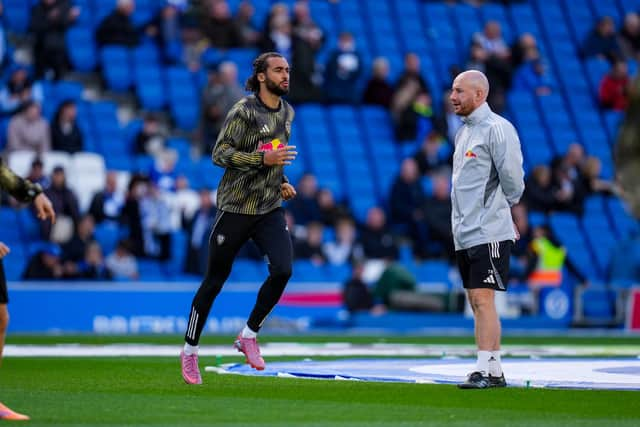

"There's been amazing groups in the whole time I've been in the first team, but I must admit this is a really special group," he said. "The way they play for each other, the way they dig in, the way they run, the way they fight to the end. There's no egos, they're all in it together, they're all trying to do the best for the club, themselves, the staff. I think that's testament to the recruitment guys, bringing these characters in and the manager for the way he's built that group and kept everyone motivated and together. I think they'll keep taking us far because that's a really hard thing to find. Once you've got it, you need to keep it together."
Looking back on all the players he's worked with Robinson finds it hard to pick out special individuals but there's pride in watching those who have departed Thorp Arch doing well elsewhere. He does however single out Alex Mowatt's dedication to addressing initial physical limitations and going on to captain Championship sides, and Kalvin Phillips' change in approach to his physique and nutrition before his 'amazing' achievements.
There's also a huge measure of pride in the way he talks about his final season, one that saw Leeds stay in the Premier League. Over the last couple of years his department has grown to include head of nutrition Elise McVicar, lead Strength and conditioning coach Paraskevas Polychronopoulos, first team sports scientist Jack Pullan and first team performance data analyst Ashmeet Anand. He credits them all and Henry McStay's medical department when it comes to the eye-catching 25/26 stats he can reel off, including the 'least days missed through injury' number that went viral not long ago.
"We had 92 per cent training availability and 91 per cent match availability, which is really high in the Premier League," he said. "In terms of physical output, we're top 10. We look at six key physical metrics from the tracking data - total distance, high speed running, high intensity distance, sprint distance, and then the number of efforts you make at high intensity or sprinting. We're top 10 in the Premier League for all of them, second for total distance and fifth for number of high intensity runs."
Robinson created a composite metric combining those six data points and it placed Leeds fourth in the top flight, behind Bournemouth, Brighton and Newcastle. He said: "As a newly-promoted team, to be sat below those three is something we're really proud of, and that is a real team effort. I think over the last three years we've had a year-on-year increase in all six of those metrics. So not only is the injury rate remaining low, performance is actually getting better."
With Leeds in such a good place - not only as a confirmed 2026/27 Premier League participant but in terms of their application of sports science - Robinson recently took the decision to leave the club. He's due to take up a role with sports technology firm Hudl.
"It was very tough," he told the YEP. "I'm fortunate that an opportunity has come that is still in sport, it's still in the realms that I've experienced with Leeds, and in a different way I'll still be helping teams and athletes and clubs improve through the adoption of different sports technologies. Essentially my entire working life has been at Leeds United. It was a hard decision to leave, but I've got a young daughter, I've got a family, I've got a partner who's had to sacrifice just as much as I have, me not being there on weekends, bank holidays, Christmases. It gets tough, but you wouldn't change anything, it has given me amazing experiences and memories and relationships that I've made. I'll be watching them and cheering them on as a fan now and I can't wait."