
Rugby league adopts captain's challenge and axes drop-out penalties as high tackle crackdown put on hold
Captain’s challenge is among new laws being introduced next season, but plans for a further crackdown on high tackles have gone on hold.
A captain’s challenge will be available in all televised matches, including men’s and women’s Super League and both Betfred Challenge Cup competitions in the running game, allowing skippers to refer a range of on-field decisions to the video referee. Teams are permitted only one unsuccessful challenge in each fixture under the system which operated at the 2022 World Cup and is also used in Australia’s NRL.
However, regulations around head contact in men’s and women’s Super League, the Championship and League One will remain as they were in 2024. Contact above the armpit was set to be outlawed from next season, but that now won’t happen following what the RFL say was a “significant reduction in concussive and sub-concussive events in the Betfred Super League in 2024, measured by the widespread use of instrumented mouthguards”.
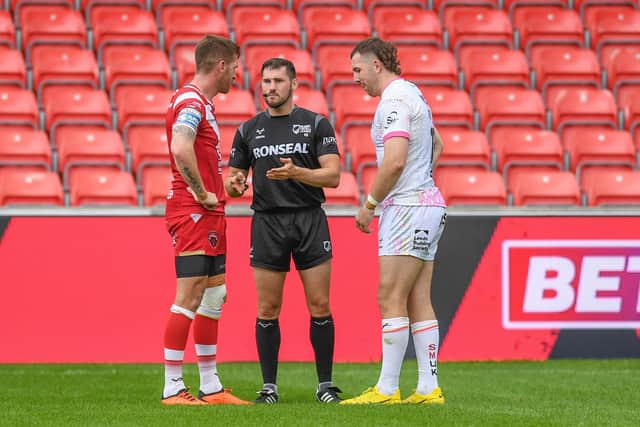

Other rule changes approved by RFL board, on recommendation from the sport’s laws committee, are:
Contested drop-outs. If a team kicks a goalline drop-out into touch on the full, or it fails to travel at least 10 metres forward, play will restart with a play-the-ball 10 metres out from the centre of the goal line, rather than a penalty kick from the centre of the 10 metre line.
Similar offences from 20-metre drop-outs will result in play restarting with a play-the-ball, rather than penalty, from the centre of the 20-metre line. Kicks must be capable of being contested in the opinion of the referee.
Offside kick-chasers. Referees and video officials will now differentiate between active and passive players when awarding penalties for offside. An active player is defined as one who takes part in and/or influenced the course of the game. A passive player is one who does not influence the course of the game.
Green Card. Now applies to attacking players as well as defending players.