
Is Die Hard a Christmas film? Why I make the same arguments every year - including this one

Every year, I find myself having a contentious debate about one particular film and its placement as a festive favourite: Die Hard.
I have spent years—decades, in fact—deconstructing the cinematic DNA of John McTiernan’s 1988 masterpiece, defending it against the traditionalists who believe a Christmas movie requires a Miracle on 34th Street rather than a shootout on the 30th floor.
After countless viewings and even more debates in pubs, office parties, and family dinners across Yorkshire, I have refined my case to a science, looking at the screenwriting cues (for another year, might I add), the orchestral score, and the thematic parallels that link John McClane to the great holiday heroes of the past.
Once again, at this time of year, I am mounting the barricades and preparing to die on the hill.
Whether you’re a long-time ally who thinks it's a festive feature, or a sceptic who thinks the "setting is just a coincidence," I invite you to put down the eggnog and examine the evidence.
Die Hard is a Christmas film - here’s why
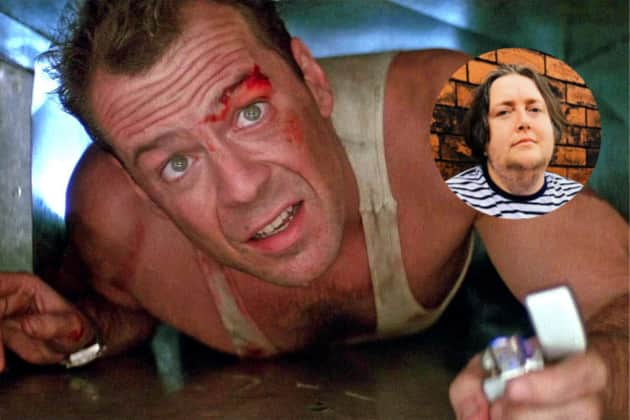

The "Holly" Factor
Let’s start with the basics of character coding. In the world of screenwriting, names are never accidental—they are emotional anchors. The lead female character, the very North Star of John McClane’s journey, is named Holly Gennaro.
In any other month of the year, she’d be Mary, Sarah, or Jennifer. But you don't name your protagonist's emotional motivation "Holly" unless you want the audience’s subconscious constantly vibrating with the imagery of wreaths, berries, and deck-the-halls cheer.
It is a deliberate piece of seasonal branding. If this were a high-octane blockbuster intended for a July release, her name would have been Summer or Sunny. If it were an autumn thriller, she’d be Autumn or Amber. It’s science: the name "Holly" is a festive beacon that tethers the entire plot to December.
It’s about family reconciliation over the festive season
Strip away the tactical gear, the MP5s, and the C4 explosives, and what do you have at the core of the script? It is a quintessential story of a man travelling a great distance to reconcile with his estranged wife and children.
John McClane is the ultimate working-class hero who has spent the year separated from his family by a continent and a career. He isn't in Los Angeles to fight terrorists—he doesn't even know they exist yet.
He is there because it is Christmas Eve, and he is attempting the most relatable festive mission of all: the desperate, last-minute journey home to fix a broken relationship.
This is the exact structural DNA found in The Santa Clause, Home Alone, and approximately 94% of the films currently playing on the Hallmark Channel.
The only difference is that instead of a misunderstanding at a pumpkin patch or a mishap with a magic reindeer, McClane has to navigate a high-rise takeover.
The villain is effectively a Corporate Grinch
Hans Gruber, portrayed with chilling perfection by the late, great Alan Rickman, isn't just a high-stakes thief; he is the ultimate anti-Christmas figure.
While he initially masquerades as a political revolutionary demanding the release of comrades, he eventually admits the truth: he’s just a common thief who happens to be "exceptional." He isn't there to change the world; he’s there for the $640 million in bearer bonds. In short, he is there to steal the "Christmas" out of the Nakatomi vault.
He views the festive season not as a time for goodwill toward men, but as a tactical window of opportunity when security is light, and the targets are distracted by mince pies and holiday cheer.
By targeting the vault, Gruber is making a direct assault on the very concept of the "holiday reward." John McClane, therefore, isn’t just an NYPD cop saving hostages; he is the guardian of the season. He is literally fighting to save the sanctity of the Christmas bonus and the hard-earned prosperity of the workers.
So when Hans eventually falls from the 30th floor—clinging to Holly’s wrist and the stolen wealth—it is the cinematic equivalent of Scrooge being confronted by the Ghost of Christmas Yet to Come.
The soundtrack is more festive than Michael Bublé
If you want to understand the soul of a film, listen to its heartbeat. The Die Hard soundtrack doesn't just feature Christmas music; it is physically constructed out of it.
The film sets its stall out immediately with the opening needle-drop of ‘Christmas in Hollis’ by Run-DMC—a track that instantly grounds the story in the specific, urban energy of a December 24 arrival.
And, of course, it concludes with the definitive safe-at-home warmth of Vaughn Monroe’s ‘Let It Snow! Let It Snow! Let It Snow!’ as the credits roll over a landscape of falling paper.
The Supermarket Test is the final proof here: if you piped the Die Hard score through the speakers of a Tesco or a Sainsbury's on December 23rd, not a single shopper would drop their mince pies in confusion.
The music isn't just accompanying the film; it's certifying it as a holiday staple.
It is literally set at a Christmas office party
Let’s look at the literal geography of the plot. Die Hard doesn't just happen near Christmas; it is physically contained within a Christmas office party. Every plot beat, every character interaction, and every location is dictated by the holiday calendar.
If it weren't Christmas Eve, the Nakatomi building wouldn't be nearly empty, allowing the terrorists to seize control. If it weren't a Christmas party, the hostages wouldn't be gathered in one room, vulnerable and distracted by festive spirits.
The very catalyst for the film's climax—the hidden Beretta taped to McClane’s back—is made possible because he uses seasonal packing tape decorated with festive patterns.
To suggest that the setting is "incidental" is like saying the iceberg in Titanic is just a minor bit of scenery - you cannot remove the holiday from Die Hard without the entire plot collapsing into a heap of logical fallacies.
The reality is that Christmas isn't always about sugar-plum fairies and jingling bells; it’s about the setting, the season, and the struggle. If a film takes place on December 24th and is fuelled by the themes of the holiday, it’s a Christmas movie.
Period.
You might have already missed the yearly screening of Die Hard on free-to-air TV this year, but you can still watch the film on demand and argue the case among family and friends over on the official Channel 4 website until January 4.