
Materials, memory, and gallery mechanics: Leeds’ emerging artists step onto the professional stage

The annual FUAM Graduate Art Prize at the Stanley & Audrey Burton Gallery brings together four distinct practices bound by a shared thread of materiality - giving recent graduates a practical bridge between university studios and the wider art world
For recent art graduates, bringing work out of a university studio and into a formal gallery environment is both a challenge and a revelation.
It falls to freelance curator Court Spencer to stitch these distinct graduate outputs into a unified visual conversation for the Friends of University Art & Music (FUAM) Graduate Art Prize.
"The selection panel chose four beautiful practices - all very distinct, but cohesive through a shared thread of materiality," Court explains. "In a gallery setting, work can feel both familiar yet entirely different to the artist.
“Seeing their pieces in this new context often makes them see their own work through a fresh lens."
Crucially, the exhibition also serves as a hands-on crash course in gallery mechanics before graduates venture out into the professional art world.
"In their degree shows, students could screw straight into studio walls and floors," says Court. "Here, they can't do that. Suddenly they have to refine and finesse, learning what's expected of them from a conservation perspective, environmental monitoring, and protecting gallery spaces."
For Court, the experience builds career readiness that goes far beyond the studio. "It’s about understanding all the different roles across a gallery team - from marketing to curation - and learning how to interact and collaborate professionally.
“It gives them the confidence of having shown in a professional setting, knowing how to build networks, and proving they are the kind of people others want to work with."
Adapting Architecture & Shifting Perspectives: Izzy Cheyne Jones
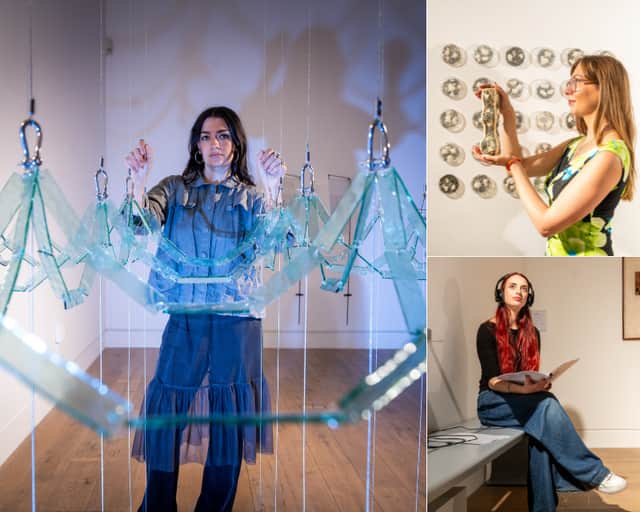

Sculptor Izzy Cheyne Jones experienced that spatial shift first-hand.
Her structural pieces (’The louder the bark, the softer the bite’ and ‘Even in absence there will always be signs’) rely heavily on spatial tension.
Where her degree show allowed for direct drilling into studio concrete, the gallery required a refined approach - incorporating dedicated plinths and tension-fitted elements anchored against ceiling beams.
"My work is almost modular, a bit like IKEA furniture - it comes apart easily and adapts to new environments," Izzy notes.
When asked whether shifting an installation into a completely different environment risks compromising the aesthetic, Izzy views the challenge as a strength rather than a limitation. "There should always be a solution. It might completely change the work, but I think that’s exciting for an audience - it allows them to get a totally different reading from it.
“It looks 100% different, but I’m always open to that."
That shift in context doesn't just alter audience perception; it changes the artist’s relationship with their own work.
As Court observed during installation, presenting a piece in a formal gallery setting can completely reframe it for the creator. "Quite often an artist won't see the potential of a piece while making it in a studio.
"Then, when we present it in an exhibition context, they look at it and say, 'Oh, now I see it the way you were seeing it.'"
Cultivating Ecosystems & Living Materials: Laura Gooch
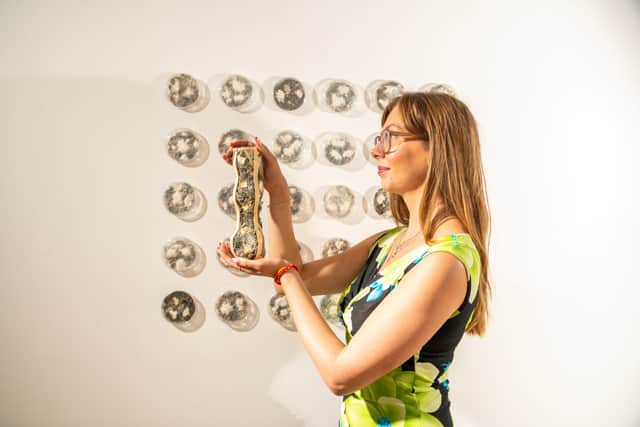
For BA Art & Design graduate Laura Gooch, exhibiting at the Stanley & Audrey Burton Gallery marks her first formal gallery outing - an experience she describes as "incredible and rare" for a fresh graduate.
Laura’s path to bio-design was anything but linear: she originally spent years wanting to be an architect before realising her strengths lay in tactile product design, homeware, and 3D forms.
"I wanted to be an architect for ages until I realised math wasn't my strongest point," Laura laughs. "So I looked at what else I could do that involved drawing and design, particularly product-based stuff - chairs, lighting, homeware, cutlery."
That interest eventually led her to mycelium, the subterranean root network of fungi. "For anyone unfamiliar, mycelium is a branching, sprouting root network that grows under the soil. It supports trees, enriches soil nutrients, and breaks down organic matter on the forest floor.
“It is a vital building block for our whole ecosystem."
Lacking a sterile commercial laboratory, Laura cultivated the organic fibres in controlled temperature setups split across her student studio, bedroom, and workshop.
By integrating the fast-growing fibres with denim, she formed sculpted 3D circular structures.
Weaving Archival Memory & Generations: Melissa Nesbitt
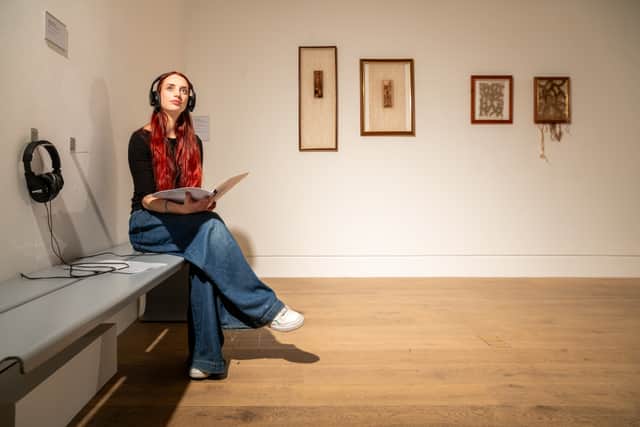
The showcase reaches an emotional high-water mark in Melisa Nesbitt’s multi-part installation (What we lived, what we left).
The project took root during a period of personal crisis when her grandmother’s worsening health brought the imminence of familial loss into sharp focus.
"It made me start thinking about the imminence of loss and prompted me to learn more about my maternal lineage," Melissa explains.
She began recording phone conversations with her grandmother, interviewing her mother, and unearthing 1980s cassette tapes recorded by her uncle that captured her great-grandmother's voice. Combining these recordings with official birth certificates, marriage records, and photos, she traced her family's migration path from Poland to Canada and beyond.
Visually, Nesbit translated this archival research into large-scale textiles woven line-by-line alongside laser-engraved wooden blocks. These wooden inserts feature cropped photographic fragments - a pair of grandparents embracing, or a daughter holding her grandmother’s hand.
"The weaving was a durational piece - I spent hours and hours in the studio working line-by-line down the wall," Melissa reflects. "It started as a very private way for me to process grief and think. But its real impact comes from sharing it.
“Exposing your family history takes vulnerability, but it allows other people to connect with their own memories."
That public resonance was immediate during its initial studio run. "A few friends told me their mothers sat down to listen to the audio track and tears came to their eyes," Melissa adds.
"So much of this is about what it means to be a mother, about loss, and about memory."
The FUAM Graduate Art Prize Exhibition runs until December 19th at the Stanley & Audrey Burton Gallery. Admission is free. Alongside the main panel prize, visitors can cast their vote for the People's Choice Award directly at the gallery front desk.