
'It starts in the locker room': Olympic hero Mark Foster on coming out ahead of Ilkley Lit Fest appearance

This article contains affiliate links. We may earn a small commission on items purchased through this article, but that does not affect our editorial judgement.
Ahead of his appearance at Ilkley Literature Festival, five-time Olympian Mark Foster speaks candidly to the Yorkshire Evening Post about hiding his sexuality in top-tier sport, the importance of locker room culture, and why he's bringing his story to Yorkshire
In modern life, there is a general acceptance when it comes to the LGBTQIA+ community across all walks of life - even in sports, as more active athletes feel empowered to come out not only to the wider public, but to their very own teammates.
"It starts in the locker room," says Olympic icon Mark Foster, who is set to appear at the Ilkley Literature Festival next month to discuss his autobiography, My Double Life.
"Your team is your family. If you can be accepted by your family, it doesn't matter what the outside noise is like, because you've got that love and support from the people you really care about."
For Mark, having that inner sanctuary of peer acceptance is precisely what makes facing the terraces, stands, and public scrutiny tolerable.
When an athlete feels secure with the people they train, travel, and share a room with every day, the outside noise loses its power to disrupt them.
That unity is especially striking given how vastly the sporting climate has shifted since Mark's own peak in the 1970s, 80s, and 90s, when opening up was simply not an option.
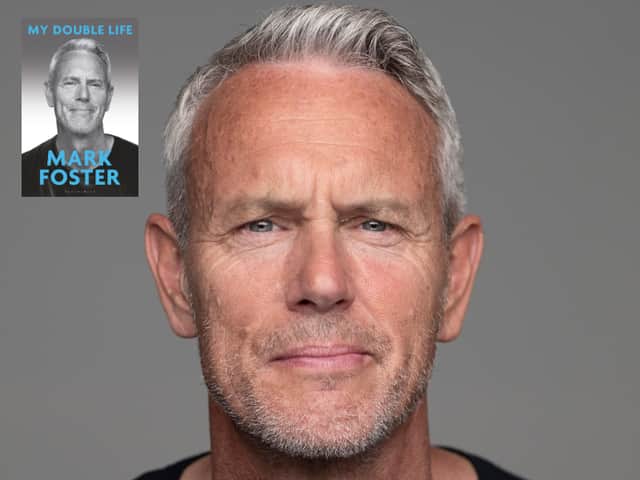

The six-time World Champion and five-time Olympian, who swam for Britain for 23 years, candidly admitted that during his early career, the fear of losing that locker room connection kept him silent.
"From such an early age, the stuff I heard in the playground, on the news, in the changing rooms... whatever I was feeling, I went, 'Well, I can't be that person,'" Mark explained. "So I showed people what they wanted to see. I got very good at being this other version of myself.
"When certain questions arose when we were talking about certain things, I’d then be in my head going, 'All right, get your story ready. You’ve got a girlfriend, her name’s Catherine, she lives in Cambridge...'”
“My big thing when I was lying was just, 'Don't go red.'”
Mark is very quick to point out, though, that he wasn’t a “tortured soul”, but “there were definitely times when I wasn’t just being myself; I was being a version of myself that I thought the world wanted to see."
'Strength in numbers'
Rather than a story of hardship, Mark’s perspective remains vibrant, humorous, and forward-looking.
A major catalyst for coming out publicly in later life was the desire to offer the representation he never had growing up - and to help normalise open conversation in every corner of society.
"I believed in visibility," Mark said. "I thought back to when I was a kid, and there was no one on TV that I went, 'Okay, I’m like that person.' The people I saw who were gay were not like me. I went, 'Where do I fit in? Where’s my tribe?'
"Tom Daley had come out, Gareth Thomas had come out - they were sports people I related to. I thought, strength in numbers. By me standing up a little bit and being a bit more visible, it may help someone on the other side of the world read the book and go, 'It’s okay to be me.'
“Ultimately in life, you just want to be accepted for who you are."
For Mark, that visibility isn't just about headline-grabbing moments - it is about starting simple, human conversations that break down long-held prejudices on a personal level.
"It’s a little bit like a story of someone who lives in a small village or town, and their friend’s daughter comes out as a lesbian. Suddenly, their friends go, 'Oh, lesbians are all right then,' because they actually know her.
“Once there is more visibility, and you have that conversation, it becomes a lot more real."
Despite decades in the spotlight - from breaking world records to competing on Strictly Come Dancing - Mark emphasises that his story is about resilience, humour, and humanity far beyond the pool.
"It’s raw, it’s vulnerable, and it’s definitely not just about my sexuality," Mark added. "It’s the story of a kid growing up in Essex in the 70s and 80s, becoming the fastest 11-year-old on the planet, the highs and lows, the Olympic villages.
“I’m very candid and very open about everything."
Mark Foster will be speaking about My Double Life at the Ilkley Literature Festival on October 10. Full details and booking information can be found via the festival website.