
Real life Riot Women: The story of Coping Saw - and the importance of Ablaze! in Leeds’ DIY music scene

This article contains affiliate links. We may earn a small commission on items purchased through this article, but that does not affect our editorial judgement.
As the first episode of Sally Wainwright’s Riot Women has aired, learn more about Coping Saw - the 90s riot grrrl act from Leeds and their influence
- Sally Wainwright’s new series, Riot Women, focuses on the struggles of middle age, and music as a form of catharsis and belonging.
- They are sentiments that share much in common with the ‘90s riot grrrl movement that the show pays homage to.
- But before Wainwright’s work, there was a group in Leeds that flew the riot grrrl and DIY flag high - Coping Saw.
Interest in the riot grrrl scene might soon be on the rise once again, in part thanks to Sally Wainwright’s latest television series - Riot Women.
Set in Hebden Bridge, the show’s premise sees women navigating the challenges of middle age—such as menopause, ageing parents, and feeling "invisible"—and finding a new sense of purpose and defiance through music. The plot is set in motion when Beth, a character on the verge of giving up, is asked by a friend to start a punk band to compete in a local talent show.
The series is notable for music fans as, as the name suggests, it’s a nod to the movement that was established in the 1990s - a movement which gave these women a powerful outlet for their rage and frustrations.
The music they create, with its raw and unapologetic tone, becomes their way of fighting back against societal expectations and personal struggles. In essence, the show is a "howl of defiance" that celebrates the empowerment and camaraderie of women reclaiming their voices
But it also bears thinking about one such name from the riot grrrl movement, who not only had a band that was formed in Leeds, but also was responsible for early coverage of the movement, the DIY music scene and saw names such as Huggy Bear and Bratmobile among those groups who were championed by the zine in the mid-90s.
This is the importance of Coping Saw, and the even more integral footprint Karren Ablaze! left with the release of Ablaze! during the time period.
Who were Coping Saw?
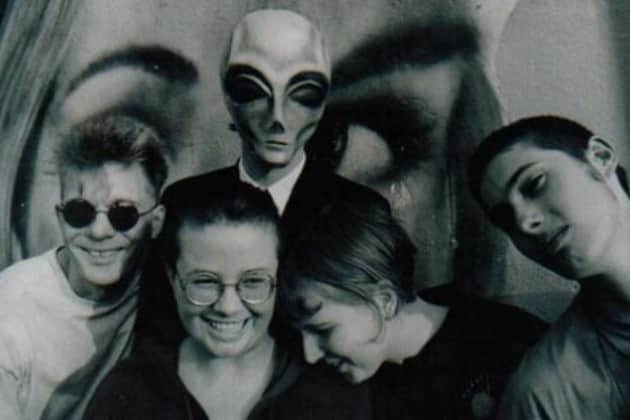

In the mid-1990s, as a tidal wave of feminist punk rock crashed onto the shores of the UK, one band from Leeds stood at the centre of the storm: Coping Saw.
More than just a musical act, they were a visceral expression of the riot grrrl ethos, a furious mash-up of styles and a megaphone for a generation of women who were no longer willing to be pushed to the back - “girls to the front,” to paraphrase from Kathleen Hanna.
Led by the formidable Karren Ablaze!, the band was a true pioneer of the UK’s riot grrrl scene. Ablaze!, a writer, musician, and gig promoter, had been a key figure long before the term "riot grrrl" exploded.
She had been publishing her influential fanzine, Ablaze!, since 1987, a vital lifeline connecting the UK and US underground scenes. When the American bands Bikini Kill and Huggy Bear toured the UK in 1993, a revolution was born. Ablaze! was at the heart of it, promoting their show in Leeds and witnessing a transformation that would change her life and the local music scene forever.
After a decade of being told she couldn't sing or play by men in the music scene, Ablaze! found her voice with Coping Saw.
Their music was a chaotic blend of influences: the raw energy of punk, the complexities of jazz-tinged improvisation, the sharp melodies of pop, the relentless drive of krautrock, and the brutal aggression of all-out punk. This eclectic fusion created a sound that was both "fearsome and genuinely exciting."
Tracks like 'For L' and the frenzied 'Gas Electric' showcased their boundless creativity while works such as album closer, 'Roadblock', were described as an "astounding musical nervous-breakdown," a testament to the band’s passion and emotional extremity.
Coping Saw was an integral part of the riot grrrl "clench" in West Yorkshire, a close-knit community of like-minded bands and artists. Their music and activism resonated deeply, providing a space where anger was a valid form of expression and female friendship was a radical act.
Coping Saw’s recorded legacy, including the single ‘Slamina’ and the albums Outside and Now, captures a moment of unbridled defiance. The music remains as "frenzied and raw" today as it did when it was created, a defining moment of the band's life and greatness.
The band's legacy is tied to its purpose: to show that a girl's voice and vision were worth hearing, on her own terms, without permission from the mainstream.
Coping Saw's brief but brilliant existence proved that feminism in punk was not just a passing trend but a powerful, life-changing force that would inspire a new generation of musicians to follow their lead and create a sound, a space, and a revolution of their very own.
How important was Ablaze! to the UK DIY scene?
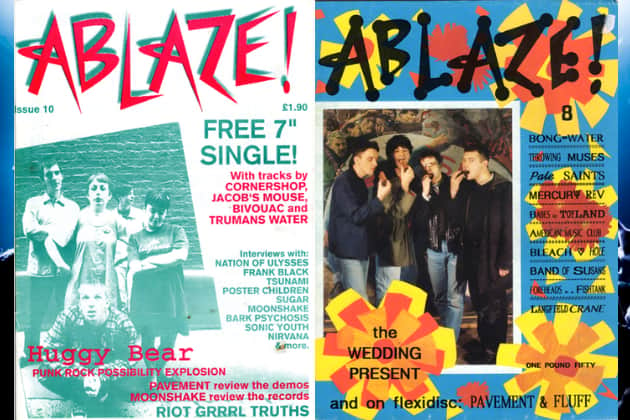
Ablaze! was profoundly important to the UK's DIY scene, serving as a vital communication hub that connected and empowered a new generation of musicians and writers. More than just a fanzine, it was a cultural document and a manifesto that helped to define the ethos of the riot grrrl movement in Britain.
The zine embodied the core principles of DIY culture by being entirely independent and self-produced. Created and edited by Karren Ablaze! from 1987 to 1993, the zine was a deliberate rejection of the mainstream music press, which was seen as a male-dominated and corporate-driven entity.
In her own words, “Ablaze! is a fanzine because we are fanz, fanatics, zealots, extremists, we are wild for stuff we're wild for and that fact can't change, except these passions are so real they have sell-by dates, determined by my own chemistry”
It was an unfiltered platform for raw, passionate, and political commentary, often presented with humour and sharp wit. Ablaze! proved that you didn't need a major record label or a professional publication to be a legitimate voice in the music scene.
Ablaze! was a crucial catalyst for riot grrrl’s spread and development in the UK, with Karren acting as a conduit, publishing riot grrrl manifestos and using her platform to rally like-minded individuals. She openly encouraged women to form their own bands and create their own art, directly challenging the notion that they should just be passive consumers of music.
The zine's content, which included interviews with iconic bands like Nirvana and Hole, treated these artists as equals, not idols, reinforcing the idea of a shared, non-hierarchical community.
Most importantly, in the pre-Internet era, Ablaze! served as a lifeline for a dispersed community. It was a physical network of communication, with readers sending in their own zines, letters, and art.
This fostered a sense of belonging and solidarity, creating a movement that was based on mutual support rather than competition. This “girl love” helped to build a local scene in places like Leeds and Bradford that was self-sustaining and fiercely protective of its artists and fans.
The zine's influence extended beyond its pages, inspiring future generations of musicians and writers to embrace their own DIY traditions, with the 2012 book, The City Is Ablaze!, cementing its legacy, ensuring that the fire it lit continues to burn.
All six episodes of Sally Wainwright’s new series, Riot Women, are available to stream now on BBC iPlayer, or can be watched each Sunday evening on BBC One at 9pm.