
Leeds Discovery Museum experts address common myths and misconceptions as spider season creeps in

Spiders weaving their way into our homes in the coming months are “looking for love” say museum experts in Leeds, who have debunked a number of common myths and misconceptions about the eight-legged invertebrates.
With spiders set to be a much more common site as they come into season, curators at the Leeds Discovery Centre have taken the chance to study their impressive collection of amazing arachnids.
Experts have also provided some insight to put arachnophobes at ease, saying that rather than deliberately encroaching on our houses to give us a scare, the web-making wonders are simply on the hunt for a partner whilst also providing one of the natural world’s most effective forms of pest control.


There are set to be more spiders appearing in homes than usual following an unusually warm year, an expert has previously told the BBC.
The Leeds Discovery Centre is home to a fascinating collection of spiders large and small originating from countries around the world, as well as many examples collected in Yorkshire.
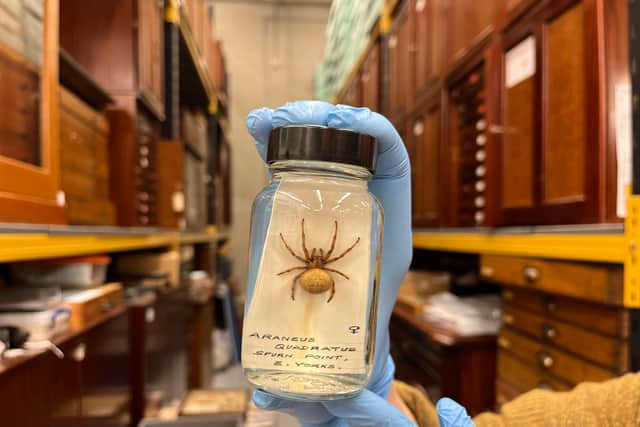
Many of those specimens are preserved in specialised spirit jars filled with powerful ethanol, designed to keep the spiders from drying out and deteriorating over time.
Among the species which make up the collection are numerous examples of the types of spiders currently more likely to be spotted in the home.
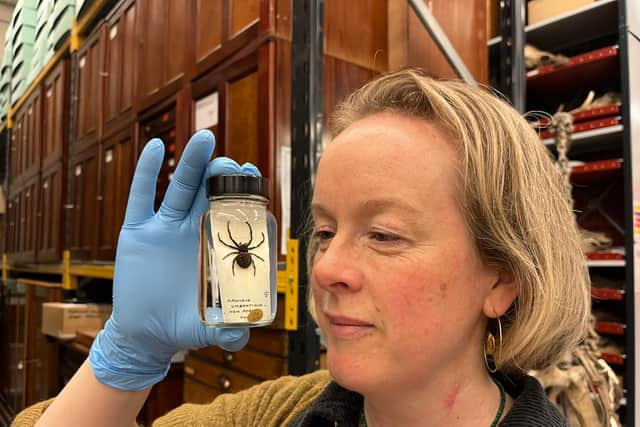
They include common house spiders, known to enter homes through open windows, chimneys or gaps beneath doors, woodlouse spiders, often found in logs or under rocks, a beautiful four-spot orb-weaver found near Spurn Point, and an impressive walnut orb-weaver, a common resident of wooden windows and door frames.
They have been collected alongside huge non-native, tropical spiders which have found their way to Leeds through the importation of fruits and vegetables. They include a large West Indian spider found in 1955, and several huntsman spiders discovered nesting in bananas.
Clare Brown, Leeds Museums and Galleries’ curator of natural sciences, said: “Spiders really are incredible, fascinating creatures and whilst there are countries where it’s sensible to be cautious around them, in the UK they are almost exclusively harmless.
“In fact, spiders are remarkably efficient pest controllers in the home and will eliminate insects which can be much more detrimental like mosquitos and house flies without causing any problems themselves.
“At this time of year, we’re likely to be seeing far more spiders in our houses and homes than usual, and that will usually be the larger males who become more active as they leave their webs in search of a mate. So it’s worth keeping in mind that they’re not there to scare you- they’re just looking for love. Hopefully this might help people see and think about them in a different way.”
Around 700 different species of spider are known to live in Britain, with approximately 109 different types recorded in Leeds alone.
As well as spiders, the Discovery Centre is home to tens of thousands of insect specimens, which are part of its million-strong collection of objects.
Councillor Salma Arif, Leeds City Council’s executive member for adult social care, active lifestyles and culture, said: “Museums like ours can teach us so much about the natural world and really deepen our understanding of the animal kingdom and how our lives intersect with other species we share the planet with.
“We’re fortunate to have such an extensive and impressive collection here in Leeds which captures the extraordinary diversity of nature and gives us the opportunity to learn and be inspired by it.”
Leeds Discovery Centre is open to the public for pre-booked tours and is a Give What You Can museum, where visitors are invited to donate to support the museum if they are able.
Donations can be made when booking a tour online, and with cash and coins in a donation box in reception. For more details please visit the Leeds Discovery Centre website.