
"It wasn’t just a phase": Meet the filmmaker looking to buck the notion that 'goth is dead’ in Leeds

In the neon-soaked history of British subculture, the story of Goth is often told through a very specific, polished lens.
London in the early 1980s, a handful of Top of the Pops appearances, and a swift decline into the bargain bins of history by 1989.
To ‘outsiders’ at the BBC or in the capital, Goth is a museum piece - a relic of hairspray and fishnets kept in a glass case.
But for Teresa Dead, the creative force behind Magic Focus Productions and frontwoman of the Leeds-based dark-electronic band Zeitgeist Zero, is currently working to film a different reality.
Her upcoming documentary, ‘It’s Not Easy Being Strange,’ isn’t just a retrospective but instead a high-decibel proof of life.
From the perspective of the "Northern Powerhouse," the scene didn’t die - it just stopped waiting for London's permission to exist.
Originally from Belfast, Teresa moved to Leeds during the Troubles and found a city with a "big city feel but a small-town community spirit."
More importantly, she found the epicentre of a global movement.


While the world looks to London’s Batcave or the Dracula-inspired cliffs of Whitby, Teresa argues that the true "Gothic Heartland" is, and always has been, Leeds.
"The biggest misconception is that it only happened in London in the 1980s," Teresa explains.
"Leeds doesn’t get the credit it deserves. We are the birthplace of a music genre that has gone across the globe."
While London’s scenes often burn out as fast as they ignite, the Leeds scene was built on a foundation of Northern independence.
Teresa notes that in the North, there is a deep-seated understanding that "no one is going to come up here and help us, so we get on and do our own thing."
This lack of arts funding and mainstream attention forced the scene to become self-sustaining, rather than kill it.
By the time the 90s and 2000s rolled around, years the media considers a "black hole" for alternative culture, Leeds was busy building a permanent infrastructure.
Iconic venues like The Cockpit, The Wendy House, and Le Phonographique became the grounds in the city where the subculture that was evolving and diversifying, while the rest of the country looked away.
Chronicling the "Unrecorded" Years
Because Teresa joined the scene around 2000, she is uniquely positioned to tell the story of the years the history books skipped.
Through her work with Zeitgeist Zero, recently honoured in the Gothic Hall of Fame at Leeds City Museum, she has witnessed the scene’s resilience first-hand.
The film uses a "grassroots" approach, eschewing tired "rock star" interviews in favour of the DJs, promoters, and fans who kept the Northern heart beating.
Teresa is currently unearthing personal archives - unseen photographs and home videos - to show that while the media spotlight moved on, the community only got tighter.
The urgency to film now is fuelled by a desire to stop the "rewriting" of history by online gatekeepers.
"I’ve seen people confidently spouting lies," she says. "One YouTuber argues that women and LGBTQ folk ruined the scene when, in fact, we were the ones there from the beginning.
“If I don’t record these stories now, parts of our musical heritage will be lost forever."
The documentary’s title is a direct retort to the "Goth is dead" narrative often pushed by broadcasters like BBC 6 Music.
Teresa recalls the frustration of hearing former 80s goths call into radio shows to dismiss the culture as a ‘teenage phase’ they outgrew.
"That’s not everyone’s experience," she counters.
"I was at a goth night last week in Leeds and met multiple 'Original Goths' who are still active. Plus, there were lots of 'baby bats' dancing along, side by side. The idea that it’s a dead scene has never made sense to me. To this day, I still play packed festivals."
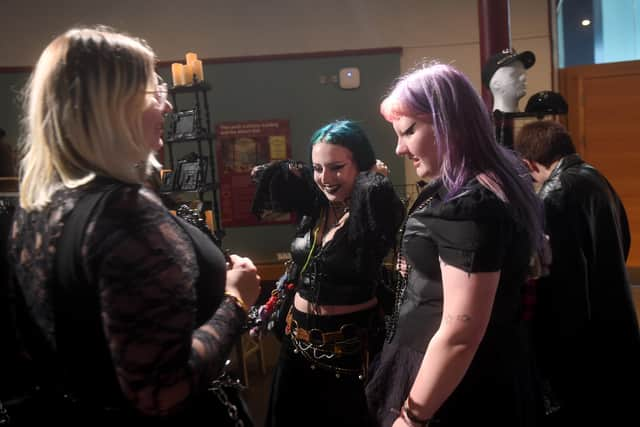
This "living lineage" is what makes the Leeds scene unique. It is a creative, supportive community that acts as a safe space for the neurodivergent and the "outsiders."
How Leeds can help bring the film to life
The film is being produced independently, supported in part by Leeds City Council’s Cultural Investment Programme, but it needs a final push.
A Kickstarter has launched to secure the remaining match funding, and by documenting it now, Teresa is ensuring that the history of the Leeds "Strange" isn't lost to time.
"It continues to live on outside of the media spotlight," Teresa concludes.
"It’s about time someone documented this."