
Century celebrations in Leeds for reporter Eileen
When Eileen Parkin was born, Stanley Baldwin was dealing with the aftermath of the General Strike, England were in the middle of a historic tussle for the Ashes and, in the heavy woollen town of Batley, the milk was delivered twice a day by horse and cart.
"I don’t remember the strike of course," says Eileen, who celebrated her 100th birthday on Tuesday, July 14. "But I do remember the horse and cart and my mother checking the delivery-man hadn’t had the cream off the top."
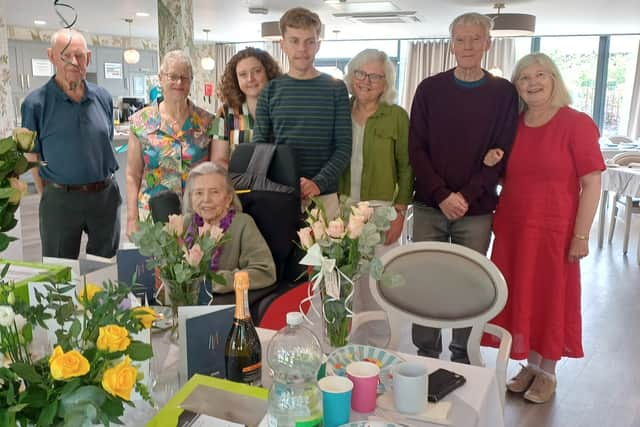

Born Eileen Mary Wood, Eileen lived in Henrietta Street and Anne Street in Batley with her parents and younger sister, Muriel. She attended Warwick Road primary school and Batley girls’ grammar school, leaving at 15 to start work as a reporter on the Batley News.
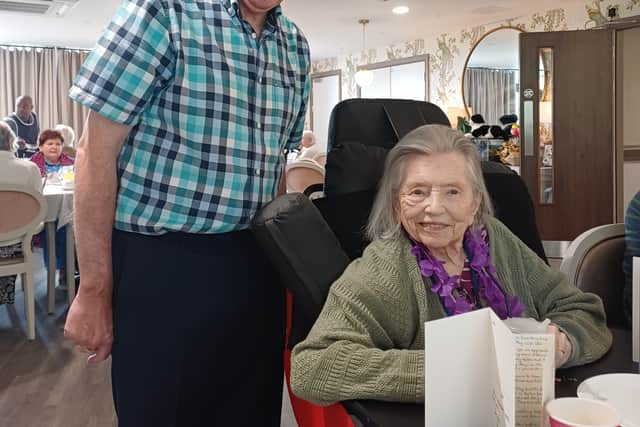
"There was a little path up the side of the parish church to Warwick Road and my best friend, Irene, and I walked hand-in-hand to school that way.
"When we were older, we’d call at the hatch at Fox’s biscuit factory on our way home to buy a bag of broken biscuits," she recalled during her family birthday party this week at Adel Manor care home in Leeds. Irene’s son, Bill Fox, joined Eileen’s family to celebrate her birthday.
It was a family with a long local history. Eileen’s grandfather on her mother’s side, Tom Hanley, was a sign-writer, painter and decorator with premises on Branch Road. Her great-grandmother on her father’s side was a local wise woman in demand for midwifery and laying-out duties in the town as well as for her herbal remedies.
"Some of my schoolmates used to say she was a witch who could see in the dark," Eileen remembers. "But it didn’t stop their parents and grandparents knocking on our door to ask for some of Grandma Purdy’s ointment long after she was dead. We had some stocks for a while."
As a young woman reporter, Eileen was a bit of a rarity, although the paper was then owned by a woman, Miss Gertie Roberts.
In spite of her young age, she remembers being sent to the houses of local people who had died to gather details of their lives.
"I was a bit nervous at first because, in those days, the dead were kept at home for a few days and I’d get there with my notebook and sometimes the family would say: “You’d like to see him, wouldn’t you, love?” Well, I couldn’t say “No, thank you.”
"So, I learned to look round the bedroom door, nod and say how peaceful he looked."
Deaths and occasional golden weddings were staples of local newspapers, as were the courts, where Eileen, with her 140 words per minute Pitman shorthand, became a regular on the press bench.
Another popular, though then rather less frequent, story was a one hundredth birthday.
"You had to ask the old girl, and it usually was an old girl, not an old boy, to what she attributed her long life.
"Sometimes it was never drinking or smoking and sometimes it was doing a lot of both. So you were never really any the wiser.
"I signed the pledge when I was a child. People did then. Not that I’ve ever been a teetotaller, but I suppose I haven’t drunk much at all or ever smoked. I don’t know if that’s part of it, though. Really, you know, you just wake up every morning and go on living. Or not."
Batley then was a town of mills, churches and chapels, the Salvation Army and even a Rugby Union team, for which Eileen’s father, Percy, played while also turning out for the local football team.
There were Easter parades with new bonnets and a regular Sunday-best stroll for young people with an eye to courting.
"That wasn’t all that was happening on Sunday mornings," Eileen says. "We called the Methodist chapel on Commercial Street the Shoddy Temple because a lot of the millowners went there and did their deals on the front steps on the Sabbath."
Her mother, Marjorie, was an amateur soloist for local choirs.
"Her speciality was Handel’s Messiah,’ Eileen says. "But before the talkies, she played the piano for the pictures at the local cinema, coming up with fast stuff for the exciting parts, like trains about to hit someone on the tracks, and slow for the romantic bits. A shilling a time. She wanted to teach me the piano but I wasn’t interested."
In 1950, while she was working on the Harrogate Advertiser, Eileen married another journalist, Leslie Parkin, born in neighbouring Dewsbury, who went on to become chief assistant editor of the Yorkshire Evening Post.
They had first met in 1941when Leslie, another reporter, used to whizz past Eileen and Irene on his pushbike as they walked to Batley girls’ grammar school. They married at Batley Parish Church.
The couple had two daughters, Janet and Jill, and Eileen went back to work on the Wakefield Express series of newspapers, where again her shorthand was in great demand for court and council reporting. Both daughters went into journalism. Leslie died in 2024, at the age of 98.
Eileen has three grandchildren and two great-grandsons. She and Leslie lived for more than 40 years on King Lane in Alwoodley, Leeds, before moving to Wike Ridge, between Shadwell and Alwoodley, when they retired.