
'They think they can't be reached': how organised crime gangs are targeting North Yorkshire farms
International criminal networks are systematically targeting farms across North Yorkshire, stealing hundreds of thousands of pounds of equipment and leaving farming families unable to sleep at night. Officers covering more than 3,200 square miles are struggling to keep pace.
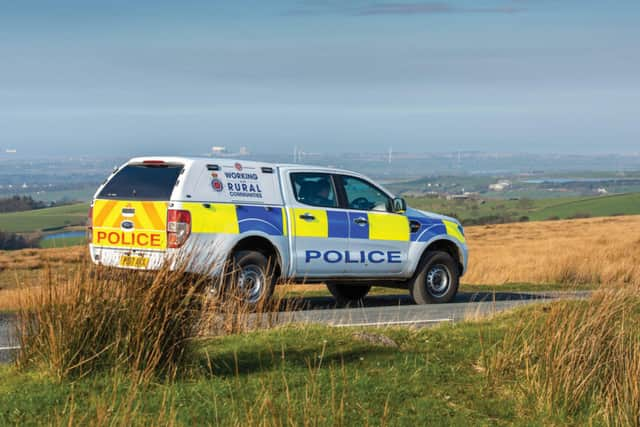
Sergeant David Lund recently tracked a quad bike stolen from a farm in Whitby to a rocky outcrop just outside Middlesbrough, roughly 25 miles away. A police car could not reach the terrain, and Cleveland Police said it did not have an off-road vehicle to send. So Lund pursued the thieves on foot, running up an 800ft peak in the dead of night.

He later showed helicopter footage of the incident. "They've come up there thinking they can't be reached," he said, pointing to the blurry image of three men on his screen. Lund broke cover and sprinted up the hill in pursuit. On that occasion, the quad bike was recovered. "Twenty years in, I still get giddy about catching the bad guy," he said. "It's why I took the job."
The incident is far from isolated. The National Farmers' Union estimated that the overall cost of rural crime across the UK in 2024 was £44.1 million, with tractor thefts alone rising 17 per cent to £1.5 million. North Yorkshire, explicitly identified by law enforcement as one of the country's most heavily targeted rural counties, is bearing a disproportionate share of that burden.
The county's Rural Task Force, which is marking its tenth anniversary this year, polices an area of more than 3,200 square miles, the largest of any force in England, stretching from Selby to just south of Middlesbrough. Officers are based across Scarborough, Malton, Tadcaster, Thirsk, Skipton and Harrogate, meaning a response to a rural crime call can easily take an hour. "When you get up there, it's literally cops and robbers," says Lund.
Inspector Mark Earnshaw, who leads the Rural Task Force, says the gangs are not opportunists. "They are purposefully targeting rural areas because of their vulnerability," he says. "They adapt and they change and sometimes they can move quicker than we can."
Many of the perpetrators have travelled from neighbouring urban centres including Middlesbrough, Stockton-on-Tees, Leeds and Bradford. Two years ago, an organised crime group from Lithuania was active across rural North Yorkshire, specifically targeting tractor GPS units worth up to £20,000 each. "They based themselves in Manchester and then they would go out across the whole of the country," says Andy Huddleston, head of the National Rural Crime Unit. "They would do the east coast on one night and then the west coast the following night, just to mix it up and make it very difficult for police to catch them."
Huddleston adds that stolen GPS equipment has been tracked as far as the United States, Eastern Europe and Russia, with experts suspecting some units may be repurposed for military use in the Ukraine conflict. "With everything that's going on in the world at the moment, demand isn't going down any time soon."
The human cost is acute. Mark and Louise Day, beef and sheep farmers near Battersby south of Middlesbrough, discovered two days before being interviewed that their quad bikes had been stolen from a locked barn. Their CCTV had been disabled. "I didn't sleep last night," Louise said. "I got up three times in the night to check the CCTV camera. I haven't been so scared since I was walking home on my own as a teenager. I was shaking."
"We need the quad bikes for everything we do on the farm," she added. "We don't have sheepdogs, but we have 500 sheep. It's not a toy for us, it's a vital part of everything we do. The theft has made us feel very unsafe. I daren't go into the farm buildings in the dark."
Dave Rutter, 74, a sheep farmer in the north of the county, had two quad bikes stolen from a locked barn in December worth almost £20,000 combined. He believes his farm was surveilled beforehand. The thieves also let out all 150 of his sheep. "And then nothing gets done. Nothing at all," he said. "Nobody catches them."
Richard, 71, who owns a 300-acre arable site between Selby and Leeds, has spent around £10,000 on CCTV, security gates and alarm systems over the past nine years. In a measure that underlines the desperation many farmers now feel, he has dug a moat around the farm's perimeter alongside a neighbour to prevent vehicle access. "When you go back to medieval times, they dug moats around properties," he said. "That's what farms are having to do now."
Almost half of rural residents surveyed in 2024 said they believe the police do not take rural crime seriously enough. The National Police Chiefs' Council announced a new three-year strategy in November targeting the 20-plus organised gangs currently believed to be operating across the British countryside, having made more than 155 arrests linked to rural organised crime gangs last year and seized £13 million worth of stolen farm equipment.
NFU Mutual, which insures the majority of British farmers, says it invested more than £500,000 in rural crime prevention initiatives in 2025. Mark Day captured the mood plainly: "We don't make any money on the farm. We're not la-di-da landowners. We're just battling our way forward in whatever way we can. So it just feels like we've had a kick in the gut."
The surge in rural crime comes as the government faces growing criticism for its decision to press ahead with a consultation on banning trail hunting. The consultation, which is currently open, has prompted accusations of misplaced priorities from rural campaign groups, who argue that countryside communities are being targeted by organised criminal gangs on one hand while facing an ideologically motivated assault on their way of life on the other. Tim Bonner, Chief Executive of the Countryside Alliance, said: “At a time when the countryside is on its knees, the government has again chosen to attack rural communities. Voters care about the countryside, the food on their table and cheaper energy bills, not toxic culture wars.”