
What it was really like the day Japan surrendered and World War Two ended - Leeds veteran shares his memories

Centenarian Reg Draper still remembers the smell of the salty sea air, the distinct taste of Navy rum and the time he took a hockey tackle from Queen Elizabeth II’s future husband.
At just 21-years-old, the Leeds lad found himself standing on the edge of history as news came that Japan had finally surrendered marking the end of the World War Two.


Eight decades on, his voice echoes the memories of the past as he recalls the moment the crew erupted into cheers with sheer relief that the bloodshed was over.
And as the world stops to remember the deadly toll of the conflict, Mr Draper has spoken of his memories after witnessing the signing of the Japanese instrument of surrender document first-hand.
He was a stores assistant on Royal Navy battleship HMS Duke of York, which was sailing off the coast of Japan in August 1945 when the country surrendered.
Recalling the day, Mr Draper said: “All the ships mustered in Tokyo Bay with the USS Missouri, which was the American ship, and it was on the Missouri where they signed the peace treaty.
“Then we all came back down to Australia and we went and celebrated – we went down to Tasmania and everybody had four days leave in Hobart.
“Everybody wanted to take us to their home and there were a couple of dances in the dance hall.”

Mr Draper witnessed the signing of the Japanese instrument of surrender document first-hand when he went on board the USS Missouri to assist his friend, the ship’s official photographer.
Mr Draper volunteered for the Royal Navy on his 18th birthday.
And he said the worst part of joining up was having all of his teeth removed after a medical examination found he had problems with his gums.
He completed his training at the Butlins holiday camp in Skegness and was sent to HMS Ambrose, on a submarine base in Dundee, Scotland, before serving on HMS Duke of York.
One of his duties on ship was rationing out the rum for everyone to have an 11am tot.
Chiefs and petty officers were served theirs neat, while the rum would be watered down for the rest of the crew, he said.
“I’ve drunk Navy rum since I’ve joined up, whenever I could,” Mr Draper said.
Mr Draper served on HMS Duke of York when it carried out Arctic convoys to deliver supplies to Russia, and in 1945 when it sailed to Sydney, Australia, before joining the East Indies Fleet.
He said: “We started going up to the islands, kicking the Japanese out of the islands as we went.”
Japan surrendered on August 15 1945 after the US dropped atomic bombs on the cities of Hiroshima and Nagasaki earlier in the month.
Mr Draper said: “We didn’t hear much about it until it got to the captain.”
HMS Duke of York was escorted by two Royal Navy destroyers including HMS Whelp – which Prince Philip, the late Duke of Edinburgh, served on as first lieutenant.
Mr Draper said he had a lasting memory of Philip coming on board when the ship was docked.
He said: “We used to have deck hockey on the quarter deck and it was murder playing deck hockey.
“He knocked me over once and then the next time he came round he hit me, there’s still a mark there, he gave me a clout with his hockey stick.
“He came to see me just to see how I was. They just put a stitch in and it was alright.”
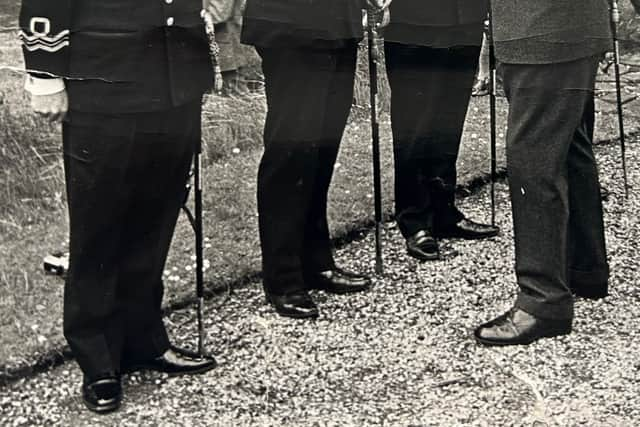
The pair met again years after the war, when Mr Draper was in the Royal Navy Reserves and training sea cadets in Wirral and Cheshire for the Duke of Edinburgh awards.
He said Philip saw his medals and remembered he had been part of the crew which escorted his ship, but there was no mention of the hockey games.
Mr Draper turned 21 on the return journey from Japan, with more than 2,000 people on board the ship because they were carrying prisoners of war home.
The father-of-two, who went on to work as an insurance salesman, said it took time to adjust back on dry land.
He said: “When we went through the Bay of Biscay at one time it was that rough that the ship’s bows would go 24ft up, 24ft down, just like that.
“You get used to it. Especially if you’re in your hammock, it rocks you to sleep.
“One of the most comfortable sleeps I’ve had is in a hammock!”
Now, at 100, Mr Draper steps may be slower and his days quieter, but his memories still remain sharp.
He knows he is one of the last to remember not just the facts of that day, but the faces, the feelings, the fragile hope that peace might last.