
Planning Inspector overturns battery farm rejection despite 2,000 objections
A planning inspector has given the go-ahead for the facility to be installed at Heath following a public inquiry
A decision to reject plans for a battery energy storage system (BESS) near to an historic Wakefield village has been overturned following an appeal.
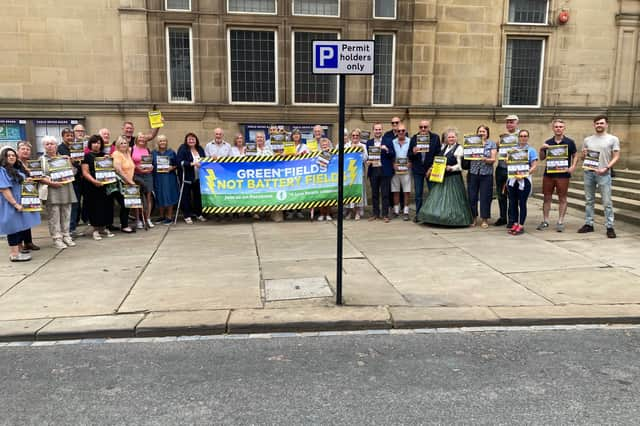

A planning inspector has given the go-ahead for the facility to be installed at Heath following a public inquiry.
More than 2,000 residents, along with MPs and councillors, objected to Harmony Energy’s plan to install 72 containers storing lithium ion batteries on farmland near to the village.
Opponents who fought a four-year campaign said the scheme could harm the local conservation area.
BESS facilities take in power from renewable energy sources and then release it back to the National Grid when demand is high.
In July last year, the council’s planning and highways committee unanimously voted against their officers’ recommendation to approve the plan.
Harmony then made an appeal to the Planning Inspectorate, saying the scheme would contribute to the government’s green energy targets.
In an appeal decision published on Thursday (July 2), planning inspector John Braithwaite said: “The world is in crisis; a climate crisis caused by carbon emissions.
“One of the remedies to the crisis is to reach net zero carbon emissions as soon as possible.
“The government has set necessarily challenging targets to reach net zero and has stated that storage has a key role to play in achieving net zero and providing flexibility to the energy system.”
Mr Braithwaite also said the need for the facility “far outweighs the low level of harm” that would be caused to the historic setting of the village.
He added: “If the climate crisis is not successfully addressed then the green belt might become no longer green and might have to be renamed the brown belt.”
Jon Trickett, MP for Normanton and Hemsworth, spoke against the scheme at the hearing in April, describing it as “environmental vandalism.”
Following the ruling, Mr Trickett said:” I am very annoyed about this decision.
“The inspector appears to have agreed with every point which I and others have made concerning our opposition to the scheme but then he has overridden the points we made.
“I firmly believe that local people know what’s best and am aghast at what has happened.
“I understand that a range of matters still may need to be resolved and I call on the new leadership of Wakefield Council to stand up for the local community.‘
During the inquiry, lawyers representing both parties said the main issues in the case related to the impact on the greenbelt and on historic buildings close to the site.
The appellant claimed the site should be redefined as ‘grey belt’, a concept introduced in 2024 aimed at freeing up some green belt areas for development.
The site lies within the setting of the Grade II-listed Dame Mary Bolles Water Tower, which dates back to the 17th Century, and the Heath conservation area.
Stephanie Hall, for Harmony, said: “The appeal scheme is strongly supported by government policy and would assist the council and the UK in delivering meaningfully on climate and biodiversity agendas.”
Ms Hall said the council had failed to allocate any sites for renewable energy in its latest Local Plan, a document which outlines future development within the district.
Ms Hall added: “Ultimately the heritage impacts are reversible and temporary and are at a lower level than assessed by other parties, which all overstate the importance of what is now a modern agricultural field.
“Given the national imperatives to address climate change, achieve net zero by 2050 and enhance our energy security, it is precisely sites such as this one, without major impacts, which can assist with a transition to a lower carbon economy and deliver a significant measurable gain in biodiversity.”
Philip Robson, representing the council, said: “Whilst the council supports the principle of renewable and clean energy development, this does not override the need to properly address the harms brought by the proposal.
“The proposed development would physically alter the historic landscape.
“It would also harm the open, rural character of the fields in the west of the designated area through the introduction of modern infrastructure, as well as the expanding development of Wakefield city centre into the historic landscape itself.”
Other local groups opposing the scheme at the hearing included the Heath Residents’ Association, Wakefield Civic Society, Wakefield and District Gypsy and Travellers’ Association and The Forgotten Women of Wakefield.
The I Love Heath Common campaign group was formed in opposition the proposals shortly after they were submitted in 2022.
A spokesperson for the group said: “This is a sad day for the thousands of people who have ever enjoyed the unique landscape of Heath and a shameful day for the Planning Inspectorate which has allowed national policy to drown out the voices of local democracy.
“We want to say thank you for the incredible support we have received over the last four years in our fight to protect this important landscape for future generations.
“Over two thousand people objected to this plan including seven MPs from across the political spectrum and a host of heritage experts.
“The people of Wakefield will not forget their voices were ignored.”