

But what are the biggest changes, from the cost of filling up to the rise of road rage and the evolution of the cars we drive?
We’ve looked back at official records from 1960 to the modern day to chart how motoring in the UK has altered over the decades.
Driving test pass rates, petrol prices and the number of cars on the road are just some of the things we’ve compared, based on official statistics.
Many of the changes have been for the better - like the introduction of seatbelts, which only became mandatory for all passengers in 1991.
But others are less welcome, including one modern bugbear people find particularly irritating and is a leading cause of road rage.
We’ve also pulled together some of the best retro photos to transport you back to the 1960s and what it was like driving on the UK’s roads then - including one showing a jubilant John Lennon celebrating passing his test with his fellow Beatles.
Do you remember the days when there was no speed limit on the nation’s motorways, and would you rather be driving today or back in the 60s? Let us know in the comments section below.

1. The cost of filling up
The cost of refuelling has increased since 1960 but not by as much as some drivers might think. The average price of a litre of petrol at a UK pump in 1960 was around 5p, according to official government records, compared with £1.33 today. According to the Bank of England's inflation calculator, 5p in 1960 is equivalent to around £1.04 today, so there's not a huge difference. Modern cars are also more fuel efficient than their 60s equivalents, meaning you should be filling up less often. | Getty Images Photo: Evening Standard

2. Cars are less curvy
Car design in the 1960s was all about looks, with lots of big curves to seduce buyers. In the 70s and 80s, cars tended to become more boxy, as makers sought to increase passenger room and storage space. Today's cars are typically sleek but, some would say, uninspiring, with safety and fuel efficiency prioritised over appearance. | Getty Images Photo: Ballard/Express

3. There's a lot more traffic
The number of licensed vehicles on the UK's roads has nearly quadrupled, from 11.4 million in 1963 to 40.2 million at the end of 2023. Given that huge increase it's hardly surprising that many drivers today feel they spend most of their time sitting in traffic - though, as some people like to point out, you're not in the traffic, you are the traffic. | Getty Images Photo: Powell/Express

4. Our roads are much safer
Too many people die or get seriously injured on the UK's roads each year, but the number of casualties has fallen massively since the 1960s. In 2024, crashes on roads around Great Britain resulted in 1,633 deaths, compared with 7,985 in 1966. That's despite a big increase in the number of cars during that time. So why are our roads safer? There are various reasons, including the introduction of drink-driving laws in 1967, better safety features, from seatbelts to airbags, and the use of speed cameras. | Getty Images Photo: Central Press

5. The driving test is very different, but not necessarily harder
The driving test has changed a lot since 1965, when John Lennon, pictured here being congratulated by his fellow Beatles, passed. But, contrary to popular belief, it doesn't appear to have got significantly harder, or easier. When driving tests became compulsory in 1935, the pass rate was 63%, compared to around 47% today, but the pass rate had already dipped below 50% in the 60s and has fluctuated since then. Some of the biggest changes over the years have included the introduction of the theory test in 1996 and the requirement to follow directions from a sat nav in 2017, when drivers also stopped being tested on reversing round a corner. | Getty Images Photo: Keystone/Hulton Archive
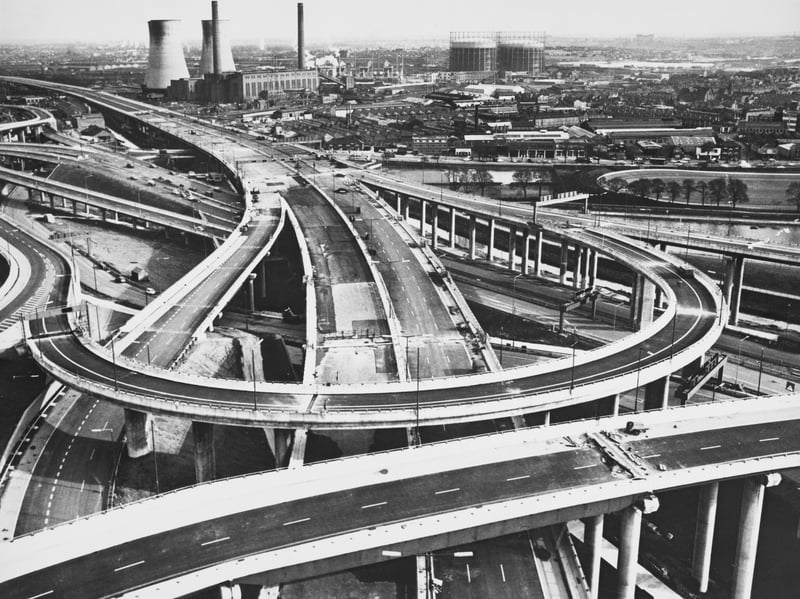
6. Driving has become more stressful
In a 2019 survey carried out by the RAC, more than two thirds of drivers said they found driving more stressful than it was 10 years earlier. There were a number of reasons given for that, including greater congestion and poorer driving standards. Complicated road junctions like Birmingham's notorious Spaghetti Junction, pictured here under construction in 1970, are hardly likely to bring down drivers' blood pressure either, while in recent years many motorists have complained that new so-called 'smart motorways' are too complicated. | Getty Images Photo: Central Press/Hulton Archive