
Joe Rodon injury update as Leeds United defender explains possible hamstring issue cause

The Leeds United defender has only just returned from 10 weeks out of action.
Joe Rodon believes a more physically demanding Leeds United role might have contributed to his serious hamstring injury.
Rodon returned from 10 weeks out of action last weekend, coming off the bench in the dying minutes of Leeds’ 1-0 win over former club Tottenham Hotspur. The centre-back hadn’t previously featured since pulling up with the hamstring injury against Brentford on August 30.
Virtually ever-present in the Leeds team until that point, Rodon had been able to avoid serious injury but Daniel Farke’s switch to a back three upped the physical toll. The 29-year-old started to operate almost as a marauding right-back at times while also covering more in behind.
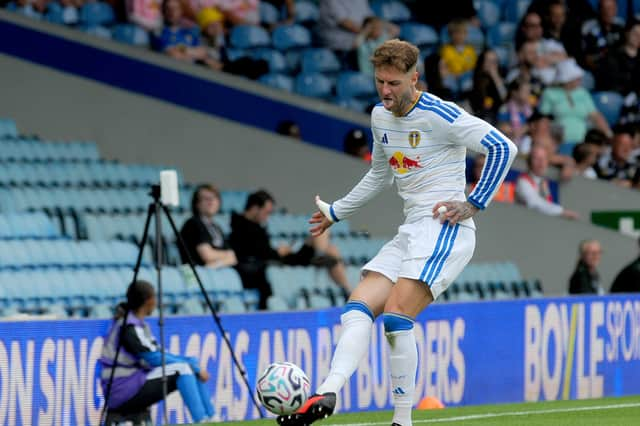

“[It was a] hamstring, grade three. So yeah, not the best,” Rodon told BBC Sport’s Feast of Football podcast, having joined up with the Wales squad for international duty this week. “I think it was around eight weeks out.
“I think just gradually, kind of a build up just from adapting positions and me running a lot more in games so that probably had something to do with it. Unfortunately that's what comes with it.”
Rodon seemed to cover far more ground in his new position with a lot more sprinting, either to provide overlapping runs out wide or chase balls in behind the wing-backs. His position at Leeds, now occupied by James Justin, has become increasingly demanding, both tactically and physically.
There was concern among sections of the Leeds fanbase when Rodon was called up to the Wales squad, where the expectation is he will play twice in the space of four days against Norway and Portugal. But the defender admits that in a back four, that demand for high-intensity running is reduced.
“I think with Leeds we play the five, but possession we shift more into a four,” he said. “So me being on the right side, I'm mainly going to play right-back in that system, and then off the ball, I'm going to be more in the channel.
“So there's a lot more high-speed running, but we want to be flexible, and the Premier League is so tough so we’ve got to do it out of possession and do it going forward as well. So there's a lot more high-speed running in that position.
“For Wales, it's a bit more simple and in a more natural position, being in the middle of the pitch. We don't want to be sprinting out to challenge. Even though [Wales boss Craig] Bellamy loves us running, there's a bit less running being the centre-half.”