
Three ways Leeds United could line up with Julian Brandt as free transfer explored

A look at how Leeds United could line up if their pursuit of Julian Brandt is successful.
Leeds United are exploring a bargain opportunity to add attacking quality this summer in the form of Julian Brandt.
As first reported by the YEP, Elland Road chiefs are exploring a move for the attacking midfielder who is set to become a free agent following the expiration of his Borussia Dortmund contract. They expect competition with at least one Champions League club also at the table.
Brandt would add the kind of attacking quality Leeds have made a priority this summer and the 30-year-old’s versatility means he could be deployed in a number of roles. Below, the YEP takes a look at three ways he could be used.
Brenden Aaronson replacement
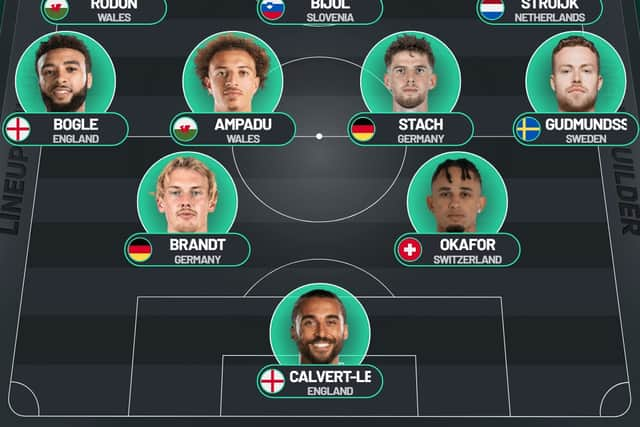

The simplest way to insert Brandt into last season’s team would be as a direct replacement for Aaronson in a 3-4-2-1. In that formation, the American operated almost in a hybrid role, defending as a right-winger but drifting into central positions when Leeds had possession, with Jayden Bogle pushing forward and Joe Rodon drifting wide to right-back.
Brandt would be a great fit for this role, with the intelligence to know when to drift into those spaces and the technical quality to exploit them. The German international is most productive in those tight areas within the width of the penalty box and has the vision to unlock a tight defence.
To be trusted by Farke, however, Brandt would need to show an understanding of his defensive role and the energy to do what Aaronson does out of possession - which is not easy. He’d also be cutting inside onto his weaker foot but that’s the same with Aaronson too, and the Dortmund star is more than good enough to do it.
Free role behind strikers

Farke switched a lot between 3-4-2-1 and 3-5-2 last season, with Noah Okafor or Lukas Nmecha able to play right up alongside Dominic Calvert-Lewin. That would open up space between the lines in central areas which is exactly where Brandt feels the most comfortable - and where he’s the most productive.
In this role, Brandt would be given free-reign to drift where he sees fit when Leeds have the ball. The German could pop up in the half-spaces of either side to combine with wing-backs Bogle and Gabriel Gudmundsson, who are tasked with maintaining width and then getting crosses into two strikers and the advancing midfielders.
But while Calvert-Lewin and Nmecha together worked against Chelsea, it was less effective when deployed later in the season and if Okafor starts, he’d drift left anyway making it closer to the above 3-4-2-1. Brandt would also have to show again his ability to match Aaronson’s defensive efforts.
Typical No.10 role

While the expectation is Farke will continue to start with a back three that brought success last season, in-game switches to a four proved useful when chasing a lead. The move allows Leeds to get an extra attacker on the pitch and it would provide an opportunity for Brandt to operate in his most natural role as a typical No.10.
The German would be Leeds’ creator-in-chief, able to drift into half-spaces and combine with wingers - in this case, Okafor and Willy Gnonto - or stay central to work off Calvert-Lewin and score himself. The extra attacking personnel would also occupy defenders, increasing the chance for Brandt to find space in key areas.
It would likely require Leeds to get a top-level right-winger through the door, however, with the likes of Gnonto or Daniel James not favoured by Farke. There would also be a risk-reward balance with four very attack-focused players on the pitch and less numbers defensively.