
'There's no fourth wall to hide behind': How Ghost Light brings slow-burn Victorian dread to Leeds next month

As four-star hit Ghost Light prepares for its Chapel Allerton run, writer Ian Tucker-Bell reveals how near-total blackout and 19th-century lanterns strip away the safety of bright stage lights
In a culture increasingly obsessed with visceral cheap shocks and frantic jump scares, playwright Ian Tucker-Bell is making a deliberate case for bringing back a far older, much more patient kind of fear.
When his play Ghost Light arrives at Seven Arts in Chapel Allerton on October 16, it won't be relying on digital effects or jarring sound design to rattle the room.
Instead, the Fringe hit - produced by theatre company Orange Works - is staged in near-total blackout, illuminated almost entirely by the flickering, amber glow of handheld Victorian lanterns carried by the cast.
For Ian, stripping away the artificial safety of bright stage lights isn't just an aesthetic choice; it’s the core engine of the entire performance.
"It’s a slow-burning, atmospheric play," Ian says. "It uses narrative, light, and suggestion to really get under your skin. There are no jump scares or cheap tricks, but as it goes on, it creeps people out a lot.
“You’re very quickly drawn into that low light, that weird orange glow of the era - it has a painterly quality that takes people right inside the story."
A spine-chilling premise
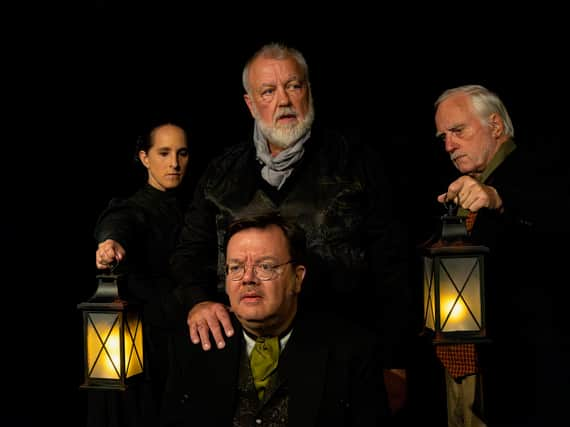

At the centre of Ghost Light lies a simple, deeply unsettling question: Why would a ghost be afraid of the dark?
Set against the backdrop of Victorian investigator Henry Webster and the London Ghost Club, the narrative centres on the haunting of Mia Sands, a woman tormented by the spirits of her two deceased children.
"The story was brewing in my head for a number of years," Ian explains. "I knew there was a ghost of a child in this story, and as it developed, it became clear there were two of them, and they were terrified of something.
“One of the ghost hunters asks why a ghost would ever be afraid of the dark, and through the story, the audience discovers why these two ghosts are running from it."
Rooted in the classic ghost tradition of M.R. James and Charles Dickens, the play leans heavily into mood over momentum - a lost art in modern horror that Ian feels often underestimates theatregoers.
"I love horror as a genre, but so much of modern media relies on relentless action or a quick door slam and passes that off as horror," he reflects. "I think it insults the intelligence of an audience. People want deeper, believable characters with real nuances, failings, and strengths.
“Ghost Light belongs to that campfire world. The kind of story you sit down and tell your friends late at night, painting the world with your voice and letting their imagination do the heavy lifting."
Intimacy without escape
By bringing the show into intimate spaces like Chapel Allerton's Seven Arts (and a performance at The Bradford Playhouse a day later), that campfire intimacy becomes almost claustrophobic.
"When we started doing fringe theatre, we realised very quickly that you've got an audience literally close enough to touch," Ian smiles. "There’s no fourth wall they can hide behind, and no escape. They are right in there in the dark with you, and that immediacy creates a whole extra level of tension.
‘You can hear a pin drop for most of the performance."
Underneath its supernatural surface, however, Ghost Light grounds its dread in acute human tragedy.
The play tackles heavy 19th-century realities, including domestic abuse, coercive control, and repressed identity.
"We experimented early on with trying it as melodrama, but it didn't work - it had to be played as real," Ian says. "The horror of the play is almost as much to do with the domestic abuse and coercive control Mia faced as it is the ghosts.“
The production also weaves in a poignant LGBT storyline told through a sequence of hidden letters; a nod to the classic epistolary format of 19th-century literature.
"His story emerges through three letters written to his lover," Ian notes. "When I wrote it, I didn't realise just how much of an impact that arc would have, but it’s consistently one of the elements reviewers and audiences connect with most."
Returning home
Directed with tight, rhythmic choreography by Philip Holden to navigate the shadows, Ghost Light represents something of a homecoming for Ian, who has family ties across West Yorkshire.
"Seven Arts is a wonderful, flexible space with a great team, so when we planned this tour, it was our very first port of call."
As autumn sets in, Ian hopes local audiences step out of the October chill and into Seven Arts ready for an immersive evening of classic storytelling.
"If someone leaves inspired to take up a pen and write their own ghost story, that’s fantastic," Ian says.
"But really, I just want people to have a fantastic night out—an hour of great theatre, and then a drink in the bar with us afterwards."
Ghost Light plays Seven Arts, Chapel Allerton, on October 16. Tickets and booking information are available directly via the venue.