
'The woman behind the powder': The secret, unbelievable life of romance icon Barbara Cartland

This article contains affiliate links. We may earn a small commission on items purchased through this article, but that does not affect our editorial judgement.
Ahead of his Ilkley Literature Festival appearance, author Matthew Sweet speaks to the YEP about opening Barbara Cartland's secret archives - revealing the fierce, campaigning powerhouse behind the pink television persona
She is often parodied (we’re looking at you, Matt Lucas), sometimes imitated, but more often than not, never equalled.
To generations of television viewers, Dame Barbara Cartland exists as a static pop culture icon: a vision in pink, false eyelashes, and powder, dictating romantic fiction from a sofa with a small dog nestled under her arm.
Yet as cultural historian and author Matthew Sweet reveals, the cartoonish public persona hides one of the most paradoxical and relentless figures in modern British literature.
His new biography, The Great Dictator, takes an uncompromising and deeply researched look at the third best-selling author of all time - a woman who penned 723 books, sold 750 million copies, and yet remains surprisingly overlooked today.
"She occupies a strange and paradoxical position," Matthew explains ahead of his appearance at the Ilkley Literature Festival next month. "She was synonymous with romantic fiction for a substantial part of the 20th century.
“She still stands for the idea of romantic fiction, but she is little known to readers under 40."
.png?trim=20,0,20,0&width=640&quality=65)

Matthew was granted unprecedented access to Cartland’s vast, undisturbed home archives - a sprawling collection of private letters, manuscript drafts, and diaries left virtually untouched at her Hertfordshire estate for over two decades.
"The family let me have the run of the house, where everything had been kept - even her Tipp-Ex bottles were still in the drawers," Matthew reveals. "I was literally opening cupboards and blowing the cobwebs and dust off letters, manuscripts, and appointment diaries.
“It might be the most substantial archive of any British literary figure. There are rooms and rooms of it."
What emerges from those private papers is a far more complex, formidable, and human character than the glittering public façade ever suggested.
Beyond the chat-show sofa and theatrical glamour (with some readers perhaps able to remember her tête-à-tête with Jackie Collins on Wogan), Cartland was a tireless social campaigner who, as a Conservative councillor in Hertfordshire during the 1960s, fought fiercely against the systematic discrimination faced by Romani and Traveller communities.
"She received lots of abuse for it when she got up on platforms and said the way these people are treated is just like Jim Crow laws in America," Sweet notes. "The end point was that she established a permanent site for travellers to pitch on that is still there today—the first of its kind in the world.
“She was a great campaigner; her energy was terrifying."
That same terrifying energy fuelled an unprecedented literary output.
Cartland’s work rate was legendary, driven by an extraordinary dictation technique. Lying back on her couch while a secretary took shorthand, she could produce up to 8,000 words a day without ever touching a typewriter, completing entire novels in a fortnight.
"She developed this dictation technique which she got so good at that plots just sort of came to her and flowed through her," Matthew notes. "In a way, lying on a couch with a secretary by her side without making eye contact is quite like Freud's consulting room.
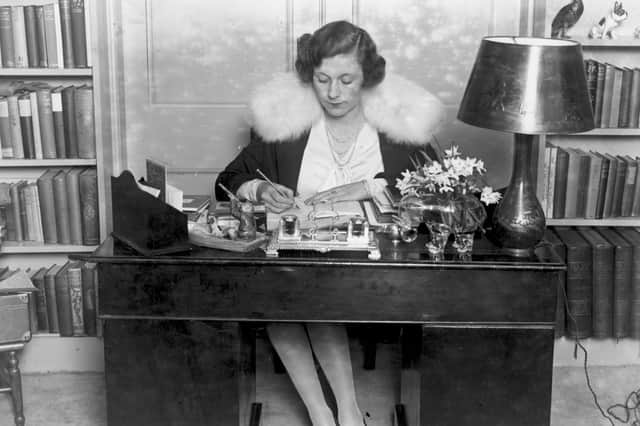
“In her fiction, she constantly went back to the traumas of her own life - her awful first marriage, her lost family fortune, and the loss of her father."
Behind that creative frenzy lay a deep-seated motivation: the collapse of her family's wealth after her grandfather committed suicide in 1903.
Forced to live in 'shabby genteel' circumstances, Cartland and her mother spent decades striving to restore the status and security they felt had been stolen from them.
Her early life in the 1920s placed her on the fringes of the 'Bright Young Things', observing a traumatised post-WWI generation with a sharp journalistic eye.
She would go on to work as a reporter for the Daily Express, gaining a shrewd understanding of media management that served her for the rest of her life.
"She knew what a journalist needed," Matthew recalls. "She would give you a fantastic quote for your opening paragraph—printable, controversial material that delighted editors. She was a totally brilliant self-publicist who knew how to pick a fight for maximum publicity, like her famous television clash with Jackie Collins."
Sweet will be presenting The Great Dictator at the Ilkley Literature Festival alongside a unique visual display curated by Leeds-based artist and academic Neil Hedges.
"He will be bringing some of Barbara’s frocks and jewellery, which will be on display up on the platform as we do the event," Sweet reveals. "People will have something spectacular to look at - those sparkling Norman Hartnell frocks catching the light.
“It was a little bit like she was in the room when we had one at the launch party."
Ultimately, Matthew hopes audiences at Ilkley and readers of the book will look past the caricature to discover the extraordinary force of nature underneath.
"I want people to get a sense of the woman behind the powder, and this tremendous energy that she had," Matthew says.
"She was an absolute powerhouse."
Matthew Sweet: A Life of Barbara Cartland takes place at All Saints Church, Ilkley, on October 3. Tickets for the event are available now through the official Ilkley Literature Festival website.