
'In my own words': Author Colin Grant on memory, history and bringing his story to Ilkley Literature Festival

Ahead of his upcoming appearance at Ilkley Literature Festival, acclaimed author and historian Colin Grant shares his insights with the Yorkshire Evening Post on memory, identity, family, and what audiences can expect from his talk
Your latest book, What We Leave We Carry, dives into the deeply personal secrets, songs, and objects of migration. What surprised you most while listening to these oral histories across the country, and what was one object or story that has stayed with you?
“I was surprised by how passionate and funny the stories were, ranging from Serbians bringing their prized manual coffee grinders with them to Puerto Ricans bringing jewellery to sell in case they got into financial difficulty. Suzanne Harrington desperately wanted to get out of Ireland where, she said, “everything, everything was a sin in the 1980s.”
“She brought with her a letter from a psychiatrist to give to the doctors at the NHS so that they’d take care of her, reminiscent of Paddington Bear arriving in London.“
From your BBC documentary work (A History of the N Word, Voices of the Windrush Generation) to your current writing, you’ve spent decades capturing spoken memories. How do oral histories capture the truth of the migrant experience in a way that traditional history books often miss?
“Oral histories capture the voices of the migrants themselves. They're not an anonymous block; they’re individuals that cut through prejudice and remind you of their bravery and the emotional cost of leaving loved ones behind.
“When there’s so much negativity around the word migration, it brings humanity back to the story.”

At Ilkley, you’ll be joined by WritersMosaic writers Suzanne Harrington, Vayu Naidu, and Chitra Ramaswamy to weave together stories spanning Ireland, South Asia, and the Caribbean. How did this panel come together, and what kind of dialogue can the audience expect?
“The book spans the whole length of Britain, from Cornwall to the Outer Hebrides. And we decided to have migrant writers, like Vayu and Suzanne, and Chitra (the daughter of migrants) do many of the interviews.
“There was an element of chance. Suzanne would talk to a migrant friend and ask that friend to recommend another migrant, passing the baton on, as it were.
“And you soon realise that almost everyone knows a migrant. There’s less than six degrees of separation between “us” and “them”. You'll hear parallels between Ireland, Jamaica and India. As we say in Jamaica, ‘all a-we is one’.
As Director of WritersMosaic, you do vital work championing new writing and diverse UK voices. How important are long-running regional festivals like Ilkley for bringing these global and cross-cultural narratives directly into local communities?
“Festivals like Ilkley open up the country, so that we’re not living in silos of separation. We get a plurality of voices, a sense of Britain’s changing identity. I’ve always loved Ilkley. It’s blessed with warm, welcoming and intelligent audiences for writers who sometimes don't have platforms to amplify their stories.
“At Ilkley there’s a sense of what Italians call ‘bella figura’. You'll see the best face of Britain.”
Having written extensively about the Windrush generation, Marcus Garvey, and your own family memoirs (Bageye at the Wheel, I’m Black So You Don’t Have to Be), how has your understanding of what 'home' means evolved over your career?
“Growing up in Luton in the 1960s and ‘70s as the child of Jamaican migrants, whenever I was asked where I was from, I’d say I was ‘British by birth, but Jamaican by will and inclination’. When my father heard this, he’d berate me saying, ‘Don't talk tripe, you is English. Me nah travel 4,000 mile, lef’ friend and relation so you can gwan with some stupidness a-pretend you is anyt'ing but English!’
“Actually, I suppose, we are the embodiment of all things British. If you want a snapshot of what it is to be British, look no further than the Alderson-Grants.”
The book highlights not just foundational tales of arrival, but 'rarely spoken stories of love and loss.' Was it difficult to coax these fragile, private moments out of people during the interview process?
“It's difficult to immediately extract stories from people who might never have shared their secrets before. I sat with them for several hours, listening carefully and the stories that ultimately emerged were beautiful and revelatory.
“And sometimes when their relatives heard the stories, they’d cry because they’d forgotten or hadn't paid enough attention to the stories over the years. It was as if they were hearing and seeing their relatives for the first time.
“For me, recording the stories was like being a producer on the Antiques Roadshow, but instead of people going into their attic to retrieve crockery or paintings or keepsakes, the stories were the antiques. I hope people will appreciate that generosity and see the sparkle in these stories; they really are treasures.”
Yorkshire audiences at Ilkley are known for being exceptionally engaged and curious. What are you most looking forward to discussing with the festival crowd during your session?
“I'd love to ask the audience whether they know any migrants or whether they’d like to know migrants; whether they feel saddened, shocked and outraged, as I do, by the spectacle of balaclava-wearing men in black descending on ports and wanting to push back into the drowning sea people who sixty years ago would have been my parents?
“Obviously, migrants are resilient, but they are also often traumatised and vulnerable. When I think of Britain, I think of noble and kind people who have endured hardships over generations, but have never lost their humanity, who have never lost the taste of themselves. I hope that the Ilkley Festival will be a beacon of light in this very dark time.”
Colin Grant will be at the Ilkley Literature Festival on October 10 at 12pm. Tickets are available through the Ilkley Literature Festival website.
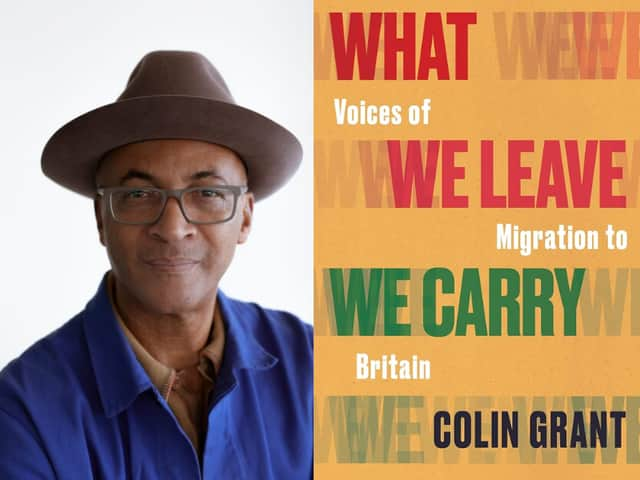
What We Leave We Carry: Voices of Migration to Britain is out now.