
"An aura you cannot ignore": Why Brahms’ Human Requiem at Leeds Minster is the ultimate Good Friday experience

Conductor Alex Woodrow discusses the intangible magic of choral music, breaking down barriers for young audiences, and why you don’t need to be a classical expert to be moved.
On Good Friday, the historic pews of Leeds Minster will hum with the "uplifting grandeur" of one of classical music’s most enduring masterpieces.
St Peter’s Singers, joined by a full orchestra, are set to perform Johannes Brahms’ A German Requiem - a work famously dubbed a "Human Requiem" by the composer himself.
Unlike traditional Requiems written as a Latin mass for the dead, though, Brahms’ work was intended to offer comfort and consolation to those left behind.
It is a distinction that Alex Woodrow keeps at the forefront of his conducting.
"The emotions - sadness, comfort, consolation, hope - are all there in the music and the words," Alex explains. "I focus mainly on encouraging the singers to shape the musical phrases in the most musical ways we can, according to our instincts and the composer’s intentions.
“Because there can be an almost indefinable type of communication at the deepest human level when choirs sing works like this, I try to ensure that the singers themselves have an understanding of what they are singing."
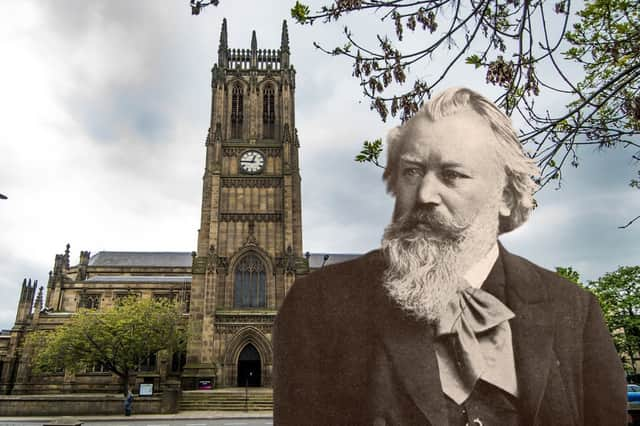

For Alex, the venue is as much a part of the performance as the instruments.
He describes the Minster not just as a building, but as an atmospheric "context" that heightens every note, contrasting it sharply with modern venues.
"When you enter a church such as Leeds Minster, it is impossible to ignore the atmosphere—an aura, almost," he says.
"There are several factors: the stillness, the history, and the spacious, austere architecture and beautiful glass that point upwards, lifting both the eye and the spirit, and an intangible focus on something bigger than ourselves that can’t be seen or pinned down, and which may remind us of our mortality.
“None of this applies to a modern, functional concert hall, however pleasing the design. The Minster provides a context for an avowedly spiritual composition to work on all our senses and deliver a heightened experience."
Breaking the 'Classical' Barrier
For those who might feel intimidated by the world of choral music, Alex is clear: you don’t need a background in the classics to be moved by this performance.
He views the German Requiem as the perfect "entry point" for the uninitiated.
"Quite simply, the German Requiem is a masterpiece," Alex says. "It features beautiful, soaring melodies and stirring harmonies which are easy to listen to and immediately moving. There are big emotional contrasts between grand, dramatic choruses and tender, intimate, reflective sections.
"Experiencing this live, in person, and acoustically in a building such as Leeds Minster makes the music immersive and can leave a lasting, deeply felt impression on anyone, perhaps especially first-timers.
“We do everything we can to put anyone coming to this sort of concert for the first time at their ease."
To further encourage new listeners, the event offers free entry for under-18s and students, a move designed to strip away the financial barriers often associated with high-level classical music.
"We want young people to experience live choral music in a welcoming, low-pressure way," Alex adds.
"For many, this could be their first time hearing a large choir and orchestra live in a beautiful space on a reflective occasion. The hope is they leave moved, inspired, and curious - realising that classical music can be emotional, relevant, and inclusive."
The evening begins with shorter, serene works by Mendelssohn and Bruckner, which Alex describes as a gentle introduction to "a world of lush German romanticism."
These pieces, including Bruckner’s Christus factus est, help the audience settle and engage emotionally before the grandeur of the main Requiem begins.
"The first half gently introduces audiences to Brahms’ musical world; a world deeply indebted to the influence of JS Bach," Alex explains.
"These works help listeners settle and feel ready for the main Requiem without being overwhelmed."
The performance takes place at Leeds Minster on Good Friday, April 3 at 7pm; tickets are available at stpeters-singers.org.uk or on the door (Free for U18s/students).